
Handbag Hardware Plating Explained: 8 Common Finishes, Durability, Cost & Rust Resistance
Handbag hardware plating directly affects color consistency, scratch resistance, rust prevention, luxury appearance, and long-term durability. In bag manufacturing, the biggest problems usually come from poor electroplating quality rather than the metal itself. Different finishes such as nickel, chrome, gold, gunmetal, rainbow, antique brass, zinc plating, chemical nickel, and PVD vacuum plating all have different wear resistance levels, production costs, and application scenarios.
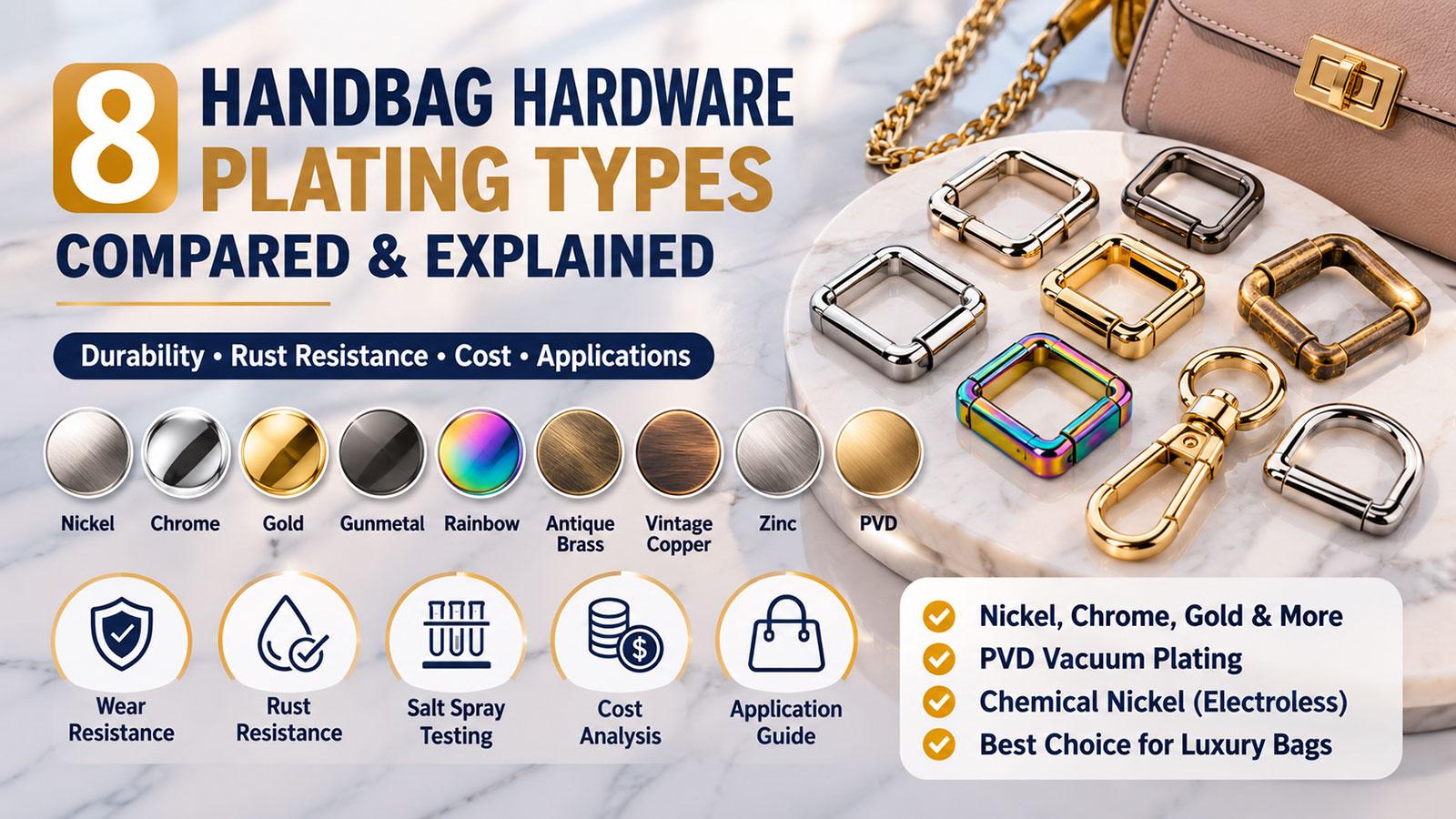
Table of Contents
- Why Buyers Pay Attention to Handbag Hardware Plating
- 8 Common Handbag Hardware Plating Types
- Wear Resistance & Rust Resistance Comparison
- How Base Materials Affect Plating Quality
- Real Factory Problems Behind Plating Failures
- Salt Spray Testing Standards Explained
- How Buyers Should Choose the Right Plating
- Final Thoughts
- FAQ
Why Buyers Pay Attention to Handbag Hardware Plating
In the handbag industry, buyers usually focus on design, logo details, and color matching first. But after mass production starts, most complaints are actually related to handbag hardware plating issues:
- Color fading after several weeks
- Scratches during transportation
- Rust after humid storage
- Different color tones between batches
- Fingerprints and oxidation marks
- Peeling around corners and edges
These problems become more obvious in:
- Luxury handbags
- High-frequency use shoulder bags
- Coastal market products
- Fast fashion brands with aggressive pricing
- Heavy zinc alloy decorative hardware
Many buyers assume all electroplating finishes are similar. In reality, the plating structure, thickness, polishing process, and sealing treatment determine whether the hardware survives 3 months or 3 years.
8 Common Handbag Hardware Plating Types
1. Nickel Plating
Nickel plating is one of the most common finishes used in handbag hardware manufacturing. It creates a silver metallic appearance with moderate brightness.
| Appearance | Silver, slightly warm tone |
| Wear Resistance | Medium to high |
| Rust Resistance | Good |
| Cost | Medium |
| Common Applications | Clasps, D-rings, chains, locks |
Nickel plating is relatively stable for daily-use bags. However, low-quality nickel plating easily shows:
- Yellow oxidation
- Surface fogging
- Peeling around sharp corners
In real production, plating thickness matters more than color itself. Cheap suppliers often reduce nickel layer thickness to lower cost, which dramatically reduces corrosion resistance.
2. Chrome Plating
Chrome plating produces a brighter mirror-like finish than nickel plating. It is harder and more scratch-resistant.
| Appearance | Bright mirror silver |
| Wear Resistance | High |
| Rust Resistance | Very good |
| Cost | Medium to high |
| Common Applications | Luxury hardware, decorative locks |
Chrome plating is harder than nickel but requires a very smooth polishing base. If the zinc alloy surface is rough, chrome will amplify imperfections instead of hiding them.
For luxury handbag brands, chrome plating is often selected for:
- Premium logo plates
- Metal frames
- High-end push locks
3. Gold Plating
Gold plating is widely used in luxury handbags because it creates a premium visual effect. However, not all gold finishes are actual gold electroplating.
In handbag hardware production, “gold” may refer to:
- Real gold plating
- Imitation gold plating
- Titanium gold
- PVD gold finish
| Appearance | Luxury yellow gold tone |
| Wear Resistance | Medium |
| Rust Resistance | Good |
| Cost | High |
| Risk | Fingerprints and fading |
One common factory issue is color inconsistency between batches. Small changes in current, temperature, or plating time can shift gold tone from light champagne to dark yellow.
4. Gunmetal / Gun Black Finish
Gunmetal plating has become extremely popular in modern fashion bags because it looks more understated than shiny silver or gold.
| Appearance | Dark gray / black metallic |
| Wear Resistance | Medium |
| Rust Resistance | Medium |
| Cost | Medium |
The biggest issue with gunmetal plating is edge fading. Friction areas usually expose the lighter base layer first.
Factories usually add top coating or sealing oil to improve durability, especially for:
- Bag chains
- Magnetic snaps
- Turn locks
5. Rainbow Plating
Rainbow plating, sometimes called iridescent plating, creates color-changing reflections under light.
| Appearance | Multicolor reflective effect |
| Wear Resistance | Medium |
| Rust Resistance | Medium |
| Cost | High |
This finish is visually attractive but harder to control consistently during mass production. Even small process fluctuations can create major color differences.
Rainbow plating is mainly used in:
- Fashion bags
- Streetwear accessories
- Limited-edition collections
6. Antique Brass / Vintage Copper Finish
Antique brass and vintage copper finishes are widely used for retro bags and leather goods.
| Appearance | Dark aged brass tone |
| Wear Resistance | Good |
| Rust Resistance | Good |
| Cost | Medium |
This finish usually includes brushing, stone washing, or artificial aging treatment.
One advantage is that minor scratches are less visible because the finish already contains texture and darker variation.
This is why many brands choose professional bag hardware suppliers to ensure consistent quality.
7. Zinc Plating
Zinc plating is more common in industrial hardware but still appears in low-cost handbag accessories.
| Appearance | Silver-gray |
| Wear Resistance | Low to medium |
| Rust Resistance | Medium |
| Cost | Low |
For fashion handbags with short product cycles, zinc plating may be acceptable. But for premium brands, it usually lacks the depth and smoothness required for luxury appearance.
8. PVD Vacuum Ion Plating
PVD vacuum ion plating is one of the highest-grade surface treatments currently used in premium handbag hardware.
Unlike traditional electroplating, PVD uses vacuum technology to bond metal coatings onto the surface.
| Appearance | Highly uniform luxury finish |
| Wear Resistance | Very high |
| Rust Resistance | Excellent |
| Cost | Very high |
| Common Materials | Stainless steel hardware |
PVD is commonly used in:
- Luxury metal chains
- Designer logo hardware
- Premium stainless steel accessories
Compared with traditional plating, PVD offers:
- Better scratch resistance
- Longer color stability
- Lower fading risk
- Better sweat resistance

9. Electroless Nickel Plating (Chemical Nickel)
Electroless nickel plating, also called chemical nickel plating, does not rely on electrical current during deposition.
| Appearance | Uniform matte silver-gray |
| Wear Resistance | Very high |
| Rust Resistance | Excellent |
| Cost | High |
The biggest advantage is coating uniformity, especially on complex structures and corners.
For complicated lock structures or deep recessed parts, chemical nickel performs better than standard electroplating because the thickness distribution is more even.
Wear Resistance & Rust Resistance Comparison
| Plating Type | Wear Resistance | Rust Resistance | Cost Level | Luxury Appearance |
| PVD | Excellent | Excellent | Very High | Excellent |
| Chemical Nickel | Excellent | Excellent | High | Industrial Premium |
| Chrome | High | Very Good | Medium-High | Bright Luxury |
| Nickel | Good | Good | Medium | Classic |
| Antique Brass | Good | Good | Medium | Vintage |
| Gold Plating | Medium | Good | High | Luxury |
| Gunmetal | Medium | Medium | Medium | Modern |
| Rainbow | Medium | Medium | High | Fashion |
| Zinc Plating | Low-Medium | Medium | Low | Basic |
How Base Materials Affect Plating Quality
Even the best handbag hardware plating cannot fully compensate for poor base materials.
Common base materials include:
- Zinc alloy
- Brass
- Iron
- Stainless steel
Zinc Alloy
Most fashion handbag hardware uses zinc alloy because:
- Easy for die casting
- Good for complex shapes
- Lower tooling cost
- Suitable for large-volume production
However, zinc alloy has porosity issues. Poor die casting creates tiny holes that later cause bubbling or peeling during plating.
Brass
Brass provides better plating adhesion and smoother polishing. Luxury brands often prefer brass for:
- Zippers
- Small logo accessories
- Premium locks
Stainless Steel
Stainless steel combined with PVD plating delivers the best corrosion resistance. But machining cost is much higher than zinc alloy die casting.
Real Factory Problems Behind Plating Failures
In actual handbag hardware manufacturing, plating failures usually come from process shortcuts rather than plating chemistry itself.
1. Poor Polishing Before Plating
Electroplating cannot hide rough surfaces. If polishing lines remain, shiny plating will magnify defects.
2. Thin Plating Layer
Some suppliers reduce plating thickness to save cost. The sample may pass visually, but mass production quickly fades.
3. Inconsistent Rack Positioning
During electroplating, current distribution changes depending on hanging position. Uneven rack arrangement causes color variation between parts.
4. Weak Top Coating
Many factories apply transparent protective coating after plating. Cheap coatings easily peel under humidity or friction.
5. Poor Salt Spray Performance
Some suppliers claim “anti-rust” without testing.
In reality:
- 24-hour salt spray = low durability
- 48-hour salt spray = standard commercial quality
- 72–96 hours = higher-end export quality
- 120+ hours = premium requirement
Salt Spray Testing Standards Explained
For export handbag hardware, neutral salt spray testing is one of the most important quality indicators.
Common standards include:
- ASTM B117
- ISO 9227
- DIN EN ISO standards
However, buyers should understand:
- Salt spray hours do not guarantee scratch resistance
- PVD usually performs better in abrasion tests
- Humidity storage conditions still affect lifespan
A common mistake is requesting “high salt spray” while still demanding ultra-low pricing. Thicker plating and stronger sealing always increase production cost.
How Buyers Should Choose the Right Plating
Choose Based on Brand Positioning
- Luxury brands → PVD, chrome, high-quality gold plating
- Mid-range brands → nickel, antique brass
- Fast fashion → zinc plating, standard gunmetal
Confirm Salt Spray Requirement Before Sampling
Do not wait until bulk production. Confirm:
- Target salt spray hours
- Scratch resistance expectations
- Humidity storage conditions
- Packaging protection method
Request Cross-Section Plating Reports
Professional factories can provide plating thickness measurements using XRF or cross-section analysis.
Test Real Usage Scenarios
Lab testing alone is not enough.
Buyers should also perform:
- Chain friction testing
- Sweat simulation
- Alcohol wiping tests
- Bag opening cycle tests
Avoid Choosing Only by Color Sample
Two suppliers may show identical colors initially, but durability differences become obvious after several months.
The cheapest plating supplier usually becomes the most expensive after returns, complaints, and brand damage.

Final Thoughts
Choosing the right handbag hardware plating is not only about appearance. It directly affects product lifespan, customer satisfaction, brand positioning, and after-sales cost.
Nickel, chrome, gold plating, gunmetal, rainbow finish, antique brass, zinc plating, chemical nickel, and PVD all serve different purposes. There is no single “best” finish — only the most suitable combination of budget, durability target, material structure, and market positioning.
Experienced factories usually focus less on surface color alone and more on:
- Base material quality
- Polishing consistency
- Plating thickness
- Protective coating stability
- Salt spray verification
For brands developing long-term handbag collections, investing in stable plating quality often reduces complaints far more effectively than changing suppliers every season.
If you are sourcing handbag hardware for OEM or private label projects, it is worth discussing plating standards, salt spray requirements, and durability expectations before tooling begins.
FAQ
Which handbag hardware plating is most durable?
PVD vacuum ion plating currently offers the best combination of wear resistance, scratch resistance, and corrosion protection for premium handbag hardware.
Why does handbag hardware fade after several months?
Common reasons include thin plating layers, poor sealing coating, weak polishing preparation, and insufficient salt spray performance.
Is chrome plating better than nickel plating?
Chrome plating is generally harder and more scratch-resistant than nickel plating, but it also requires better polishing quality and higher production control.
What salt spray standard is suitable for export handbag hardware?
Most export handbag hardware targets 48–72 hours neutral salt spray testing. Luxury brands may require 96–120+ hours depending on market conditions.
Why is PVD plating more expensive?
PVD requires vacuum equipment, stricter material compatibility, and more complex processing. However, it provides significantly better durability and long-term color stability.
If you are developing a new collection or looking for stable OEM manufacturing support:
For pricing and sampling:
For additional information about international neutral salt spray corrosion testing standards used in electroplating quality control, you can refer to the official ASTM B117 testing specification here: ASTM B117 Salt Spray Testing Standard