
Bag Hardware MOQ: Mold Fees, Sampling & OEM Ordering Guide
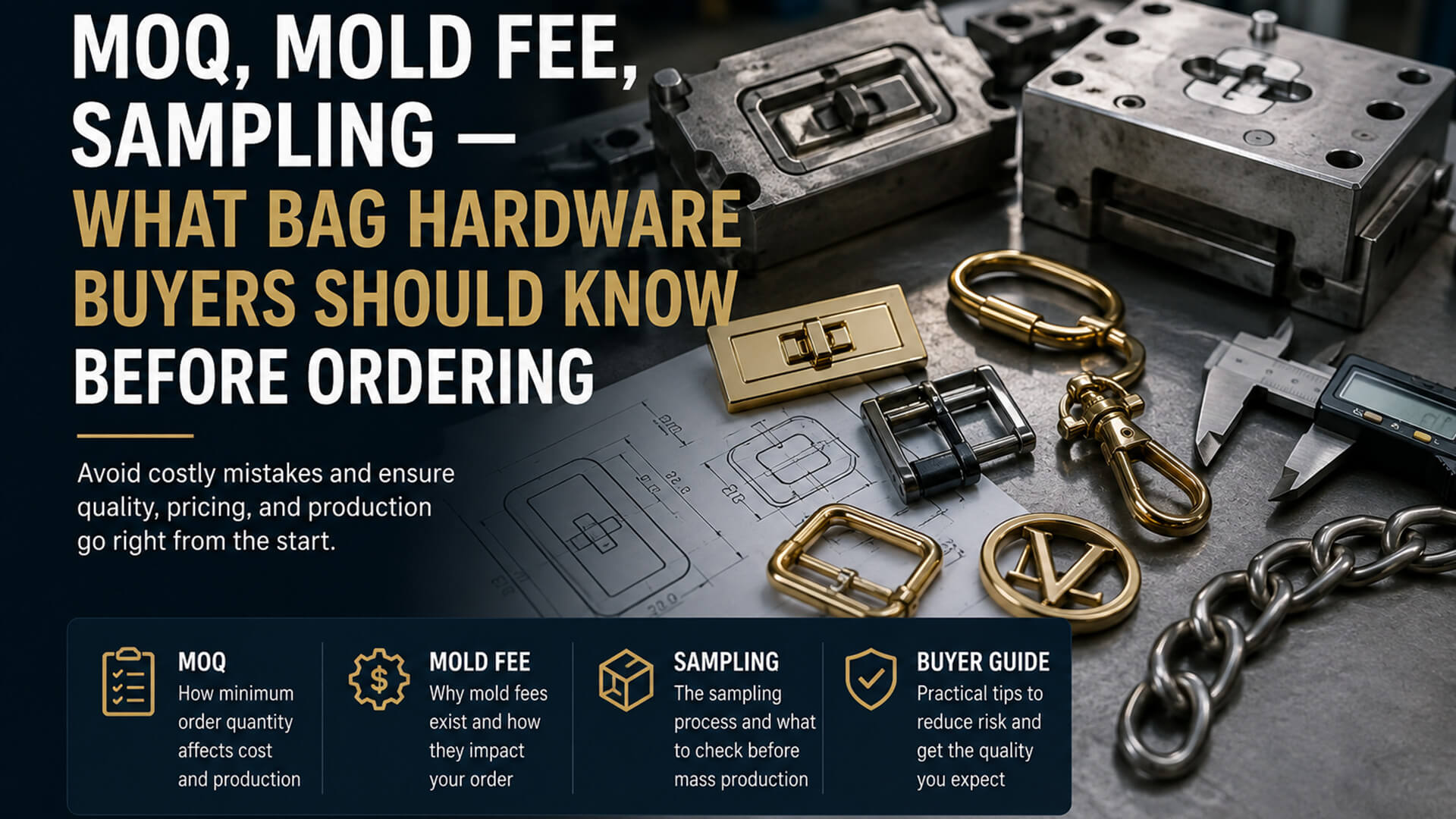
Understanding bag hardware MOQ, mold fees, and sampling requirements is critical before starting OEM production. Many sourcing problems in handbag hardware manufacturing happen long before mass production begins. Unclear MOQ expectations, low-quality tooling, and incomplete sample evaluation often lead to plating defects, unstable quality, delayed delivery, and unnecessary costs. Buyers who understand how hardware factories manage tooling, production setup, and quality control usually reduce sourcing risks significantly.
Table of Contents
- Why Bag Hardware MOQ Matters in OEM Production
- How Factories Calculate Bag Hardware MOQ
- Why Mold Fees Exist in Custom Bag Hardware Manufacturing
- Understanding the Bag Hardware Sampling Process
- How Materials and Production Methods Affect MOQ
- Common OEM Problems Buyers Discover Too Late
- Factory Experience: What Usually Causes Delays and Quality Issues
- How Buyers Can Reduce Bag Hardware Sourcing Risks
- Final Summary
- FAQ
Why Bag Hardware MOQ Matters in OEM Production
Many overseas buyers focus heavily on unit price during quotation comparison, but in custom metal accessory manufacturing, bag hardware MOQ directly affects tooling cost, plating efficiency, material sourcing, and production stability.
Unlike fabric accessories or ready-stock trims, custom bag hardware production involves:
- Die casting setup
- Mold development
- Polishing processes
- Electroplating preparation
- Assembly testing
- Quality inspection standards
Each production stage has fixed startup costs. This is why factories cannot always support extremely low MOQ for fully customized hardware projects.
In many OEM projects, buyers misunderstand MOQ as a factory sales policy. In reality, MOQ is often tied to manufacturing efficiency and defect control.
How Factories Calculate Bag Hardware MOQ
Different bag hardware products require different production methods, which directly influence MOQ requirements.
Typical MOQ Ranges
| Product Type | Common MOQ |
| Stock snap hooks | 100–500 pcs |
| Custom logo plates | 1000–3000 pcs |
| Custom turn locks | 1000–5000 pcs |
| Decorative chain accessories | 500–2000 pcs |
| Solid brass hardware | Usually higher MOQ |
Why Low MOQ Often Increases Production Risk
Very low MOQ orders sometimes force factories to compromise on production efficiency.
This may result in:
- Shortened polishing time
- Thinner electroplating layers
- Lower-grade zinc alloy material
- Combined plating batches
- Less stable color consistency
- Reduced QC inspection frequency
For premium handbag projects, low MOQ is not always the most cost-effective option long term.
Why Mold Fees Exist in Custom Bag Hardware Manufacturing
Mold fees are one of the most misunderstood costs in OEM handbag hardware production.
Custom bag hardware usually requires dedicated tooling to achieve accurate dimensions, logo details, assembly precision, and stable surface finishing.
What Mold Fees Usually Include
- 3D engineering drawing adjustment
- CNC mold engraving
- Die casting tooling development
- Test sample production
- Structure optimization
- Surface texture adjustment
- Logo detail refinement
High-quality molds improve:
- Dimensional consistency
- Surface smoothness
- Assembly stability
- Plating adhesion
- Long-term production repeatability
Common Problems Caused by Poor Tooling
Factories using low-grade mold steel or simplified mold structures often experience:
- Burr formation
- Surface pitting
- Uneven edges
- Weak structural corners
- Logo deformation
- Assembly alignment issues
These problems may not appear during early sampling but become serious during mass production.
Understanding the Bag Hardware Sampling Process
The sampling process is not only about visual approval. Professional factories use sampling to evaluate manufacturability, plating compatibility, assembly precision, and structural durability.
Typical Sampling Workflow
- 2D or 3D drawing confirmation
- Mold opening
- Raw casting sample
- Polishing sample
- Electroplating test sample
- Functional assembly testing
- Final approved sample

Why Samples Sometimes Differ From Bulk Production
This is a common issue in OEM bag hardware manufacturing.
Samples are often manually polished and individually inspected. Bulk production depends on process consistency across thousands of pieces.
Differences may appear in:
- Plating tone
- Gloss level
- Logo sharpness
- Edge smoothness
- Spring tension
- Assembly precision
Experienced factories reduce this gap by establishing SOP standards and QC checkpoints before mass production begins.
How Materials and Production Methods Affect MOQ
Zinc Alloy Hardware
Zinc alloy is widely used in fashion handbag accessories because it supports complex shapes and relatively low tooling costs.
Advantages:
- Good die casting flexibility
- Efficient mass production
- Lower tooling cost
- Suitable for decorative designs
Limitations:
- Lower structural strength than brass
- Sensitive to plating preparation
- Possible surface bubbles if casting quality is unstable
Brass Hardware
Brass is commonly used for premium leather goods and luxury handbags because of its durability and heavier feel.
Advantages:
- Excellent durability
- Stable polishing performance
- Premium appearance
- Better threading performance
Limitations:
- Higher material cost
- Longer machining time
- Higher MOQ in many factories
Stainless Steel Hardware
Stainless steel is increasingly used for luxury and outdoor bags because of its corrosion resistance and structural strength.
However, machining stainless steel is slower and more difficult than zinc alloy die casting, which affects both MOQ and production lead time.
Common OEM Problems Buyers Discover Too Late
Electroplating Failure
One of the most common complaints in bag hardware sourcing is plating discoloration or peeling after shipment.
Typical causes include:
- Insufficient polishing before plating
- Thin electroplating layers
- Poor nickel adhesion
- Improper sealing treatment
- Humidity exposure
Many professional buyers request salt spray testing before confirming production.
Common references include:
- 24-hour NSS testing for standard decorative hardware
- 48–72 hour salt spray testing for premium hardware
- ASTM B117 testing standards
Weak Structural Components
Some decorative hardware looks acceptable visually but fails under repeated use.
Weak points often include:
- Thin hinge areas
- Spring fatigue
- Weak soldering
- Poor chain welding
- Weak rivet fixation
Factories focused only on appearance may skip durability testing entirely.
This is why many brands choose professional bag hardware suppliers to ensure consistent quality.
Factory Experience: What Usually Causes Delays and Quality Issues
From actual OEM production experience, many delays happen because specifications remain unclear during development.
Common Communication Problems
- Buyers approve renderings but not engineering dimensions
- Plating color references are inconsistent
- Logo artwork resolution is too low
- Assembly methods are not confirmed early
- Packaging requirements change during production
Another major issue is unrealistic delivery expectations.
Custom bag hardware production often involves multiple suppliers:
- Die casting factory
- Polishing workshop
- Electroplating supplier
- Assembly department
- Packaging supplier
Rushing production usually increases defect rates significantly.
Why Some Factories Reject Small Trial Orders
Engineering adjustment and sample development often consume nearly the same resources as larger production runs.
For highly customized hardware projects, factories sometimes prefer long-term repeat customers because production consistency improves after the first completed order.
How Buyers Can Reduce Bag Hardware Sourcing Risks
Request Functional Samples
Appearance approval alone is not enough.
Buyers should test:
- Opening and closing cycles
- Scratch resistance
- Load-bearing performance
- Plating adhesion
- Logo durability
Confirm Specifications Clearly
Instead of simply writing “metal hardware,” buyers should confirm:
- Base material
- Electroplating layers
- Color reference standard
- Salt spray requirements
- Surface finish
- Logo production method
Similar-looking hardware can use completely different internal structures and plating processes.
Evaluate Factories Beyond Price
The cheapest quotation is not always the safest sourcing option.
Professional buyers usually evaluate:
- Engineering capability
- Mold quality
- QC workflow
- Electroplating consistency
- OEM project experience
- Communication efficiency
Experienced bag hardware factories often identify production risks before bulk manufacturing begins.

Final Summary
Understanding bag hardware MOQ, mold fees, and sampling processes helps buyers reduce sourcing risk, improve quality consistency, and avoid expensive production mistakes.
In OEM handbag hardware manufacturing, tooling quality, electroplating stability, material selection, and engineering communication all directly affect the final product.
Many quality problems that appear during bulk production actually begin during early sampling and specification confirmation.
Before starting a custom bag hardware project, buyers should discuss:
- MOQ structure
- Mold development details
- Material standards
- Testing requirements
- Electroplating expectations
- Production feasibility
Careful preparation during the early development stage usually prevents much larger losses after production begins.
FAQ
Why is bag hardware MOQ usually higher for custom products?
Custom hardware requires mold development, production setup, electroplating preparation, and engineering adjustment. Factories need minimum volume to maintain production efficiency and stable quality.
Can low MOQ affect bag hardware quality?
Yes. Extremely low MOQ orders sometimes reduce plating consistency, polishing quality, and production efficiency because setup costs are spread across fewer units.
Why do factories charge mold fees for OEM bag hardware?
Mold fees cover tooling development, engineering adjustment, test production, and structure optimization required for custom hardware manufacturing.
What is the most common problem during bag hardware mass production?
Electroplating inconsistency is one of the most common issues, including color variation, peeling, and reduced corrosion resistance.
What tests should buyers request before bulk production?
Common tests include salt spray testing, plating adhesion testing, opening-cycle testing, load-bearing testing, and scratch resistance evaluation.
Explore Custom Bag Hardware Solutions
If you are planning an OEM handbag project, choosing the right hardware structure, plating process, and material specification early can significantly reduce production risks and improve long-term product consistency.
If you are developing a new collection or looking for stable OEM manufacturing support:
For pricing and sampling:
Technical Reference
For buyers who want to better understand corrosion resistance and electroplating durability standards used in metal accessories, ASTM B117 remains one of the most widely referenced salt spray testing standards in the industry.