
Inside the Modern Bag Hardware Electroplating Process: 2026 Supply Chain Evolution and Technical Upgrades
The global premium luggage and luxury fashion handbag sectors are facing a profound paradigm shift. Procurement teams are moving away from traditional transactional manufacturing toward integrated supply chain ecosystems that balance extreme durability with environmental transparency. At the absolute center of this shift is the bag hardware electroplating process. Because hardware components handle the vast majority of physical touchpoints and wear, their surface finish directly dictates the long-term value retention of a finished product. This report provides a technical, factory-floor analysis of how hardware manufacturers are upgrading their chemical workflows, mastering international compliance, and resolving common production bottlenecks to meet modern B2B brand demands.
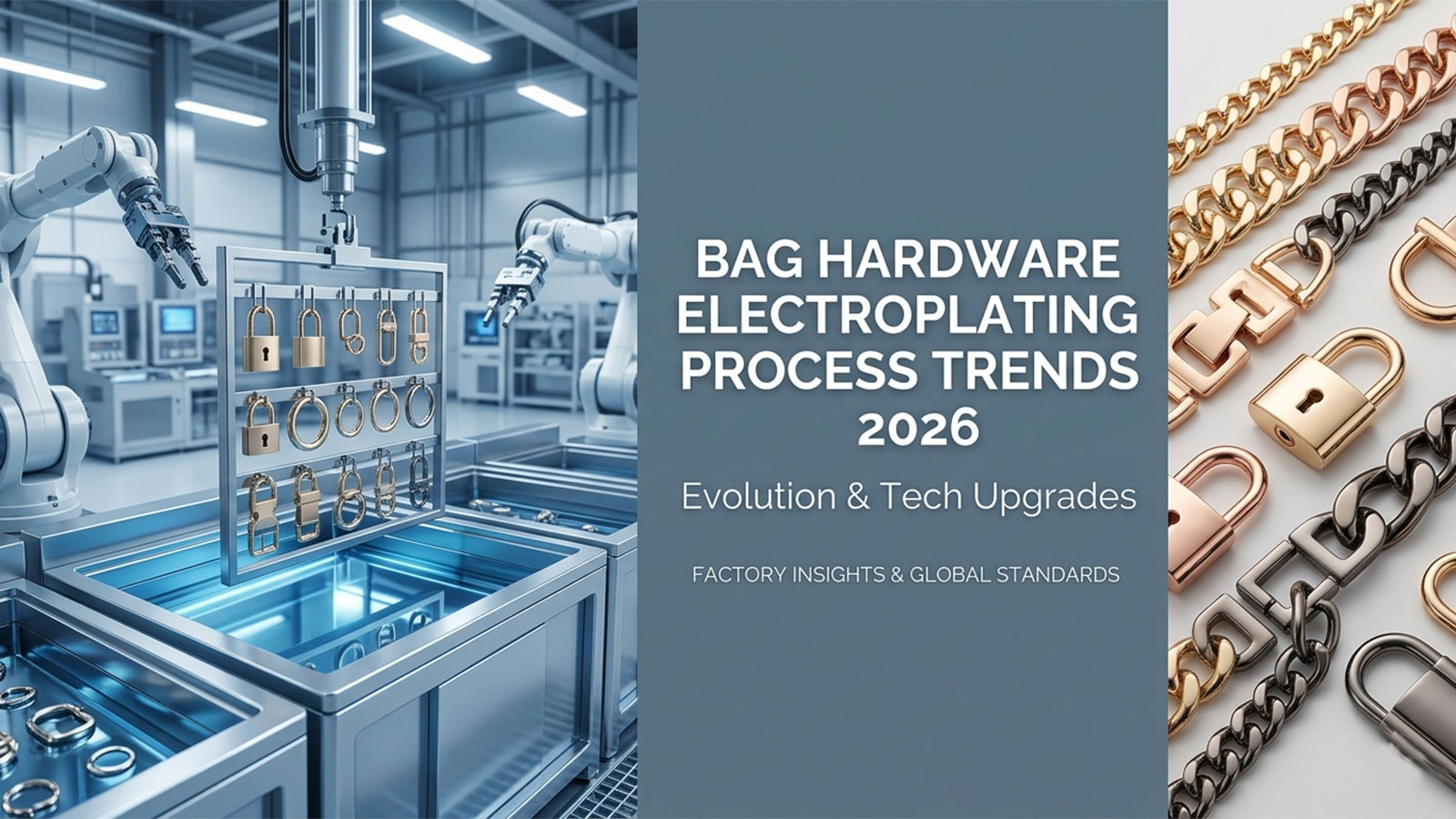
- 1. Market Dynamics and Sourcing Shifting Trends
- 2. Engineering the Layering Structure: Technical Upgrades
- 3. Regulatory Standards and Environmental Compliance
- 4. Overcoming Factory-Floor Technical Bottlenecks
- 5. Strategic Sourcing Matrix for Procurement Managers
- 6. Conclusion and Strategic Collaborative Outlook
1. Market Dynamics and Sourcing Shifting Trends
The evaluation metrics for a high-end bag hardware electroplating process have shifted from simple cosmetic brilliance to multi-dimensional long-term performance. Historically, a B2B buyer judged quality primarily on Initial Cosmetic Quality (ICQ)—ensuring a light gold, nickel, or gunmetal finish looked flawless on the boardroom table. Today, global consumer brands demand rigorous structural validation, prioritizing wear resistance, oxidation defense, and non-toxic chemical formulations. European and North American fashion houses are actively auditing their supplier networks, directing high-volume orders exclusively toward factories utilizing closed-loop eco-friendly chemical lines and advanced vacuum deposition setups.
This market shift is heavily accelerated by the growth of luxury resale economies and circular fashion. Brands are now held accountable for how their hardware ages after three to five years of field use. Consequently, the traditional, highly pollutive manual dipping methods are being systematically replaced by high-precision, automated rack plating and dry Physical Vapor Deposition (PVD) techniques. Procurement executives are no longer just purchasing raw casted metal shapes; they are purchasing verified engineered surface barriers.
2. Engineering the Layering Structure: Technical Upgrades
Achieving a premium finish within the modern bag hardware electroplating process requires a meticulous, multi-tiered molecular approach. While base metal options such as zinc alloy die-castings, solid machined brass, and stainless steel remain industry staples, the technical complexity lies in the barrier chemistry beneath the final hue. Below is the technical structural blueprint implemented by advanced manufacturers for luxury-tier luxury hardware:
| Plating Sequence | Chemical Composition | Engineering Objective | Thickness Benchmark (μm) |
| 1. Base Metal Base | Zinc Alloy / Solid Brass / Stainless Steel | Provides structural mold and initial shape geometry | Core Base |
| 2. Acid Copper Coating | Pure Copper (Cu) | Fills surface micro-pores and microscopic pitting | 15.0 – 25.0 μm |
| 3. Barrier Matrix | Nickel-Free Bronze or Bright Nickel | Halts copper migration and blocks underlying oxidation | 5.0 – 10.0 μm |
| 4. Precious Metal Flash | 24K Gold / Real Palladium / Rose Gold | Establishes the true luxury aesthetic hue and tone | 0.1 – 0.5 μm |
| 5. Shield Lacquer | Electrophoretic Coating (ED) / PVD Protective Topcoat | Provides anti-scratch, anti-sweat, and UV defense | 10.0 – 15.0 μm |
Handbag Hardware Plating Explained: 8 Common Finishes, Durability, Cost & Rust Resistance.
Simultaneously, leading production facilities are deploying hybrid PVD finishing techniques, especially when processing premium stainless steel hardware. PVD applies coatings inside an unheated vacuum chamber using plasma sputtering. This alters the surface characteristics at an atomic scale, creating extreme hardness and scratch resistance that traditional wet chemistry methods cannot duplicate. Because PVD yields absolutely zero toxic liquid waste, it offers an immediate compliance roadmap for enterprise buyers focused on green manufacturing initiatives.
3. Regulatory Standards and Environmental Compliance
Executing a reliable bag hardware electroplating process requires complete synchronization with evolving chemical laws across international retail markets. Products must endure rigorous testing to confirm the elimination of heavy metals that present consumer health risks or trigger customs penalties. The dominant compliance frameworks include:
- REACH Directive (EC No 1907/2006): Regulates Substances of Very High Concern (SVHC). Total Lead (Pb) parameters must register under 0.05% (500 ppm), and Cadmium (Cd) must stay below 0.01% (100 ppm).
- EN 1811 Nickel Release Mandates: Since bag chains, locks, and handles encounter repeated dermatological contact, the permissible nickel release threshold is restricted to under 0.5 μg/cm²/week. Top-tier production lines replace nickel entirely with nickel-free bronze alloys during the barrier sequence to guarantee consumer safety.
- RoHS Guideline (2011/65/EU): Dictates the complete elimination of Hexavalent Chromium ($Cr^{6+}$) in post-plating chemical passivation. Compliant factories successfully implement Trivalent Chromium ($Cr^{3+}$) stabilization or dry vacuum methods to maintain supply chain safety.
To verify the mechanical integrity of these finishes during overseas shipping, technical engineers rely on the ASTM B117 salt spray standard. High-end lifestyle and designer luggage brands now mandate that all electroplated metal components withstand 48 to 96 hours of uninterrupted exposure without developing micro-blistering, flaking, or substrate corrosion.

4. Overcoming Factory-Floor Technical Bottlenecks
From an actual workshop perspective, mass-producing thousands of complex hardware items with total color consistency is an engineering battle. A universal hurdle within the bag hardware electroplating process is Managing Current Density Variations across intricate geometries, such as deep debossed brand logos, sharp corners, or interlocking spring gates. Areas directly facing the anodes inherently draw a heavy electrical current, creating a thicker deposit, whereas deeply recessed hollows receive insufficient deposition, triggering localized shade shifts or premature wear.
To neutralize this current dispersion anomaly, factory tooling engineers utilize custom-designed rack jigging and strategically placed internal auxiliary anodes to achieve a balanced electric field. Another critical floor challenge centers on pre-treatment micro-cleaning. If polishing paste residues, oils, or die-casting mold-release chemical coatings are not thoroughly removed using multi-stage ultrasonic degreasing tanks, microscopic film barriers form. These micro-films will cause plating adhesion failures, manifesting as catastrophic blistering or peeling when subjected to cross-hatch adhesion tests or sudden temperature shocks. Real manufacturing expertise is evidenced by automated chemical dosing controls that adjust pH, ion replenishment, and filtering cycles on a continuous loop, removing human guesswork.
5. Strategic Sourcing Matrix for Procurement Managers
These evolving industrial dynamics have deep ramifications for procurement cycles, pricing structures, and Minimum Order Quantities (MOQs). Upgrading to highly controlled, eco-friendly chemical formulations and multi-station automated plating infrastructure demands heavy capital outlays from manufacturers. Consequently, the piece-rate cost for fully compliant, long-lasting electroplated metal trim has shifted upward. However, this initial expenditure drastically minimizes the factory-level Return Merchandise Authorization (RMA) rate and eliminates the legal disaster of customs seizures due to hazardous chemical compliance violations.
For strategic global global sourcing professionals, aligning with these physical realities is key to protecting production schedules. Automated rack plating systems demonstrate peak color consistency and lowest defect rates during extended, continuous production runs. Segmenting orders into microscopic micro-batches increases color-variance risks between lots. Procurement executives should seek out production partners that provide fully transparent lab analysis reports and upfront component prototyping, ensuring a stable B2B supply chain built to survive harsh retail market scrutinies.
6. Conclusion and Strategic Collaborative Outlook
The technical engineering governing the bag hardware electroplating process has evolved far beyond a basic ornamental aesthetic step; it now serves as a foundational pillar for B2B global compliance, consumer safety, and luxury brand longevity. As international chemical supervision intensifies and consumer demands for transparent manufacturing accelerate, collaborating with technologically advanced, modern B2B manufacturers is non-negotiable. Adapting to these rigorous workshop realities ensures that global designer bag portfolios maintain their surface prestige, material integrity, and market value over extended lifespans.

How does an advanced production line ensure absolute color matching across multiple bag hardware components?
Absolute color replication across distinct items (such as zip pullers, chains, and D-rings) is maintained by stabilizing the bath chemistry in automated rack lines. Engineers regulate precise chemical ion balances, maintain uniform electrical current density, and mandate identical zinc alloy or brass substrate casting compositions across all components to prevent subtle hue variances.
What makes a nickel-free bag hardware electroplating process safer for luxury brands?
A nickel-free process swaps out the standard electro-nickel barrier layer for a safe, non-allergenic copper-tin-zinc bronze alloy matrix. This engineering alternative delivers equivalent leveling and anti-corrosive performance to block copper migration from the core substrate, while successfully keeping nickel release levels below the strict 0.5 μg/cm²/week mandated by international EN 1811 protocols.
Why is the pre-treatment degreasing step so critical to preventing plating adhesion failure?
Pre-treatment ultrasonic degreasing eliminates hidden residues from high-pressure zinc alloy die-casting mold release sprays and aggressive industrial polishing waxes. If even microscopic oil barriers remain on the raw metal, they isolate the substrate from the incoming acid copper layer, resulting in sub-surface gas accumulation and subsequent blistering or peeling during durability tests.
Custom Handbag Hardware Service
OEM & ODM manufacturing support for bag brands, wholesalers, and handbag factories.
Get a Quote & Samples
Contact us for pricing, MOQ details, plating options, and sample support.
For official corrosion resistance testing standards commonly used in metal hardware manufacturing, refer to the ASTM B117 salt spray testing specification published by ASTM International: ASTM B117 Salt Spray (Fog) Testing Standard .