
Handbag Turn Lock Types: Complete Guide for OEM Buyers
Whether you’re developing a structured flap bag, a crossbody, or a luxury tote, the closure hardware is one of the first details a customer touches — and judges. Choosing the wrong lock type can affect both the function and the perceived quality of your entire collection.This guide covers every major handbag turn lock type used in OEM bag manufacturing today, including how each works, which bag styles they suit, and what to specify when ordering from a supplier.

Quick Answer
The main handbag turn lock types are: twist turn locks, push-button locks, magnetic snap locks, press locks (barrel locks), slide locks, and flip locks. Each differs in opening mechanism, security level, and visual style. Twist turn locks are the most common in luxury and mid-range handbags; magnetic snaps are preferred for everyday convenience.
Table of Contents
What Is a Handbag Turn Lock?
A handbag turn lock — also called a bag closure lock or flap lock — is the metal hardware mechanism that secures the front flap or opening of a structured handbag. It serves both a functional purpose (keeping the bag closed) and a design purpose (acting as a visual focal point and brand identifier).
The term “turn lock” is often used broadly to refer to all types of metal bag closure hardware, even though technically a turn lock refers specifically to a mechanism that opens by rotating. In practice, OEM buyers use the term to cover all decorative bag lock hardware types.
Most handbag turn locks are made from zinc alloy using high-pressure die casting, which allows complex 3D shapes and detailed brand logos at relatively low tooling cost. Premium locks for luxury collections are sometimes made in brass for added weight and durability.
6 Main Handbag Turn Lock Types Explained
1. Twist Turn Lock (Rotating Turn Lock)
The classic handbag closure. A flat or oval disc on the bag flap is rotated 90° to unlock, then twisted back to secure. The locking post mounts through the flap and engages a receiver plate on the bag body.
Best for: Structured flap bags, satchels, crossbody bags, shoulder bags with a formal look.
Brand examples: This mechanism is widely used across mid-range and luxury handbag collections globally.
OEM note: The face plate is the primary branding surface — most buyers customize this with a logo, monogram, or geometric shape via a custom die-cast mold.
2. Push Lock (Push-Button Lock / Press Lock)
A spring-loaded mechanism that opens by pressing a button or tab on the front face. Often uses two side buttons that are squeezed simultaneously, or a single central press. The lock clicks audibly when secured.
Best for: Structured satchels, briefcase-style bags, doctor bags, formal handbags.
Advantages: Fast one-handed operation; the click mechanism provides a premium tactile feel.
OEM note: The spring mechanism requires consistent zinc alloy casting quality. Poor casting tolerances result in locks that feel loose or fail to click properly. Always request a functional sample from actual production tooling before approving mass production.
3. Magnetic Snap Lock
Uses embedded magnets to hold the flap closed. Opens with a simple pull — no rotating or pressing required. Can be concealed inside the leather or fabric (invisible magnetic snap) or exposed as a decorative element.
Best for: Everyday bags, totes, casual crossbody bags, bags targeting busy commuters.
Advantages: Maximum convenience; very fast opening; suitable for high-use frequency.
OEM note: Magnetic strength is measured in pull force (typically 3–8 kg for handbags). Specify the required pull force in your tech pack. Weak magnets are a common complaint that leads to warranty issues.

4. Barrel Lock (Cylinder Lock / Clasp Lock)
A cylindrical or box-shaped lock where a bolt or tab slides into a receiver. Common in vintage-inspired bags and structured clutches. Some barrel locks include an actual key mechanism for added security.
Best for: Clutches, evening bags, vintage or retro-styled collections, high-security luggage.
Advantages: Strong visual presence; the keyed version appeals to consumers who want security.
OEM note: More complex internal mechanism means higher tooling cost. Plan for additional QC testing of the sliding/latching action across at least 500 open-close cycles.
5. Flip Lock (Toggle Lock / Lobster Flip)
A lever or toggle that flips over a post or loop to secure the bag. Popular in casual and bohemian bag styles. Visually distinctive and easy to operate with one hand.
Best for: Saddle bags, bohemian/western styles, casual leather bags, festival bags.
Advantages: Easy to use; distinctive visual character; lower tooling cost than twist locks.
OEM note: The hinge point is the most common stress failure area. Specify minimum hinge thickness in your BOM and request a 1,000-cycle durability test on development samples.
6. Slide Lock (Sliding Bar Lock)
A horizontal bar or tab that slides left or right to lock and unlock. Less common than twist or push locks but distinctive in appearance. Often used as a feature element on minimalist or architectural bag designs.
Best for: Minimalist structured bags, contemporary fashion collections, bags with a modern architectural aesthetic.
Advantages: Clean visual profile; unusual enough to act as a design signature.
OEM note: The sliding mechanism needs tight dimensional tolerance (±0.2mm) to feel smooth rather than loose. Requires careful inspection during sampling.
Comparison Table: Handbag Turn Lock Types at a Glance
| Lock Type | Open Method | Best Bag Style | Tooling Cost | Brand Customizable? | Security Level |
|---|---|---|---|---|---|
| Twist Turn Lock | Rotate 90° | Structured flap bags, luxury | Medium | Yes — face plate | Medium |
| Push Lock | Press button | Satchels, doctor bags | Higher | Yes — front panel | Medium–High |
| Magnetic Snap | Pull open | Everyday bags, totes | Low | Limited | Low |
| Barrel Lock | Slide / key | Clutches, vintage bags | Higher | Yes — barrel face | High (keyed) |
| Flip Lock | Flip lever | Saddle, bohemian bags | Low | Yes — lever face | Low–Medium |
| Slide Lock | Slide bar | Minimalist, architectural | Medium | Limited | Medium |
How to Choose the Right Handbag Lock for Your Collection
Choosing a lock type is a design and sourcing decision at the same time. The wrong choice can create problems at the production stage — wrong weight, wrong feel, or inconsistent finishes between batches.
Consider Your Brand Positioning First
For luxury and premium collections: Twist turn locks and push locks in brass or high-quality zinc alloy with rack plating deliver the weight and tactile feel that luxury consumers expect. A custom-molded logo face plate on a twist lock becomes a signature hardware element that reinforces brand identity.
For mid-range and fashion collections: Zinc alloy twist locks and magnetic snaps give you the visual appeal at manageable cost. Consider a custom logo plate even at this tier — it separates your product from generic alternatives on the shelf.
For everyday and casual collections: Magnetic snaps and flip locks prioritize convenience. Consumers using these bags frequently want fast access, not ceremony.
Match the Lock to the Bag Structure
A twist turn lock requires a structured flap with enough rigidity to hold the lock body flat against the bag. Magnetic snaps work in soft or unstructured flaps. If your bag uses soft or semi-structured construction, confirm the lock mechanism can be mounted securely before finalizing the design.
Think About Your Customer’s Daily Use
A lock that requires two hands to open — or that makes the user feel uncertain whether it’s properly secured — will generate complaints. For bags intended for commuting or daily use, ease of operation matters as much as appearance.
Not sure which lock type suits your collection?
Send us your design sketch or tech pack — we’ll recommend the right hardware and provide a free quote within 24 hours.
Materials and Finishes for Handbag Turn Locks
Base Material Options
Zinc alloy (Zamak): The industry standard for 80–90% of fashion handbag hardware. Die-castable into complex shapes, cost-effective, and accepts electroplating well when properly pre-treated. Recommended for most OEM projects.
Brass: Preferred for luxury collections. Approximately 15% heavier than zinc alloy, which contributes to the premium feel when a customer handles the lock. Higher corrosion resistance and better plating adhesion. Higher unit cost and longer lead times.
Surface Finish Options
Warm, approachable finish. Most popular in mid-range collections.
High gloss, bold statement. Common in fashion-forward collections.
Warm aged look. Suits vintage, bohemian, and artisan styles.
Cool, classic tone. Works across a wide range of bag colors.
Dark, matte-metallic. Trending in contemporary and streetwear collections.
White-platinum tone. Premium alternative to nickel for luxury bags.
Maximum durability via PVD process. Preferred for high-wear locks.
Warm pink tone. Popular in feminine collections and accessories.
For turn locks that will be handled frequently — opened and closed multiple times per day — specify rack plating rather than barrel plating. Rack-plated parts receive thicker, more even coating that resists wear at contact points. Request a minimum plating thickness of 0.3–0.5 µm for mid-range products and 0.5–1.0 µm for luxury applications.
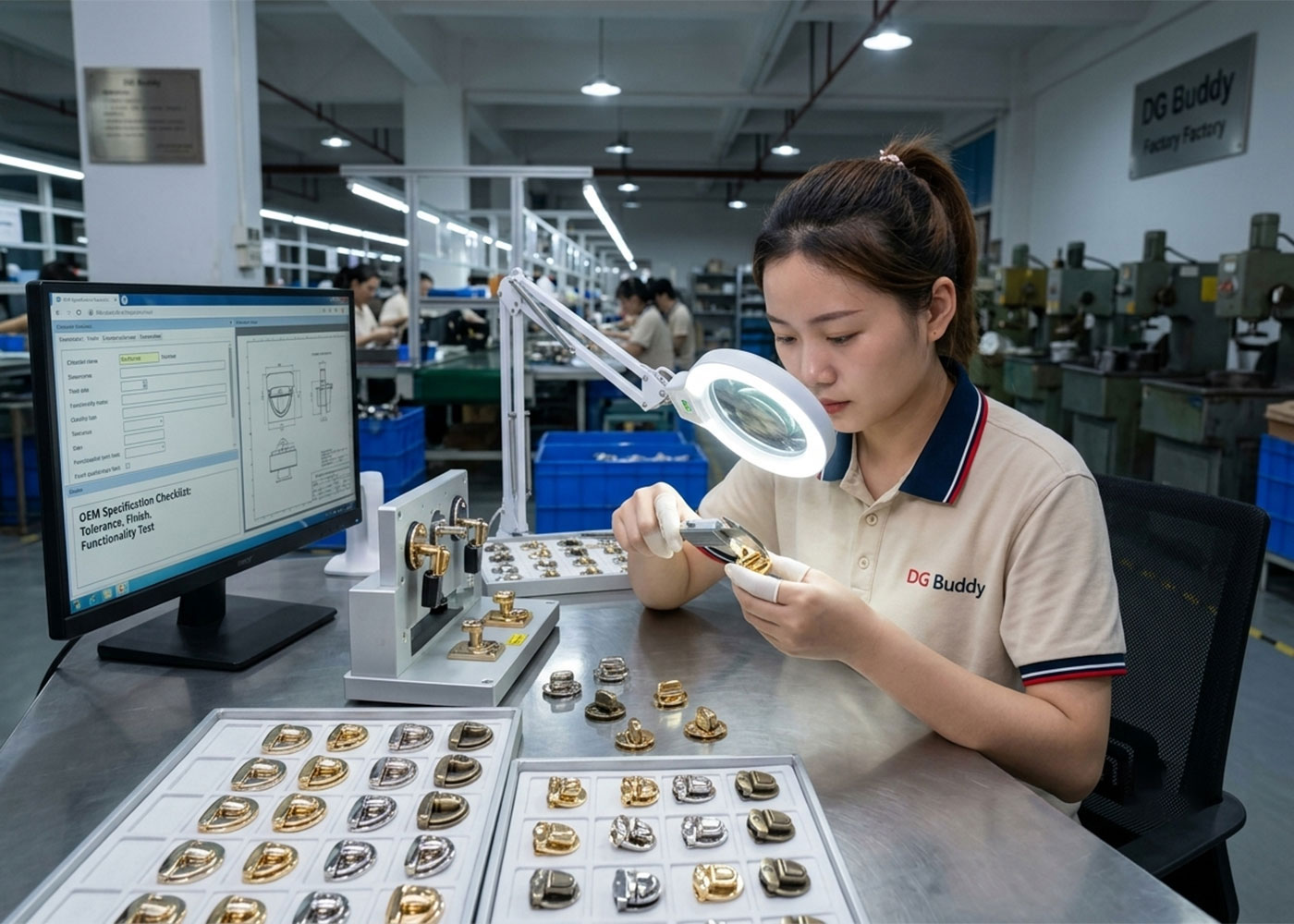
OEM Ordering Guide: What to Specify When Ordering Bag Locks
When placing an OEM order for handbag turn locks, vague specifications are the leading cause of sample rejection and costly revisions. Use this checklist to communicate clearly with your supplier from day one.
- Lock type and opening mechanism — specify exactly (e.g., “twist turn lock, 90° rotation, single post mounting”).
- Overall dimensions — face plate diameter/width × height × total depth when installed. Include tolerance (e.g., ±0.3mm).
- Base material — zinc alloy (specify Zamak 3 or Zamak 5) or brass (specify grade H62 or H65).
- Surface finish and color — use a named reference (e.g., “light gold, Pantone 872C equivalent”) not just “gold.”
- Plating method — rack plating required for all visible surfaces.
- Plating thickness — specify minimum microns (e.g., “≥0.5 µm on face plate and post”).
- Salt spray test requirement — specify hours (e.g., “48H NSS per ISO 9227, zero corrosion”).
- Logo or branding on face plate — provide artwork in AI or CDR vector format; confirm mold ownership terms in writing.
- Mounting method — screw post, rivet post, or prong (clamp) mounting; confirm post length for your specific leather/fabric thickness.
- MOQ and sampling requirements — confirm development sample quantity, cost, and lead time before tooling approval.
(See: ASTM B117 Salt Spray Testing Standard)
Factory Insight — DG Buddy
One of the most common issues we see in new OEM development is buyers approving a hand-made pre-production sample, then finding the mass production run looks slightly different. The reason is almost always that the approved sample was polished differently or used a different plating bath. At DG Buddy, we require first-article inspection from actual production tooling — not hand-made samples — before any mass production is approved. This eliminates the most common source of “why does it look different?” complaints after delivery.
Frequently Asked Questions
What is the most popular handbag turn lock type?
The twist turn lock (rotating lock) is the most widely used type across mid-range and luxury handbag collections globally. It offers a good balance of visual impact, security, and brand customization through the face plate. Magnetic snap locks are the most common in everyday and casual bag categories.
What material should I specify for a luxury handbag turn lock?
Brass is the preferred base material for luxury locks because it is approximately 15% heavier than zinc alloy, which gives the lock a satisfying heft when handled. It also has better natural corrosion resistance and plating adhesion. For most mid-range and fashion collections, high-quality zinc alloy (Zamak 5) with rack plating is the more cost-effective choice without significant visual compromise.
Can I put my brand logo on a handbag turn lock?
Yes. The face plate of a twist turn lock is the most common surface for brand logo customization. This requires creating a custom die-casting mold for your specific logo design. Most OEM suppliers offer custom mold development with a one-time tooling fee. At DG Buddy, tooling fees for standard logo plates start from a modest amount and mold ownership can be transferred to the buyer after full payment.
What is the typical MOQ for custom handbag turn locks?
MOQ varies by supplier and lock type. For standard (non-custom) turn locks in existing molds, many suppliers accept orders from 100–300 pieces. For custom-mold locks with your logo, MOQ is typically 500–1,000 pieces for the first production run to offset tooling costs. At DG Buddy, we offer flexible MOQ for development and sampling stages to help brands test designs before committing to large quantities.
How do I test the quality of a handbag turn lock before mass production?
Request a first-article sample from actual production tooling (not a hand-finished prototype). Key tests include: open-close cycle durability (minimum 500 cycles), salt spray testing (48–72 hours for fashion, 96–120 hours for luxury), plating adhesion test (cross-cut tape test per ISO 2409), and dimensional verification against your approved spec sheet.
What is the difference between a turn lock and a push lock?
A turn lock requires the user to rotate the face plate to open and close the bag. A push lock uses a spring-loaded mechanism that opens when a button or tab is pressed and clicks shut automatically when the flap is closed. Push locks are faster to operate and feel more “mechanical,” while turn locks are considered more traditionally elegant and are more common in luxury collections.
How long does gold plating last on a handbag turn lock?
Plating longevity depends on thickness, method, and usage frequency. Barrel-plated finishes (0.01–0.05 µm) may show wear within 3–6 months of daily use. Rack-plated finishes (0.3–1.0+ µm) can last 2–5 years under normal conditions. For locks that will be touched frequently, specify rack plating with a protective lacquer topcoat and request a salt spray test report to verify corrosion resistance before approving production.

Conclusion
Handbag turn locks are not interchangeable commodities. Each type — twist, push, magnetic, barrel, flip, and slide — serves a different design language, customer use case, and production requirement. Choosing the right type early in development prevents costly tooling changes, sample rejections, and after-sales complaints.
For OEM buyers, the most important step is communicating precise specifications to your supplier before tooling begins. Material, finish, plating thickness, mounting method, and testing requirements should all be defined in writing — not left to interpretation.
Ready to Source Handbag Turn Locks for Your Next Collection?
DG Buddy manufactures custom handbag lock hardware with in-house die casting, rack plating, and salt spray testing. Low MOQ available for development orders. Free samples on request.
Related Articles
- Zinc Alloy vs Brass Handbag Hardware: OEM Buyer’s Guide
- Rack Plating vs Barrel Plating: What Really Makes the Difference?
- Handbag Hardware Plating Types: A Complete Guide
- Bag Hardware MOQ, Mold Fee and Sampling: What Buyers Need to Know
- Gold Hardware vs Palladium Hardware: How to Choose the Right Finish
- How Luxury Handbag Turn Locks Are Manufactured: 9 Steps from Design to Mass Production