
Types of Handbag Buckles: Complete Guide for OEM Buyers
Buckles do more work than most bag designers give them credit for. They adjust strap length, anchor a closure, and — on a well-made bag — they’re one of the first pieces of metal a customer’s fingers find. A buckle that feels flimsy or turns green after a few months undermines everything else on the bag, no matter how good the leather is.
This guide covers every major handbag buckle type used in OEM and wholesale bag manufacturing today: how each one works, which bag styles and strap widths they suit, and exactly what to specify when you send a tech pack to a supplier.
Quick Answer
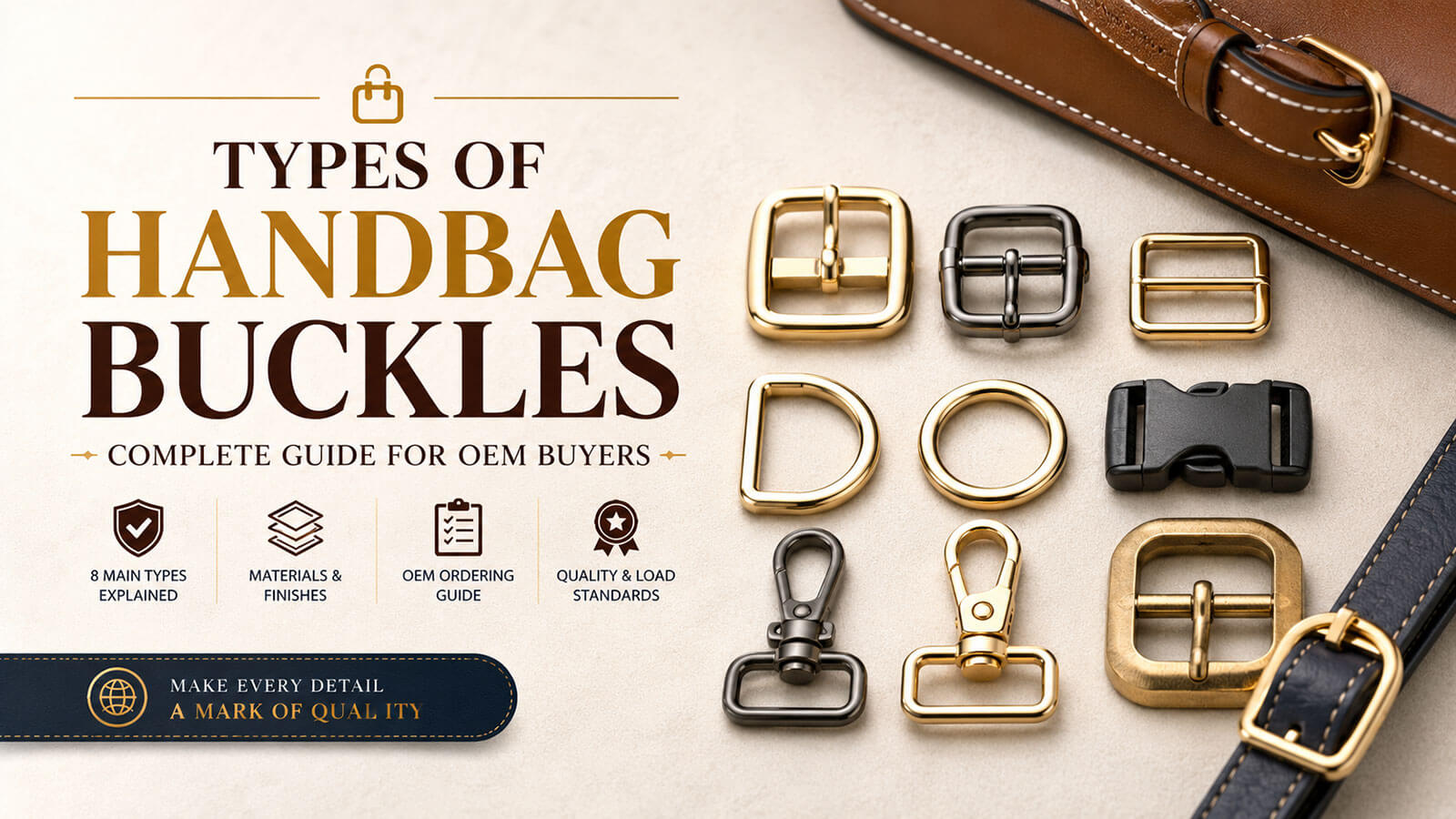
The main types of handbag buckles are: pin buckles, roller buckles, slide/adjuster buckles, D-ring buckles, O-ring buckles, side-release buckles, swivel buckles, and belt-style buckles. Pin and roller buckles dominate adjustable straps on mid-range and luxury bags; D-rings and O-rings are used for detachable straps and decorative hardware; side-release buckles appear mostly on technical and utility-style bags.
What Is a Handbag Buckle?
A handbag buckle is the metal hardware component that fastens, adjusts, or joins two ends of a strap, belt, or closure flap. Depending on the mechanism, a buckle can let a wearer shorten or lengthen a shoulder strap, attach and detach a strap from the bag body, or simply act as a decorative anchor point where two pieces of leather meet.
Buckles are sold and specified by two things that matter more than the shape: strap width (the inside opening the buckle must fit, usually 10–40mm for handbags) and mechanism type (how it locks or adjusts). Get either wrong and the part is unusable, regardless of how well it’s finished.
Most handbag buckles are die-cast from zinc alloy, though frame-style buckles under real mechanical load — like adjustable pin buckles on heavier bags — are sometimes stamped or cast in brass or stainless steel for extra strength. As with turn locks and zipper pulls, buckle hardware is also one of the easiest places to build a coordinated hardware “family” across a collection: buckle, D-ring, and zipper pull in one matched finish read as an intentional design decision, not a random parts bin.
8 Main Handbag Buckle Types Explained
1. Pin Buckle (Frame Buckle)
The most familiar buckle mechanism — a metal frame with a center bar and a pin (tongue) that passes through pre-punched holes in the strap, the same way a belt buckle works. The frame can be square, rectangular, D-shaped, or oval.
Best for: Adjustable shoulder straps and crossbody straps on structured handbags, briefcases, and travel bags.
Advantages: Infinitely field-adjustable within the punched hole range; strong mechanical hold; familiar to consumers, so no learning curve.
OEM note: Strap thickness and the number/spacing of punched holes need to be specified alongside the frame’s inner width — a frame cut for 25mm strap will not sit correctly on a 20mm strap. Request a functional sample with the actual leather or webbing you’ll be using, not a generic strap.
2. Roller Buckle (Roller Pin Buckle)
A variation on the pin buckle with a rotating bar or roller built into the frame. The roller reduces friction as the strap slides through, which makes length adjustment noticeably smoother — especially on thicker or stiffer leathers.
Best for: Adjustable straps on premium and luxury handbags, where the “feel” of adjusting the strap is part of the perceived quality.
Advantages: Smoother adjustment action than a plain pin buckle; reduces wear on the strap leather over repeated adjustment.
OEM note: The roller bar must be cast or assembled with minimal play — a loose or rattling roller is one of the most common QC rejections on this buckle type. Ask for a sample with the roller pre-installed, not just the frame.
3. Slide / Adjuster Buckle (Ladder-Lock Buckle)
A rectangular frame with one or two cross-bars that the strap weaves through. There’s no pin — length is held by friction and the zig-zag path of the webbing through the bars. Common on both leather straps and webbing.
Best for: Backpacks, technical bags, tote bag straps, and any strap that needs tool-free length adjustment without punched holes.
Advantages: No holes needed in the strap, so it works with webbing as well as leather; adjustment is continuous rather than fixed to hole positions.
OEM note: Bar spacing and bar diameter must match your webbing or strap thickness closely — too loose and the strap slips under load; too tight and it’s hard to adjust. Specify the strap material (webbing gsm or leather thickness) when requesting samples.

🛠️ OEM/ODM Custom Hardware Solutions
Have a specific engineering drawing or custom design for luxury leather goods? Collaborate directly with our master engineers to transform your sketches into premium brass or zinc alloy components.
Start Your Custom Project →📂 Digital Product Catalog Access
Explore our comprehensive range of high-end handbag accessories, metal logo,turn locks, buckles, and chains. Download the full specifications and options catalog for your sourcing library.
Download Full Catalog ↓4. D-Ring Buckle
Not a buckle in the strict mechanical sense, but grouped with buckles in nearly every hardware catalog because it performs the same connecting function. A D-shaped ring, usually paired with a strap keeper or a swivel clip, used to attach a detachable strap or as a decorative pull point.
Best for: Detachable and interchangeable crossbody straps, decorative strap connectors, tassel and charm attachment points.
Advantages: Simple, low-cost, extremely durable — no moving parts to fail; easy to coordinate in a matched finish with other hardware.
OEM note: Wire gauge (the thickness of the metal forming the ring) determines load capacity. For straps that will bear the full weight of a loaded bag, specify a minimum wire diameter rather than leaving it to the factory’s default stock size.
5. O-Ring Buckle
The rounded counterpart to the D-ring. A continuous circular ring, typically welded closed, used the same way — as a strap connector, a decorative accent, or a mounting point for a swivel hook.
Best for: Rounded-hardware aesthetics, connecting points on totes and bucket bags, coordinating with O-ring style feet or logo tags.
Advantages: Rotates freely in any direction, which reduces strap twisting compared to a D-ring; visually softer, which some brands prefer over the angular D-ring look.
OEM note: Confirm whether the ring is welded closed or split (open) — split rings are cheaper but not appropriate for load-bearing strap connections. Welded O-rings should be specified explicitly for anything that carries weight.
6. Side-Release Buckle (Clip Buckle)
A two-part plastic or metal buckle that snaps together with a push-button release — the same mechanism used on backpack chest straps and outdoor gear. Metal versions in zinc alloy are increasingly used on fashion-technical crossover bags.
Best for: Utility and technical-style handbags, crossbody bags aimed at a sportier or streetwear customer, quick-release strap systems.
Advantages: Fastest one-handed operation of any buckle type; strong visual “technical hardware” signal that resonates with certain customer segments.
OEM note: The release tabs are the highest-stress point and the most common failure point. Request a minimum cycle-test count (open-close cycles) from your supplier before approving mass production, and confirm the tab thickness is adequate for the buckle’s overall size.
7. Swivel Buckle
A buckle frame mounted on a rotating base or combined with a swivel hook, allowing the strap end to turn freely without twisting. Often built as a hybrid: a small buckle frame fused to a swivel clasp.
Best for: Convertible bags where the strap needs to rotate between crossbody and shoulder positions, bags with a single detachable strap used multiple ways.
Advantages: Prevents strap twist during wear; adds a functional, premium-feeling detail that’s easy to demonstrate to buyers.
OEM note: The swivel joint is a two-part assembly (pin and barrel), which adds an assembly step versus a single die-cast buckle. Confirm assembly tolerance and ask for a torque/rotation test on samples — a stiff swivel defeats the purpose.
8. Belt-Style Buckle (Decorative Frame Buckle)
A larger, purely decorative buckle styled after a belt buckle — often oversized relative to its functional counterparts, used as a design statement rather than a working strap adjuster. May be functional (with a pin) or purely ornamental, sewn or riveted flat onto the bag.
Best for: Statement bags, belt-bag and waist-bag styles, designer collections where the buckle is a visible brand signature.
Advantages: High visual impact; large surface area is ideal for logo engraving or an embossed brand mark.
OEM note: Because these are often oversized and highly visible, plating quality and edge finishing matter more than on smaller functional hardware — any casting flash or uneven plating is immediately noticeable at this scale.

Related Products You May Also Need
- Metal Rings & D-Rings — strap and closure hardware
- Handbag Locks — turn locks, magnetic closures, frame locks
- Snap Hooks — trigger and bolt snaps for straps
- Zipper Pulls — custom logo zipper pulls, tassel pulls
- Handbag Turn Lock Types: OEM Buyer’s Guide
- Custom Metal Zipper Pulls Wholesale: The Complete Buyer’s Guide
Comparison Table: Handbag Buckle Types at a Glance
| Buckle Type | Mechanism | Best Bag Style | Tooling Cost | Brand Customizable? | Load Capacity |
|---|---|---|---|---|---|
| Pin Buckle | Pin through punched hole | Structured straps, briefcases | Medium | Yes — frame shape | High |
| Roller Buckle | Pin + rotating bar | Premium adjustable straps | Medium–High | Yes — frame shape | High |
| Slide/Adjuster | Friction through cross-bars | Backpacks, webbing straps | Low–Medium | Limited | Medium–High |
| D-Ring Buckle | Fixed connector loop | Detachable straps, decorative | Low | Yes — ring shape/logo tag | Medium–High |
| O-Ring Buckle | Fixed rotating loop | Totes, bucket bags | Low | Limited | Medium |
| Side-Release | Push-button snap | Technical/utility bags | Medium | Yes — face plate | Medium |
| Swivel Buckle | Pin + rotating joint | Convertible strap bags | High | Yes — frame shape | Medium–High |
| Belt-Style Buckle | Pin or decorative-only | Statement/designer bags | Medium–High | Yes — full face | Varies |
How to Choose the Right Buckle for Your Bag
Buckle selection is a design decision and an engineering decision at the same time. The wrong choice shows up later as sample rejections, strap failures, or a piece of hardware that just looks wrong against the leather.
Start With How the Strap Needs to Function
If the strap needs to adjust in length, you’re choosing between a pin buckle, roller buckle, or slide/adjuster — the decision then comes down to strap material (leather favors pin or roller; webbing favors slide/adjuster) and how premium the adjustment action needs to feel. If the strap only needs to attach or detach, a D-ring, O-ring, or swivel buckle is the right category instead.
Match the Buckle to Your Brand Positioning
For luxury and premium collections: Roller buckles and swivel buckles in brass or high-grade zinc alloy with rack plating deliver the smooth action and weight that signal quality on contact. A custom-shaped pin buckle frame with an embossed logo becomes a signature hardware element, the same way a face-plate logo works on a turn lock.
For mid-range and fashion collections: Zinc alloy pin buckles and D-rings in a coordinated finish across the whole strap system give strong visual appeal without the cost of a swivel assembly. This is usually where brands see the best return on adding a custom logo detail.
For technical and streetwear-adjacent collections: Side-release buckles and slide/adjuster hardware in matte black or gunmetal read as intentional, functional design rather than an afterthought.
Confirm the Strap Width and Load Path Before Tooling
This is the single most common source of rejected samples in our experience: a buckle ordered before the final strap width was locked, or a buckle specified for a decorative role that later gets used to carry the bag’s full weight. Confirm both before requesting a custom mold — changing a buckle’s inner width after tooling means cutting a new mold.
Not sure which buckle type suits your strap system? Send us your design sketch or tech pack — we’ll recommend the right hardware and provide a free quote within 24 hours.
Materials and Finishes for Handbag Buckles
Base Material Options
Zinc alloy (Zamak): The industry standard for the large majority of fashion handbag buckle hardware. Die-castable into complex frame shapes, cost-effective at wholesale volumes, and accepts electroplating well when properly pre-treated. Recommended for most OEM projects, including decorative and light-to-medium load buckles.
Brass: Preferred for luxury collections and any buckle under sustained mechanical load, such as adjustable straps on heavier bags. Roughly 15% heavier than zinc alloy per equivalent volume, which contributes to a premium feel when the buckle is handled. Better natural corrosion resistance and superior plating adhesion, at a higher unit cost.
Stainless steel: Used selectively for high-load pin buckles and roller buckles on travel and utility-leaning bags where strength matters more than decorative finish range. More limited in finish options than zinc alloy or brass, but essentially immune to corrosion.
Surface Finish Options
- Light Gold — Warm, approachable finish. Most popular in mid-range collections.
- Shiny Gold / Real Gold — High gloss statement finish; real gold plating uses a thicker deposit for longer wear life.
- Antique Brass — Warm aged look. Suits vintage, bohemian, and artisan styles.
- Nickel / Silver — Cool, classic tone. Works across a wide range of bag colors.
- Gunmetal / Matte Black — Dark, matte-metallic. Strong demand in menswear and technical-leaning collections.
- Palladium — White-platinum tone. Premium alternative to nickel for luxury bags.
- Rose Gold — Warm pink tone. Trending in North America and Europe for feminine accessories.
- Black PVD — Maximum durability via physical vapour deposition. Preferred for buckles that see frequent friction and adjustment.
For buckles that will be adjusted regularly — pin buckles, roller buckles, and slide/adjusters especially — specify rack plating rather than barrel plating. Rack-plated parts receive thicker, more even coating that resists the specific wear pattern caused by repeated strap friction against the frame. Request a minimum plating thickness of 0.3–0.5 µm for mid-range products and 0.5–1.0 µm for luxury applications, and confirm testing against ASTM B117 salt spray standards.
A note on plating and friction wear: Buckles fail differently than static hardware like logo plates. The strap rubs against the frame every time it’s adjusted, which wears plating from the inside edge first — often invisibly, until the base metal shows through as a dull grey line. Ask any prospective supplier specifically how they plate the inner frame edge, not just the visible outer face.

OEM Ordering Guide: What to Specify When Ordering Bag Buckles
Vague specifications are the leading cause of sample rejection on buckle orders specifically, because buckles have more dimensional constraints than most other handbag hardware. Use this checklist when briefing a supplier.
- Buckle type and mechanism — specify exactly (e.g., “roller pin buckle, single roller bar, brass frame”).
- Inner strap opening width — the critical dimension; include tolerance (e.g., 25mm ±0.3mm).
- Overall frame dimensions — outer width × height × frame thickness.
- Strap/webbing thickness and material — leather (with thickness in mm) or webbing (with gsm), since this determines bar spacing and pin length.
- Base material — zinc alloy (specify Zamak 3 or Zamak 5), brass (specify grade H62 or H65), or stainless steel grade.
- Surface finish and color — use a named reference (e.g., “light gold, Pantone 872C equivalent”) rather than just “gold.”
- Plating method and thickness — rack plating required for load-bearing and frequently-adjusted buckles; specify minimum microns.
- Salt spray test requirement — specify hours (e.g., “48H NSS per ISO 9227, zero corrosion”).
- Logo or branding placement — provide artwork in AI or CDR vector format; confirm mold ownership terms in writing.
- Load / pull-strength requirement — especially for pin buckles, roller buckles, and D-rings used as the sole strap connector; specify a minimum pull-test force in kg.
- MOQ and sampling requirements — confirm development sample quantity, cost, and lead time before tooling approval.
Factory Insight — DG Buddy: The most common post-delivery complaint we help buyers avoid on buckle orders isn’t finish or logo accuracy — it’s fit. A buckle that looks correct in a product photo can still be cut for the wrong strap width, or have bar spacing that’s slightly too tight for the actual leather thickness once it’s dyed and finished. We require the buyer’s actual strap sample — not just a spec sheet — before cutting a custom mold, and we run a physical fit test with that sample at the first-article inspection stage. It adds a few days up front and prevents a full production run of buckles that technically match the drawing but don’t work with the real strap.
Frequently Asked Questions
What is the most common type of handbag buckle?
The pin buckle (frame buckle) is the most widely used mechanism across mid-range and luxury handbag straps globally, largely because it’s familiar, strong, and infinitely adjustable within the punched-hole range. Roller buckles are a premium variant used where a smoother adjustment feel matters, and D-rings are the most common choice where straps need to detach rather than adjust.
What’s the difference between a D-ring and an O-ring buckle?
Both are simple loop connectors rather than mechanical buckles. A D-ring has a flat edge, which keeps a strap or clip oriented in one direction and prevents twisting. An O-ring is fully circular and rotates freely in any direction, which some brands prefer for its softer visual profile and its ability to let a strap swivel naturally as it’s worn.
What material should I specify for a load-bearing handbag buckle?
Brass or stainless steel is recommended for any buckle that will carry the full weight of a loaded bag on a regular basis, such as the main pin buckle on an adjustable shoulder strap. Brass offers better plating adhesion and corrosion resistance than zinc alloy at a moderate cost premium; stainless steel is the strongest option but has a narrower range of decorative finishes.
Can I put my brand logo on a handbag buckle?
Yes. The flat frame face of a pin buckle, roller buckle, or belt-style buckle is a common surface for logo customization, achieved through embossing, engraving, or a fully custom die-cast mold. Larger, more visually prominent buckle types — like belt-style buckles — are especially popular for this because of their surface area.
What is the typical MOQ for custom handbag buckles?
MOQ varies by buckle type and complexity. For standard buckles in existing molds, many suppliers accept orders from 300–500 pieces. For fully custom-mold buckles with your logo or a proprietary frame shape, MOQ is typically 500–1,000 pieces for the first production run to offset tooling costs. Flexible MOQ is usually available for development and sampling stages.
How do I make sure a buckle will fit my strap correctly?
Send your supplier a physical strap sample — not just a written width spec — before they cut a custom mold. Strap thickness, especially on dyed or heavily finished leather, can vary enough to affect fit even when the stated width is correct. A reputable supplier will run a physical fit test at the first-article inspection stage using your actual strap material.
How long does plating last on a buckle that’s adjusted frequently?
Adjusted buckles wear differently than static hardware because the strap creates friction against the inner frame edge every time it’s used. Barrel-plated finishes (0.01–0.05 µm) can show wear at contact points within 3–6 months of regular adjustment. Rack-plated finishes (0.3–1.0+ µm), especially with a protective topcoat, typically hold up for 2–5 years under normal use. Always ask specifically how the inner frame edge — not just the outer face — is plated.
Conclusion
Handbag buckles are not interchangeable commodities, and treating them as one generic category is one of the more expensive mistakes we see in early-stage bag development. Pin, roller, slide/adjuster, D-ring, O-ring, side-release, swivel, and belt-style buckles each solve a different functional problem, and each carries its own tooling, material, and testing requirements.
For OEM buyers, the details that prevent costly rework are the same ones that are easiest to skip when a deadline is close: confirmed strap width, a physical strap sample sent before tooling, a named finish rather than a general color, and a stated load requirement for anything that will bear the bag’s weight. Put those in writing before mold cutting begins, and the rest of the process is far more predictable.
Ready to Source Handbag Buckles for Your Next Collection?
DG Buddy manufactures custom handbag buckle hardware with in-house die casting, rack plating, and salt spray testing. Low MOQ available for development orders. Free samples on request.
Get a Free Quote | Browse Buckle Hardware → | Download Catalog →
Related Articles
- Handbag Turn Lock Types: OEM Buyer’s Guide
- Custom Metal Zipper Pulls Wholesale: The Complete Buyer’s Guide
- Zinc Alloy vs Brass Handbag Hardware: OEM Buyer’s Guide
- Rack Plating vs Barrel Plating: What Really Makes the Difference?
- Handbag Hardware Plating Types: A Complete Guide
- Bag Hardware MOQ, Mold Fee and Sampling: What Buyers Need to Know
Ready to source your handbag hardware?
Explore our full product range, request a custom quote, or reach out directly — we respond fast.