
Iron Handbag Hardware: Cost, Strength, Rust Risk and OEM Buying Guide
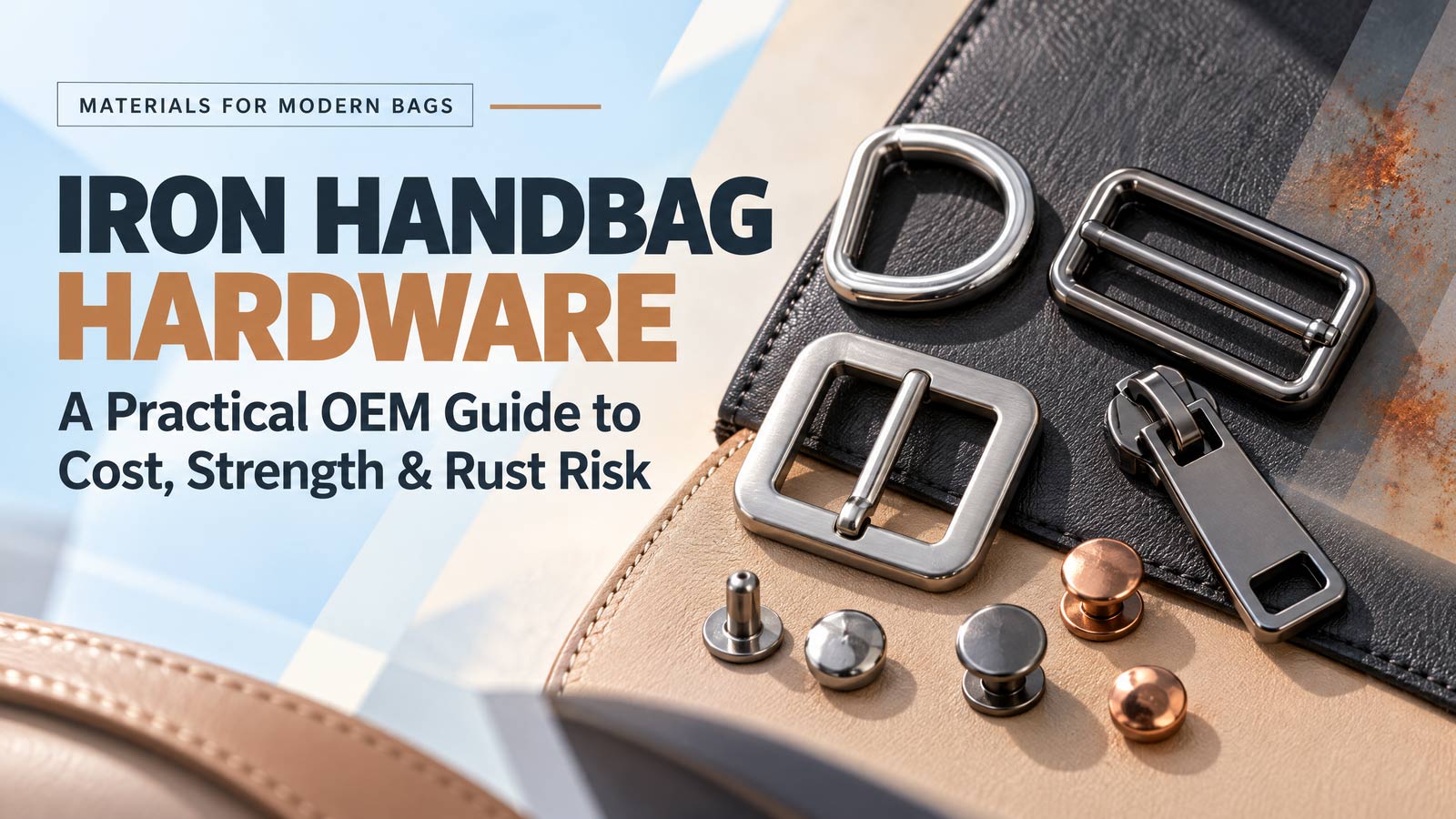
When buyers say “iron handbag hardware,” they usually mean low-carbon steel or another carbon-steel part rather than pure iron. Steel is inexpensive, strong for simple load-bearing shapes and well suited to stamping, so it remains common in cost-sensitive bags. The trade-off is corrosion: the base metal needs suitable pretreatment and a reliable finish system. This guide explains where iron handbag hardware works, where it creates avoidable risk, and how OEM buyers should specify and inspect it.
Quick Answer
Iron handbag hardware is a practical choice for low-cost bags, simple rings, buckles, zipper pulls and internal parts when the design is easy to stamp and the expected service environment is controlled. It is not naturally rust-resistant, so the steel grade, edge coverage, pretreatment, plating or coating, and inspection standard matter more than the word “iron” alone. For premium, humid, coastal or long-life products, zinc alloy, brass or stainless steel may be a safer starting point.
Key Takeaways
- In commercial bag hardware, “iron” normally means low-carbon steel, mild steel or another carbon-steel substrate.
- Steel offers high strength and low raw-material cost, but corrosion resistance comes mainly from the surface-treatment system.
- Choose stamped steel for simple, repeatable two-dimensional or folded parts; do not force it into complex cast shapes.
- Ask for the substrate, finish stack, thickness or coating requirement, appearance limit and test method in the purchase specification.
- Use salt spray as a controlled quality check, not as a universal lifetime promise or a simple ranking of materials.
Table of Contents
- What “Iron” Means in Handbag Hardware
- Performance: Strength, Weight, Cost and Rust Risk
- Where Iron Bag Hardware Works Best
- Stamping, Finishing and Corrosion Control
- Material Comparison and Buying Decision
- Common Buyer Mistakes
- Factory Expert Tips
- Expert Recommendation
- FAQ
What “Iron” Means in Handbag Hardware
“Iron hardware” is a commercial category, not a precise material grade. In most OEM conversations, the part is made from low-carbon steel or mild steel. Low carbon makes the sheet relatively formable, which supports blanking, piercing, bending and other stamping operations. Pure iron is rarely the useful assumption for a buckle, ring or zipper pull. A buyer should request the actual substrate and grade instead of approving a quotation that only says “iron.”
Knowledge Box: Iron Is Usually a Steel Substrate
What: Low-carbon steel contains a relatively low percentage of carbon and is commonly supplied as sheet, strip or wire. Why it matters: the grade influences hardness, bendability, springback, edge quality and load performance. How to use the information: put the substrate and forming method on the drawing or purchase order. If the supplier cannot identify the steel family, the buyer cannot meaningfully compare corrosion, stamping or finish results with another quotation.
Knowledge Box: Magnetic Does Not Mean Good or Bad
Most plain carbon-steel hardware is magnetic, so a magnet can be a useful first screening tool. It cannot prove the exact grade, plating thickness, strength or corrosion performance. Some stainless steels are also magnetic, while a plated zinc-alloy part may contain a steel spring or insert. Treat the magnet test as a quick identity check, then confirm the material through the supplier’s specification, sample approval and, when necessary, laboratory analysis.
Performance: Strength, Weight, Cost and Rust Risk
Iron handbag hardware sits at the low-cost, high-formability end of the material decision. Its density is close to ordinary steel at about 7.85 g/cm³, so a steel part is not automatically light. Its practical advantage is that thin sheet can provide good stiffness and load performance at a low material price. Its main weakness is that an exposed or poorly protected steel surface can oxidize quickly in moisture, salt, sweat or aggressive packaging conditions.
| Material or category | Typical density reference | Strength and forming profile | Corrosion position | Typical bag decision |
|---|---|---|---|---|
| Low-carbon steel / “iron” | About 7.85 g/cm³; grade-dependent | Good for stamping, bending and simple load-bearing parts | Low without protection; finish-dependent after plating | Cost-sensitive bags and simple structural parts |
| Zinc alloy | About 6.6–6.7 g/cm³; alloy-dependent | Excellent for complex die-cast shapes; not the first choice for every high-load part | Moderate to good only when the casting and finish are controlled | Decorative buckles, locks, logos and shaped connectors |
| 304 stainless steel | About 8.0 g/cm³; grade-dependent | High strength and good durability; harder to form and machine | High relative resistance, but not corrosion-proof in every environment | Outdoor, travel, premium or long-life hardware |
| Brass | About 8.4–8.7 g/cm³; alloy-dependent | Good machinability and a distinctive solid-metal feel | Does not rust like steel but can tarnish or develop patina | Vintage, luxury and decorative leather goods |
| Aluminum | About 2.7 g/cm³; alloy-dependent | Very light; strength depends strongly on alloy and section design | Oxide protection is useful, but finish and galvanic contact still matter | Weight-sensitive designs and the next material category to evaluate |
The table is a procurement guide, not a laboratory ranking. Mechanical performance changes with alloy, temper, thickness, geometry and heat treatment. ASTM physical and mechanical testing standards are used to evaluate metals and alloys for properties such as strength, ductility and hardness. For a critical buckle or load-bearing connector, specify the required function and test method rather than selecting from a generic material label alone.
Where Iron Bag Hardware Works Best
Iron bag hardware is most useful when the design is simple, the order is cost-sensitive and the product does not need the highest corrosion resistance. Typical examples include basic D-rings, square rings, strap adjusters, simple buckles, zipper pulls, rivet components, washers and hidden reinforcement parts. It can also be appropriate for promotional bags, entry-level backpacks, short-season fashion programs and components protected inside the bag construction.
Good Applications
- Flat or folded parts made from strip or sheet.
- Simple rings and adjusters with predictable loads.
- Internal plates, clips or reinforcement components that are not continuously exposed.
- Large-volume programs where tooling and unit-cost control are more important than a solid premium feel.
Applications Requiring More Caution
Use more caution for exposed parts on coastal products, outdoor bags, sports equipment and bags handled with wet hands. Also reconsider steel when the product depends on a deep mirror finish, intricate three-dimensional geometry or a luxury tactile impression. A plated steel part can look attractive, but a scratch at an edge, hole or moving contact area can expose the substrate and start local corrosion.

Browse the hardware catalog
Download our full product catalog to explore styles, materials, and specifications for all hardware collections.
⬇ Download catalogCustom OEM manufacturing
Need a unique design? We offer full OEM customization — your logo, finish, and specifications on any hardware.
→ Learn about OEMStamping, Finishing and Corrosion Control
The manufacturing route is a major reason to choose steel. A stamped steel part begins as coil or sheet. The tool may blank the outline, pierce holes, form bends and calibrate the final shape. This route is efficient for repeatable parts, but it does not remove burrs, sharp corners or tool marks by itself. Those details affect user safety, leather wear, coating coverage and the visual quality of the finished hardware.
1. Form the Part
Engineering should review sheet thickness, bend radius, grain direction, springback, hole position and the location of visible tool marks. A sharp internal corner can concentrate stress, while an exposed cut edge can become a corrosion hotspot. For a complex three-dimensional buckle or logo plate, zinc-alloy die casting may reduce secondary operations and provide more design freedom than stamped steel.
2. Deburr and Prepare the Surface
Trimming, tumbling, grinding or polishing remove burrs and improve the surface before finishing. Cleanliness is essential because oil, oxide, scale and polishing residue can reduce coating adhesion. DG Buddy’s public manufacturing guide makes the same practical point for handbag hardware generally: electroplating improves a prepared surface, but it cannot hide deep scratches, pits, porosity or uneven polishing.
3. Apply the Finish System
Bag hardware plating may include cleaning, activation, a strike or barrier layer, decorative metal layers and a protective topcoat, depending on the required color and wear performance. The exact stack should be approved with a physical sample. Ask whether the specified finish is electroplating, PVD coating, paint, powder coating, conversion coating or a combination. Finish names such as “gold” or “gunmetal” do not define the corrosion system by themselves.
4. Control Edges and Contact Areas
Edges, holes, folded corners, joints and rubbing surfaces are often more important than the large flat face. They may receive less even coverage or experience faster wear. A competent supplier should discuss rack plating or barrel plating, part orientation, masking, contact marks and the areas that must remain functional. The correct answer depends on part size, geometry, finish and expected handling.
5. Test Against an Agreed Requirement
ISO 9227:2022 states that salt spray methods are useful for detecting discontinuities such as pores and defects in metallic, organic, anodic-oxide and conversion coatings. It also states that these methods are not intended to rank materials against one another or predict long-term corrosion resistance. Therefore, a buyer should define the test method, duration, specimen condition, failure criteria and reporting format for the approved finish. Do not treat an unexplained “48-hour” or “96-hour” claim as a universal guarantee.
Material Comparison and Buying Decision
The best metal for bag buckles depends on geometry, load, finish, target retail position and service environment. Use the following decision table to narrow the material before requesting a quotation. Then ask the factory to confirm the actual grade, process and sample result.
| Buyer priority | Usually suitable starting material | Why | Main risk to control |
|---|---|---|---|
| Lowest cost for simple, high-volume parts | Low-carbon steel | Low raw-material cost and efficient stamping | Rust, burrs, edge coverage and finish adhesion |
| Complex decorative shape | Zinc alloy | Die casting supports three-dimensional details and plating-friendly surfaces | Porosity, thin sections, brittle features and coating defects |
| High exposure to moisture or outdoor use | Stainless steel | Better intrinsic corrosion resistance and strong functional performance | Higher processing cost and more limited forming economics |
| Premium solid-metal feel or vintage aging | Brass | Distinctive weight, machinability and patina potential | Higher material cost, tarnish and color consistency |
| Weight reduction | Aluminum | Much lower density than steel, brass or stainless steel | Alloy strength, surface protection and galvanic contact |
For buyers comparing iron vs zinc alloy bag hardware, the practical question is not which material is universally better. Choose steel when the part is simple, flat, folded or load-oriented and the finish risk is manageable. Choose zinc alloy when the part is decorative, highly shaped or dependent on a premium plated appearance. If the item is both complex and heavily loaded, ask the factory to review the geometry rather than assuming either material will solve the design alone.
Pros and Cons of Iron Handbag Hardware
Pros
- Low raw-material cost for cost-driven programs.
- Good stamping and bending potential for simple geometries.
- Useful strength-to-cost ratio for rings, clips, adjusters and internal parts.
- Magnetic response makes a fast preliminary material screen possible.
- Suitable for repeatable production when the tool and finish specification are stable.
Cons
- Rust risk is inherent when the steel substrate is exposed.
- Cut edges, holes and moving contact areas can fail before broad flat surfaces.
- It is less suitable for intricate cast shapes than zinc alloy.
- It may feel less premium than brass or solid stainless steel in a hand-held product.
- Plating quality depends heavily on cleaning, activation, surface preparation and handling.
Common Buyer Mistakes
- Approving “iron” without a substrate definition. Ask whether the part is low-carbon steel, another carbon steel, plated steel or a steel assembly with inserts.
- Comparing finish names instead of finish systems. “Antique gold” or “black” is a color reference, not a complete specification. Confirm the process, visible sample and protection layer.
- Testing only the large front face. Inspect edges, holes, folds, joints and rubbing zones because these areas often determine real-world failure.
- Using salt-spray hours as a lifetime promise. A controlled test is useful only when method, specimen, acceptance criteria and finish are defined.
- Choosing stamped steel for a cast-shaped design. Review whether the design needs die casting, machining, wire forming, forging or an assembly instead.
Factory Expert Tips
From common OEM production experience, the most preventable steel-hardware complaints begin before plating. A drawing that shows only the outside dimension is not enough. Include material family, thickness or section, critical holes, bend direction, burr limit, finish reference, functional contact zones and the inspection method. This gives the supplier a production target instead of a color description.
Use a three-stage approval sequence. First, approve the formed sample for dimensions, assembly and load function before judging color. Second, approve a finished sample under the intended light and against the bag material. Third, retain a signed master sample or finish panel for production inspection. DG Buddy’s public OEM process describes incoming, in-process, final and outgoing inspection checkpoints; buyers should still agree what each checkpoint measures for their own part.
For an OEM iron hardware supplier for bags, request a quotation that separates tooling, sampling, forming, finishing, assembly, packaging and testing. Ask which costs change if the substrate changes to stainless steel, brass, aluminum or zinc alloy. This makes the material trade-off visible and helps prevent a low initial quote from becoming an expensive rework cycle later.
When the program is exposed to sweat, rain or salt air, ask for a finish sample made on the actual steel substrate and geometry. A flat test panel may not represent coverage at a folded edge or inside a hole. If the part is safety-critical or carries a heavy strap, request a functional test plan as well as a corrosion test plan. The test should reflect the failure that matters to the final bag.
Expert Recommendation: When to Choose Steel and When Not To
Choose iron handbag hardware when cost is a primary constraint, the part is simple to stamp, the expected product life is defined, and the factory can control pretreatment and finish consistency. It is especially reasonable for mass-market bags, basic strap hardware and hidden or lightly exposed components. The decision is strongest when the buyer has an approved sample and a clear inspection specification.
Do not make steel the default for a premium bag simply because the quote is lower. Use stainless steel when intrinsic corrosion resistance and long-term exposure matter, brass when solid feel and aging are part of the design language, and zinc alloy when complex decorative geometry is central. For a new design, ask a manufacturer to compare at least two feasible materials using the same geometry, finish intent and functional requirement.
DG Buddy’s OEM custom handbag hardware service can be used for that material review. Buyers can also compare the company’s bag ring hardware range before submitting drawings, reference photos, target dimensions and finish requirements.

Conclusion
Iron handbag hardware remains relevant because low-carbon steel combines low material cost, useful strength and efficient stamping. Its weakness is not mysterious: the exposed steel substrate needs a properly engineered and inspected finish system. The safest buying decision comes from specifying the substrate, geometry, pretreatment, coating, edge condition and test acceptance together.
For more detail on process checkpoints, review DG Buddy’s 16-step manufacturing process guide. If the finish route is unclear, the PVD and electroplating comparison can help frame the discussion. For a project-specific recommendation, send the drawing, target quantity, use environment and finish reference through the custom hardware inquiry page.
FAQ
Is iron good for handbag hardware?
Yes, when the product is cost-sensitive, the part is simple and the steel is protected with a suitable finish. It is not the best default for humid, coastal, outdoor or premium long-life products unless the corrosion system has been validated for the intended use.
How do you prevent iron bag hardware from rusting?
Start with clean, suitable steel; remove burrs and oxides; control pretreatment; apply a compatible plating or coating system; protect vulnerable edges and holes; and package the finished parts against moisture. Confirm the result with an agreed test method and acceptance criterion rather than relying on color alone.
Is iron handbag hardware cheaper than zinc alloy?
Iron or stamped steel is often the lower-cost starting point for simple high-volume parts because the raw material and forming route can be economical. Zinc alloy may be more cost-effective for complex shapes because one die-casting process can reduce several secondary operations. Tooling, part size, order quantity, finishing and inspection can change the final comparison.
Can a magnet identify iron bag hardware?
A magnet can indicate that a part contains magnetic steel, but it cannot confirm the exact grade, thickness, coating or strength. It is a screening step only. Verify the material with the supplier’s specification and, for a critical project, use an appropriate material or composition test.
What should an OEM buyer ask for in a salt spray test for bag hardware?
Ask for the test method, specimen preparation, substrate and finish stack, test duration, inspection intervals, failure definition and report format. ISO 9227 explains the purpose and limits of salt-spray methods. The agreed result should be tied to the actual finish and geometry, and it should not be presented as a universal prediction of service life.
What is the best metal for bag buckles?
There is no single best metal. Low-carbon steel is practical for simple, cost-sensitive buckles; zinc alloy suits complex decorative buckles; stainless steel suits corrosion-sensitive or heavy-duty use; and brass suits premium or vintage designs. The correct choice depends on load, geometry, finish, environment and target product position.
Ready to source your handbag hardware?
Explore our full product range, request a custom quote, or reach out directly — we respond fast.