
How Luxury Brands Prevent Hardware Tarnish: 7 Factory-Level Methods
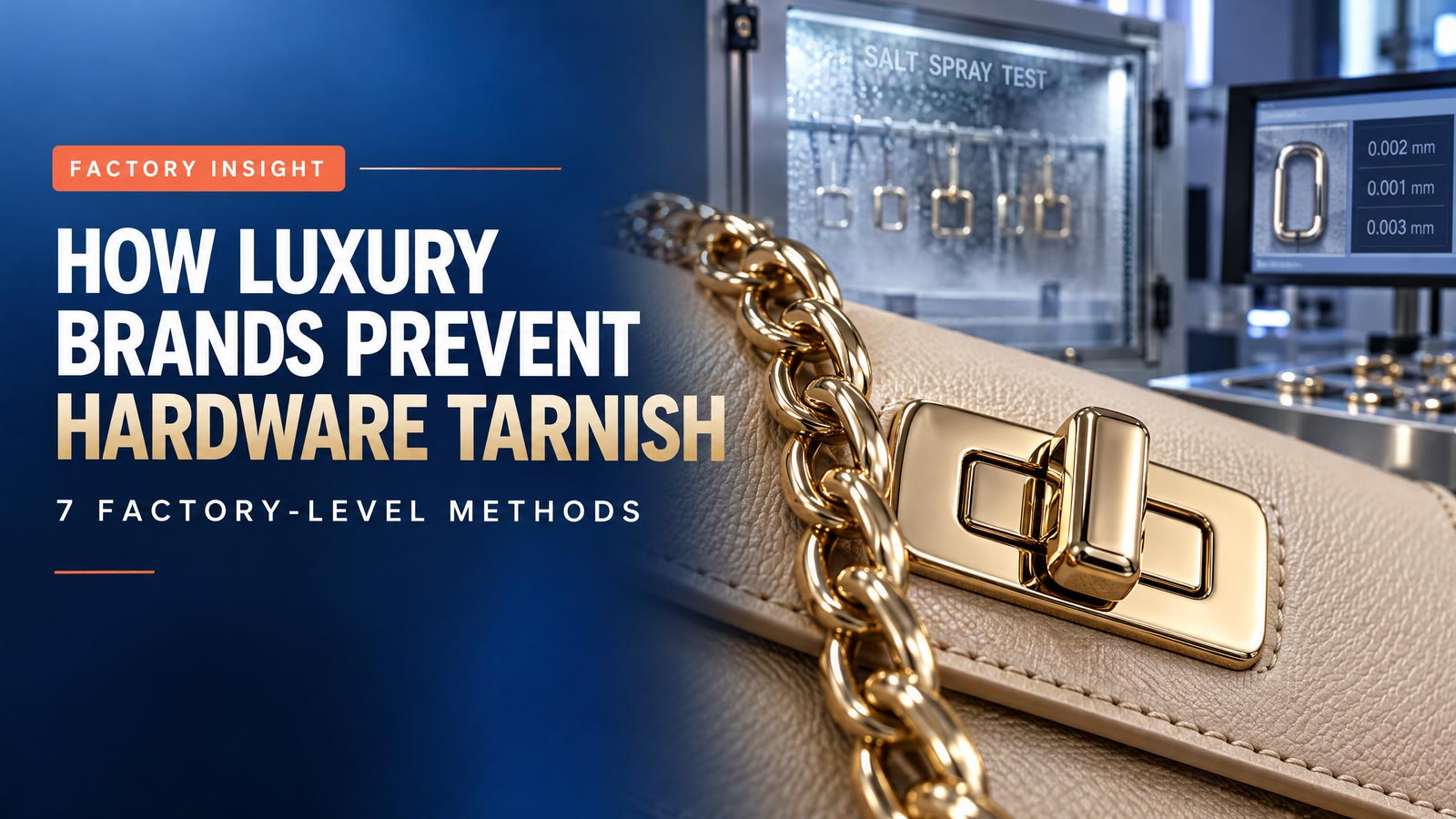
When a customer pays four figures for a handbag, a single dark spot on a turn lock can trigger a warranty claim and a social media complaint. Tarnish is not a cosmetic detail — it is a brand risk. The most reliable luxury bag hardware tarnish prevention happens before the bag is ever assembled, inside the factory, through seven deliberate decisions about base metal, coating, process, and testing.
Quick Answer
Luxury brands prevent hardware tarnish by specifying corrosion-resistant base metals (brass or 316L stainless steel), building multi-layer plating at controlled thickness in microns, upgrading signature pieces to PVD coating, sealing finishes with clear lacquer, using rack plating for visible components, and verifying every batch with ASTM B117 salt spray testing. End-user care extends the result, but factory-level specification is what makes tarnish resistance a property of the product rather than a hope.
Key Takeaways
- Base metal decides the ceiling: brass and 316L stainless steel resist corrosion even when scratched; Zamak depends entirely on its plating.
- Write plating thickness in microns on the spec sheet — “gold finish” without a micron value is not a buyable specification.
- PVD coating bonds at the molecular level and outlasts standard electroplating on high-touch hardware by years (industry-typical estimate: 3–5x).
- Use rack plating, not barrel plating, for any visible luxury component.
- Specify ASTM B117 salt spray hours in the purchase order: 48h baseline for fashion, 72–96h+ for premium and coastal markets.
- Request REACH-compliant, test-verified finishes from accredited labs — paperwork is your audit trail when claims are disputed.
Table of Contents
- Why Metal Oxidizes & How Luxury Bag Hardware Tarnish Prevention Works
- Method 1: Base Metal Selection
- Method 2: Plating Systems and Thickness
- Method 3: PVD Coating
- Method 4: Clear Lacquer Topcoats
- Method 5: Rack Plating vs Barrel Plating
- Method 6: Salt Spray and Lab Verification
- Method 7: Compliance, Packaging, and Humidity Control
- Finish Systems Comparison Table
- Pros and Cons of Each Approach
- Common Mistakes Buyers Make
- Factory Expert Tips
- Expert Recommendation
- Conclusion
- Frequently Asked Questions
Why Metal Oxidizes & How Luxury Bag Hardware Tarnish Prevention Works
Tarnish is a surface chemical reaction between metal and oxygen, moisture, sulfur compounds, or chlorides. On plated hardware, the danger is structural: the decorative top layer is only microns thick, so once friction or a plating defect exposes the base metal, oxidation begins at that point and spreads under the surrounding coating.
Three forces accelerate the process in real use. First, friction — clasps, chain links, and lock plates are touched and rubbed hundreds of times per week. Second, chemistry — perfume, hand sanitizer, lotion, and leather conditioner leave residues that attack plating. Third, environment — humidity above roughly 60% RH, coastal salt air, and temperature swings that cause condensation on metal surfaces inside closets and shipping containers.
Luxury brands treat these forces as engineering inputs, not accidents. Every method below removes or delays one link in the corrosion chain: the base metal, the coating system, the application process, or the verification protocol.
Knowledge Box: What Is Tarnish and Why Does It Spread So Fast?
What: Tarnish is a chemical reaction product — oxides and sulfides — forming on or under a metal surface. Why it spreads: early tarnish products are porous, so air and moisture travel through them and attack fresh metal underneath, expanding the damaged zone far beyond the original scratch. How to use this: in specifications, demand coating integrity and adhesion, not just color. A finish with strong adhesion contains a failure at the scratch; a weak one lets it run.
Method 1: Base Metal Selection
The base metal sets the worst-case scenario. If the coating is ever breached, the underlying material decides whether the damage stabilizes or propagates. This is where the zamak vs brass corrosion trade-off becomes a brand decision, not just a cost line.
Brass contains copper and zinc and forms a stable, self-limiting patina when exposed. A scratched brass lock may darken slightly at the scratch, but the reaction slows down on its own. Zamak (a zinc-aluminum-magnesium-copper die-casting alloy) offers superior detail reproduction and lower cost, but when its plating is breached, zinc oxidation continues and can creep under adjacent coating. For hidden or low-stress components, Zamak is entirely appropriate; for signature locks and logo plates on premium lines, brass or 316L stainless steel removes the base-metal risk entirely.
316L stainless steel is the quiet benchmark. Its chromium oxide layer is self-healing: scratch it, and the surface re-passivates in air. This is why the highest-tier hardware programs increasingly specify stainless steel substrates with PVD finishes for pieces that must look identical for a decade. If your line targets humid or coastal markets, this is the specification that survives them.
If you are weighing die-cast Zamak against machined or stamped brass for a new collection, our zinc alloy vs brass handbag hardware guide covers cost, detail fidelity, and corrosion behavior in depth.
Method 2: Plating Systems and Thickness
Decorative electroplating is a stack, not a layer. A typical luxury-grade system on brass or Zamak runs copper strike (adhesion), one or more nickel layers (corrosion barrier and leveling), then the precious-metal or decorative top layer — gold, palladium, ruthenium, or chrome — measured in microns. Each layer has a job, and skipping the middle layers to save cost is the most common cause of field tarnish we see in incoming third-party complaints.
Thickness is the specification most often missing from purchase orders, and it is the single most predictive number for finish life. Industry-typical tiers look like this: flash plating under 0.25 µm (budget, fails within a season), 0.5–1.0 µm (mid-market, one to two years of normal use), and 2–3 µm or more for luxury and heritage positioning, sometimes sealed with an additional topcoat. Two locks can photograph identically at sample approval and diverge completely within six months — the difference was written in microns, not in color.
For a broader view of how finish choices interact with brand color palettes across a full collection, see our guide to gold vs silver vs black handbag hardware finishes.
Method 3: PVD Coating
Physical Vapor Deposition (PVD) is a vacuum-chamber process in which metal or ceramic compounds — titanium nitride for gold tones, zirconium nitride, diamond-like carbon for deep black — are vaporized and deposited onto the hardware surface, bonding at the atomic level rather than sitting on top of it like electroplating. The result is a ceramic-hard layer with industry-reported hardness of roughly 1,500–3,000 HV versus roughly 600–800 HV for electroplated chrome.
For luxury programs, PVD solves two problems electroplating cannot. First, wear: on high-pivot components like swivel hooks and turn locks that cycle thousands of times, a PVD surface resists the micro-scratches that give tarnish its entry points. Second, chemistry: PVD layers are dense and impermeable to sweat and cosmetics, and the process is inherently nickel-free, which simplifies EU market compliance.
The trade-offs are real: PVD equipment costs more, batch processing in vacuum chambers lengthens lead times, and unit cost typically runs 30–40% above standard electroplating (industry-typical estimate). This is why most brands reserve PVD for signature components — locks, chains, logo plates — rather than entire hardware sets.
Knowledge Box: PVD Coating vs Electroplating — What Actually Differs?
What: Electroplating deposits metal ions onto a conductive surface in a liquid bath; PVD deposits vaporized material in a vacuum, atom by atom. Why it matters: electroplated layers are mechanically layered and depend on thickness for life; PVD layers are metallurgically bonded and depend less on thickness than on density and bond strength. How to decide: electroplating wins on color range, unit cost, and complex-batch flexibility; PVD wins on wear life, color stability, and nickel-free compliance. Many luxury programs use both on the same bag, matched in one plating batch to keep tone consistent.
Method 4: Clear Lacquer Topcoats
A clear lacquer (or an electrophoretic dip-coat variant of the same idea) is a transparent organic film applied over the plated finish. It works as sacrificial protection: air, moisture, and skin oils attack the lacquer first, and the decorative metal underneath stays untouched. When the lacquer eventually scuffs, the damage is nearly invisible because the metal color beneath is identical.
Specification details matter here. Fashion hardware typically carries 5–10 µm of lacquer (typical industry range); thicker films last longer but can slightly soften mirror gloss. Compatibility testing matters too — alcohol-based cleaners and some leather care products can cloud or dissolve certain lacquer formulations, which is why premium suppliers test lacquer chemistry against the care products the end customer is likely to use.
Lacquer is also the cheapest insurance on the list. If a buyer can only add one line to an existing electroplating specification, a qualified clear topcoat is usually the highest-value addition per dollar.

🛠️ OEM/ODM Custom Hardware Solutions
Have a specific engineering drawing or custom design for luxury leather goods? Collaborate directly with our master engineers to transform your sketches into premium brass or zinc alloy components.
Start Your Custom Project →📂 Digital Product Catalog Access
Explore our comprehensive range of high-end handbag accessories, metal logo,turn locks, buckles, and chains. Download the full specifications and options catalog for your sourcing library.
Download Full Catalog ↓Method 5: Rack Plating vs Barrel Plating
In barrel plating, parts tumble loosely in a rotating barrel full of electrolyte. It is fast and inexpensive, but parts collide constantly, leaving micro-scratches and contact marks, and current distribution is uneven, so thickness varies piece to piece. Rack plating mounts each component individually on conductive fixtures, holding polished faces apart so the coating deposits uniformly and the surface stays flawless.
For luxury applications the distinction is decisive. A barrel-plated turn lock may meet the same nominal thickness on paper while carrying thin spots at edges and contact points — exactly the locations that see the most friction in use. Those thin spots become the corrosion initiation points that show up as “tarnish” within a season.
Best practice in high-end sourcing is to specify the method per component, not per order: rack for visible and high-touch pieces (locks, logo plates, clasps, chains), barrel acceptable for hidden functional parts (internal washers, rivets, ferrules). A supplier who quotes one blanket process for an entire hardware set is telling you something about how they think about finish quality.
Method 6: Salt Spray and Lab Verification
Every method above is a promise until it is tested. The industry benchmark is the ASTM B117 salt spray (fog) test: hardware sits in a sealed chamber at 35°C in a continuous 5% sodium chloride mist, and inspectors log the hours until the first visible corrosion, blistering, or base-metal exposure. ASTM itself notes the test gives relative corrosion-resistance data and should be corroborated for real-environment predictions — so treat hours as a comparison tool between suppliers and systems, not as a literal service-life guarantee.
Typical hour tiers reported across the industry: 24–48h for standard decorative electroplating on Zamak; 72–96h for multi-layer copper-nickel-chrome systems on brass; 100–200h+ for PVD on well-prepared substrates. Premium brands commonly specify 72–120h in purchase orders, and coastal-market programs push higher. Cross-hatch adhesion testing (ASTM D3359) belongs in the same protocol — a corrosion-resistant coating that peels is not corrosion-resistant.
Two verification rules separate serious buyers from the rest. First, test the actual production finish from a production batch, never a hand-prepared prototype. Second, require reports from an accredited third-party lab or in-house calibrated equipment, and confirm the report references the correct standard and duration. If a supplier resists either rule, the quote is not finished.
Knowledge Box: What Do Salt Spray Hours Actually Tell a Buyer?
What: ASTM B117 hours measure time to first visible coating failure under accelerated 5% NaCl fog at 35°C. Why it matters: it compresses months of humid or coastal exposure into days, making finish systems comparable on one axis. How to use it: specify minimum hours by market (48h temperate, 72h+ tropical/coastal, 96h+ luxury flagship) in the PO; demand production-sample testing; and pair it with adhesion and abrasion tests, because salt spray alone never measures scratch resistance.
Method 7: Compliance, Packaging, and Humidity Control
The final method is procedural. Compliance paperwork — REACH registration data for chemical substances and restricted-substance declarations for skin-contact hardware — correlates with plating discipline, because a factory that cannot document its chemistry usually cannot control it. Under the EU REACH regulation (EC 1907/2006), manufacturers and importers must register substances above one tonne per year and communicate safety information down the chain; a supplier fluent in this documentation is a supplier with controlled process inputs.
Packaging closes the loop. Hardware leaves the plating line protected, but the weeks inside a shipping container crossing the ocean can undo the work: condensation cycles corrode unprotected metal. Export-grade practice includes individual poly or tissue separation for plated parts, VCI (vapor corrosion inhibitor) options for long transits, and silica gel humidity control in cartons — plus end-customer guidance to keep storage humidity below about 60% RH.
None of this is glamorous. All of it shows up in warranty rates, which is why the strongest luxury programs audit packaging and storage with the same energy they audit the plating line.
Finish Systems Comparison Table
The table compares the four finish systems buyers most commonly choose between. Use it to match system cost and test performance to your brand tier and target climate. Ranges are industry-typical values compiled from multiple published hardware sourcing guides (estimate; confirm per project with your supplier’s test reports).
| Finish System | Typical Top Layer Thickness | Typical Salt Spray (ASTM B117) | Wear Resistance (relative) | Approx. Cost Delta vs Standard EP | Best For |
|---|---|---|---|---|---|
| Flash electroplating | <0.25 µm | 8–24h | Low | Baseline | Fast fashion, hidden parts |
| Standard electroplating + clear lacquer | 0.5–1.0 µm + 5–10 µm lacquer | 24–48h | Medium | +10–20% | Mid-market, temperate climates |
| Heavy multi-layer electroplating (rack) | 2–3 µm, Cu-Ni stack | 72–96h | Medium-High | +30–50% | Premium lines, heritage positioning |
| PVD coating (on brass or 316L) | ~0.5–3 µm ceramic bond | 100–200h+ | High (1,500–3,000 HV) | +30–40% | Signature hardware, coastal/tropical markets |
The reading is simple: cost and corrosion resistance rise together, but the jump from standard electroplating to rack-processed multi-layer systems is larger than most buyers expect, while PVD’s premium over heavy electroplating is smaller than its performance gap on wear. For a signature lock on a flagship bag, PVD on stainless steel is usually the lowest-risk choice per year of expected service.
Pros and Cons of Each Approach
Multi-Layer Electroplating (Rack)
- Pros: Widest color range (gold, rose gold, gunmetal, antique); mature global supply base; per-unit cost predictable at volume.
- Cons: Life is proportional to thickness, so under-specified parts fail quietly at edges; nickel underlayers require EU nickel-release management.
PVD Coating
- Pros: Molecular bond resists scratching and tarnish 3–5x longer than standard EP (industry estimate); inherently nickel-free; superior color stability.
- Cons: Higher unit cost; longer lead times from vacuum batch processing; limited color palette versus wet plating.
Clear Lacquer Topcoat
- Pros: Cheapest meaningful upgrade; protects thin platings; invisible sacrificial layer.
- Cons: Alcohol-based cleaners can cloud some formulations; adds a compatibility-testing step; eventually wears and needs reapplication in professional care.
Base Metal Upgrade (Brass / 316L)
- Pros: Self-healing or self-limiting corrosion; failure mode is cosmetic, not structural; strongest warranty story.
- Cons: Highest material and machining cost; brass density adds weight; design changes may be needed versus die-cast Zamak.
Common Mistakes Buyers Make
- Buying color instead of specification. “Gold hardware” is not a spec. Thickness in microns, plating system, and method (rack vs barrel) are the spec. Write all three in the PO.
- Approving samples that don’t represent production. Prototypes are often hand-finished. Demand test reports and golden samples pulled from actual production runs.
- Testing salt spray only. Salt spray measures corrosion, not wear. High-touch hardware fails by abrasion first — add cross-hatch adhesion and abrasion tests to the protocol.
- One process for the whole hardware set. Barrel-plating visible components to save cost creates thin spots exactly where friction concentrates.
- Ignoring storage and transit. A 72-hour salt-spray finish can still arrive corroded after a humid ocean crossing without VCI packaging and silica gel. Packaging is part of the finish system.
- Polishing damaged plating harder. Once base metal shows, cleaning cannot rebuild the coating. Restoration belongs to professional replating — our guide on how to restore tarnished purse hardware explains when cleaning is safe and when it makes things worse.
Factory Expert Tips
From OEM production experience at our Dongguan facility, the finishes that survive five years in the field share a pattern that has little to do with the top-layer color: pre-treatment discipline. Polishing quality, ultrasonic cleaning, and activation before plating decide adhesion more than any later layer. A mirror-polished, properly activated brass part with a 2 µm plating routinely outperforms a rougher part with 3 µm, because coating follows — and seals — the surface it lands on.
Second, batch consistency protects color matching. When a hardware set (lock, chain, logo plate, zipper pull) is plated in one rack batch from one bath, the gold tone matches at assembly. Splitting the set across batches or suppliers is the most common cause of “the chain is a different gold” complaints, and no after-the-fact sorting fully fixes it.
Third, match the test protocol to the sales climate, not to the sample room. Hardware destined for coastal markets should be validated at elevated salt-spray hours and sweat-simulation exposure, not just baseline fashion-tier testing. We run in-house salt spray and adhesion testing on production batches and provide full reports on request — specifying that reports come from production lots, not prototypes, is the habit that separates premium buyers from everyone else. Our handbag hardware manufacturing process guide shows where each finishing and testing step sits in the production flow.
Expert Recommendation
Recommend PVD on 316L or brass, with rack processing and 96h+ salt-spray verification, when: the piece is signature hardware on a flagship line, the target market is coastal or tropical, the brand promises multi-year durability, or the component is high-pivot and high-touch. The 30–40% finish premium is typically recovered through reduced warranty claims.
Recommend multi-layer rack electroplating with clear lacquer, verified at 48–72h, when: the line is mid-premium, volumes are high, color range matters (rose gold, antique tones), and the sales climate is temperate. This is the best value position for most contemporary brands.
Do not specify barrel-plated or flash-plated visible hardware for any premium exterior component. The cost saving is small, the failure mode is visible, and the warranty math never works. Reserve barrel processing for hidden functional parts, and always insist on documented, production-sample testing before release.

Conclusion
Luxury brands prevent hardware tarnish the same way they prevent every other quality failure: by converting a vague expectation (“it shouldn’t tarnish”) into written, testable specifications. Base metal choice sets the worst case. Plating thickness and rack processing set the baseline life. PVD and lacquer set the ceiling on high-touch pieces. Salt spray verification, run on production samples with accredited reporting, proves the claim before a single bag reaches a customer.
If you are building a collection specification now, start with the decision table above, then bring your climate and price-point constraints to a factory that tests what it sells. Explore our custom handbag hardware range for finish options across locks, chains, logo plates, and buckles — and contact our engineering team to review plating specifications and salt-spray requirements for your next OEM or ODM project.
Frequently Asked Questions
How do luxury brands keep gold hardware from tarnishing?
At the factory level: brass or stainless substrates, multi-layer plating at 2–3 microns on visible parts, rack processing, optional PVD or lacquer topcoat, and salt-spray verification. At the consumer level: dry wiping, humidity control below ~60% RH, and keeping perfume and sanitizer off the metal. The factory methods do the heavy lifting; care extends the result.
How many salt spray test hours should luxury handbag hardware pass?
Industry-typical guidance: 24–48h for fashion tiers, 72–96h for premium, and 96–120h+ for luxury flagship pieces or coastal markets. PVD systems often exceed 100h. Treat hours as a supplier-comparison and contract tool, since ASTM notes salt spray results need corroboration to predict real-world life.
Is PVD coating or electroplating better for luxury hardware?
For wear and tarnish resistance, PVD wins: the coating is metallurgically bonded and far harder. For color range and unit cost, electroplating wins. Most luxury programs use both — PVD on signature high-touch pieces, matched rack electroplating for the rest of the set, plated in one batch so tones match.
Does PVD coating completely prevent tarnishing?
No coating is absolutely impervious. Extreme edge abrasion or impact can eventually penetrate even PVD. However, under normal use PVD maintains its appearance roughly 3–5 times longer than standard electroplating (industry estimate), which makes it the most practical near-permanent option for hardware touched daily.
What is the best base metal for handbags sold in humid or coastal climates?
316L stainless steel is the strongest choice because its chromium oxide layer self-heals when scratched. Among plated options, brass outperforms Zamak because its patina stabilizes instead of spreading. If Zamak is required for design complexity, specify PVD or minimum 2-micron plating with a lacquer sealant, and raise salt-spray hours accordingly.
Ready to source your handbag hardware?
Explore our full product range, request a custom quote, or reach out directly — we respond fast.