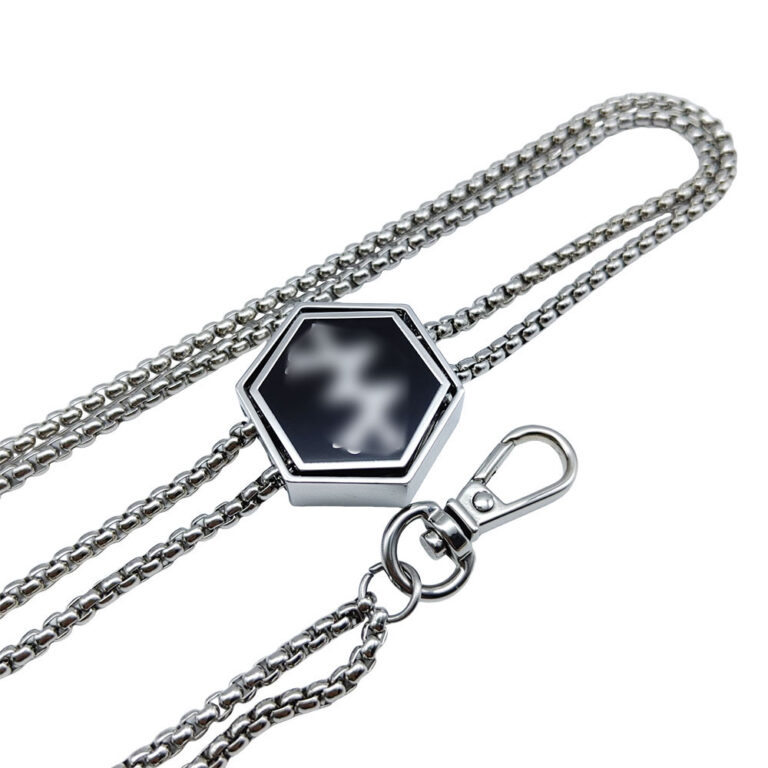
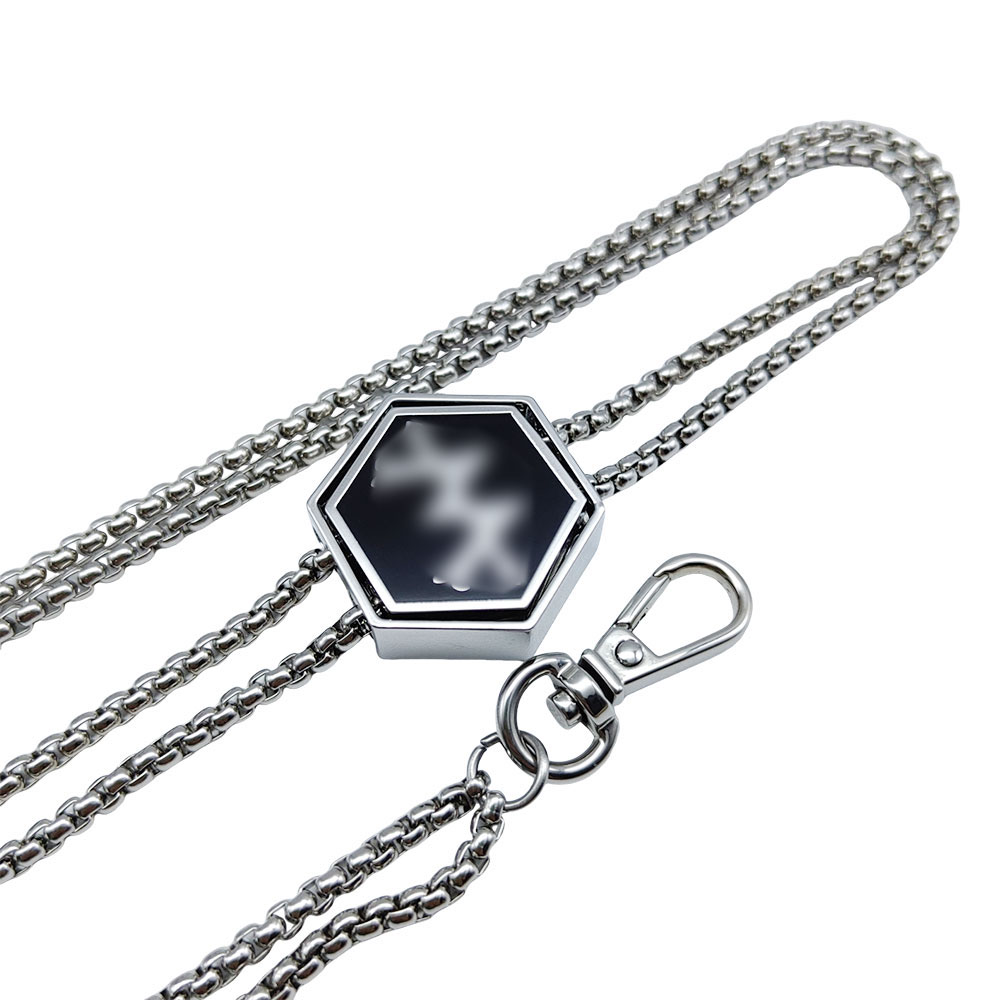
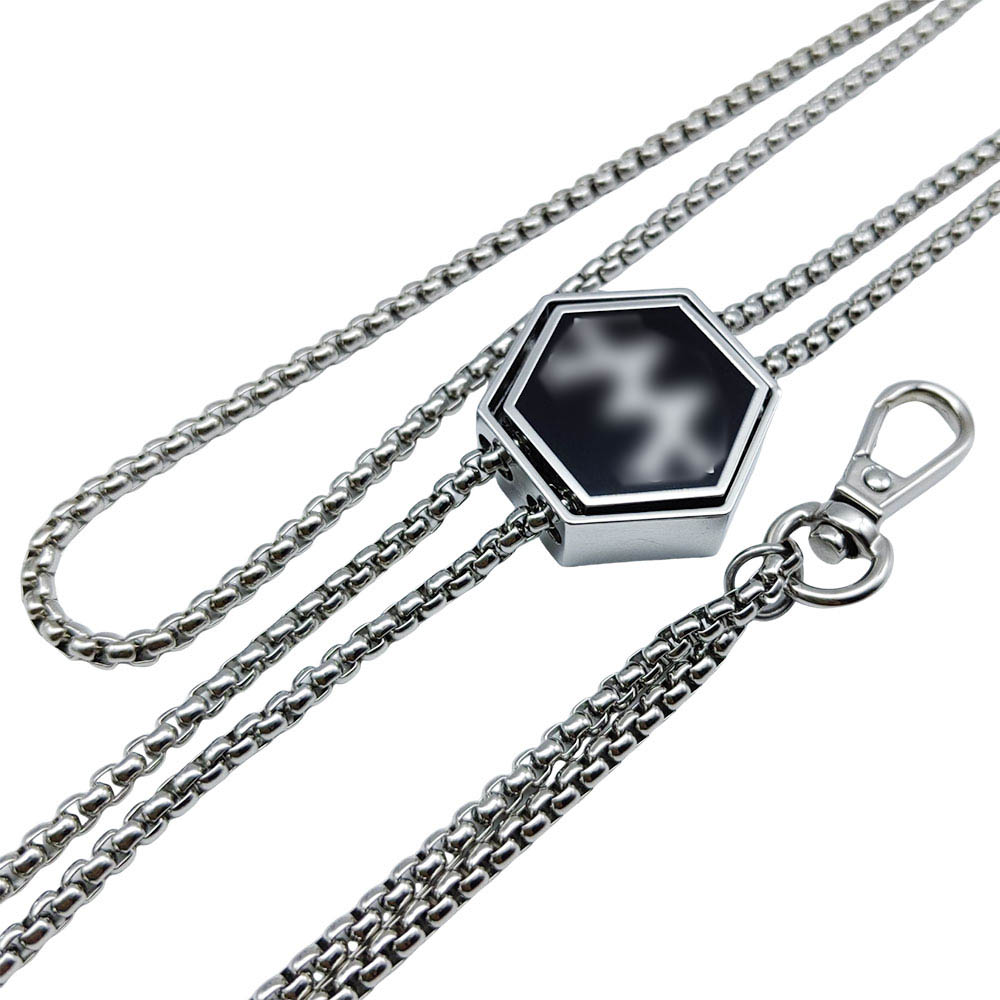
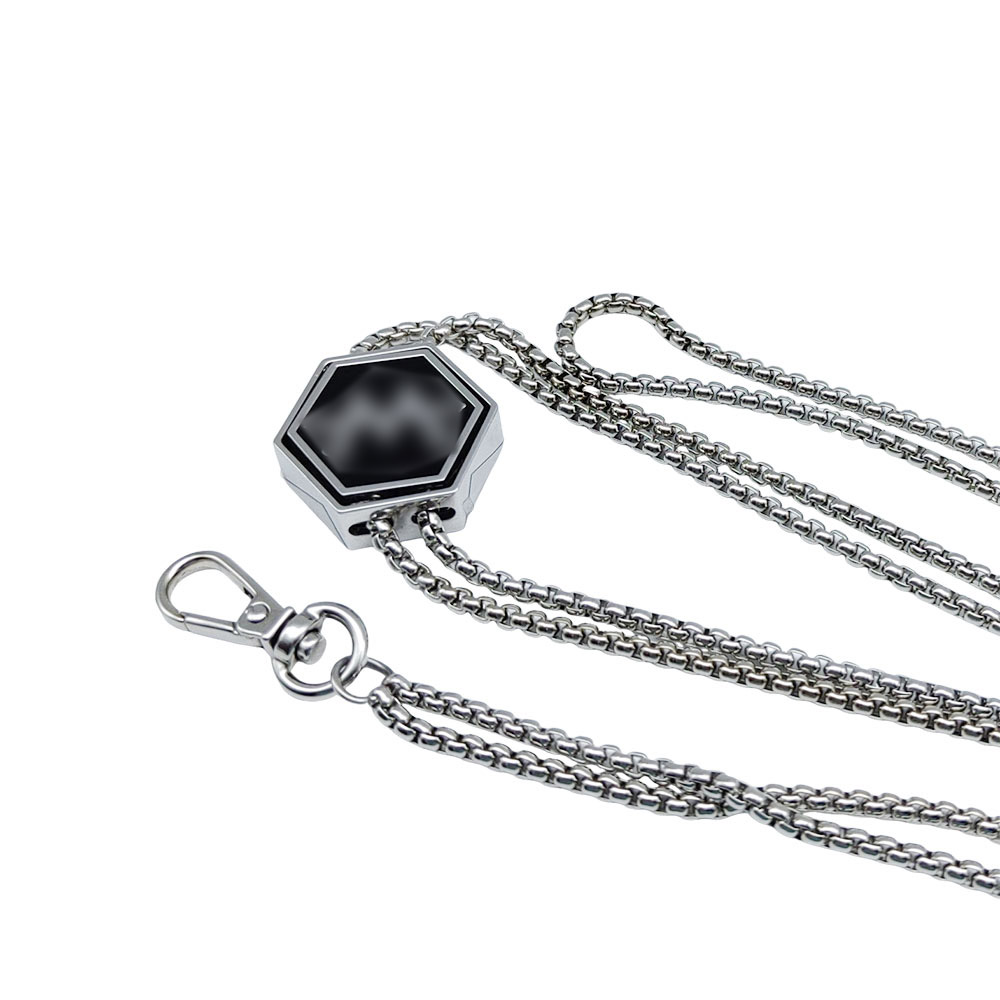
An adjustable slider necklace combines a 55 cm zinc alloy box chain with a silver electroplated finish and a press-release locking mechanism. Its geometric center pendant creates a distinctive appearance, while the slider allows the chain position to be adjusted and locked when released. This design is intended for necklace styling and compatible bag charm applications. DG Buddy supports OEM development, with final customization, dimensions, and production details confirmed against the approved sample and technical requirements.
For a sourcing team, the central question is not only how the product looks. It is whether the slider works consistently with the selected chain, whether the finish matches the approved appearance, and whether the end connector suits the intended use. Those details should be agreed before bulk production.
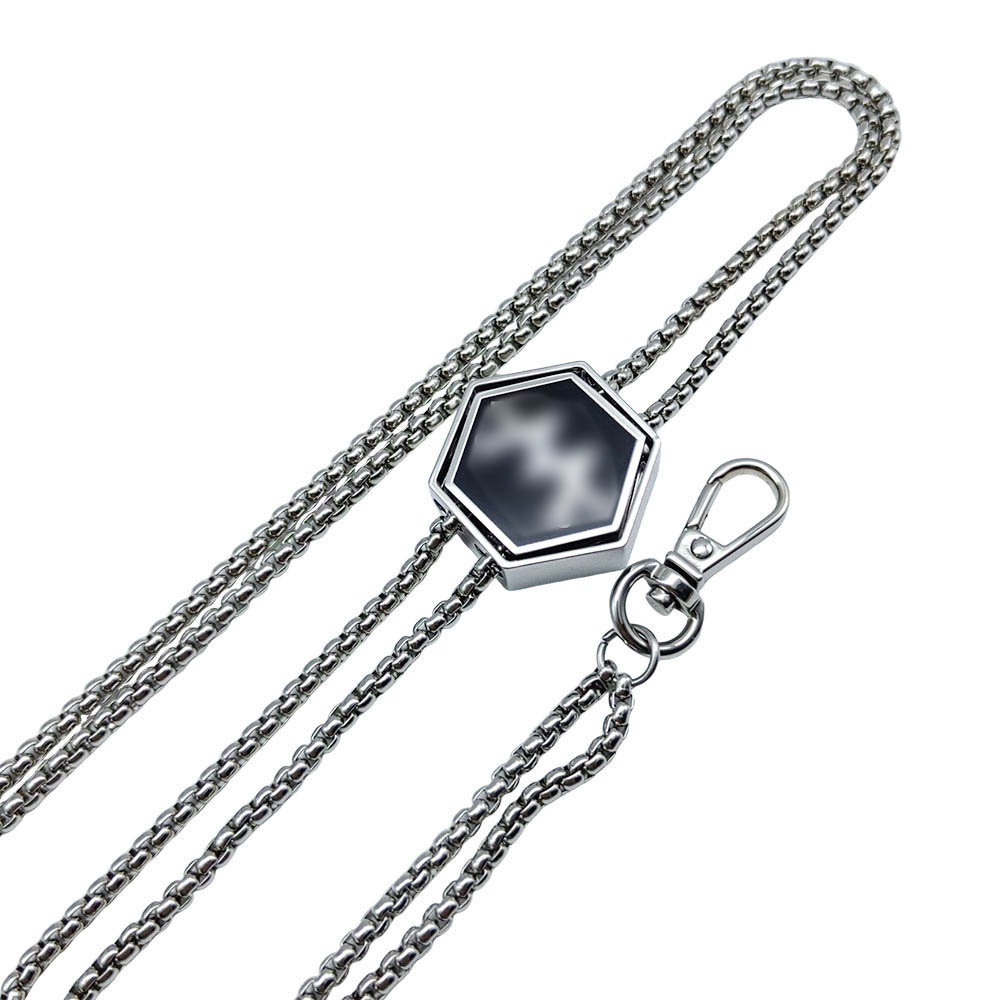
An adjustable slider necklace uses a movable component to change the position or effective arrangement of the chain. In this design, the center slider has a press-release mechanism: the user presses the mechanism to release the sliding action, adjusts the position, and releases it to engage the locking function. The precise internal construction should be verified from a sample or engineering drawing rather than inferred from the exterior appearance.
The product has three visible functional areas: the box chain, the geometric center slider, and the end connector assembly. Each has a separate role. The chain establishes the visual line and length; the slider provides the adjustment feature; and the connector allows the assembly to be attached to a compatible point. A buyer evaluating an adjustable slider chain necklace should inspect all three as one system, because a change to the chain profile can affect how the slider moves and locks.
| Question | Why It Matters | What to Confirm |
|---|---|---|
| Does the slider move smoothly? | Resistance can affect ease of adjustment. | Movement across the intended usable chain area. |
| Does it lock when released? | The adjustment feature must perform its intended function. | Retention behavior on the actual chain sample. |
| Does the chain fit the slider? | Visual width alone does not establish internal compatibility. | Chain profile, slider channel, and working clearance. |
| Is the finish consistent? | Visible color differences can affect the finished product. | Approved color reference and surface appearance. |
| Does the connector suit the application? | Different attachment points may require different connector geometry. | Connector dimensions and opening method. |
The phrase adjustable necklace slider may appear in a buyer’s search process, but the specification should always explain the actual press-release action. Naming the mechanism clearly helps product developers distinguish it from other sliding designs that operate differently.
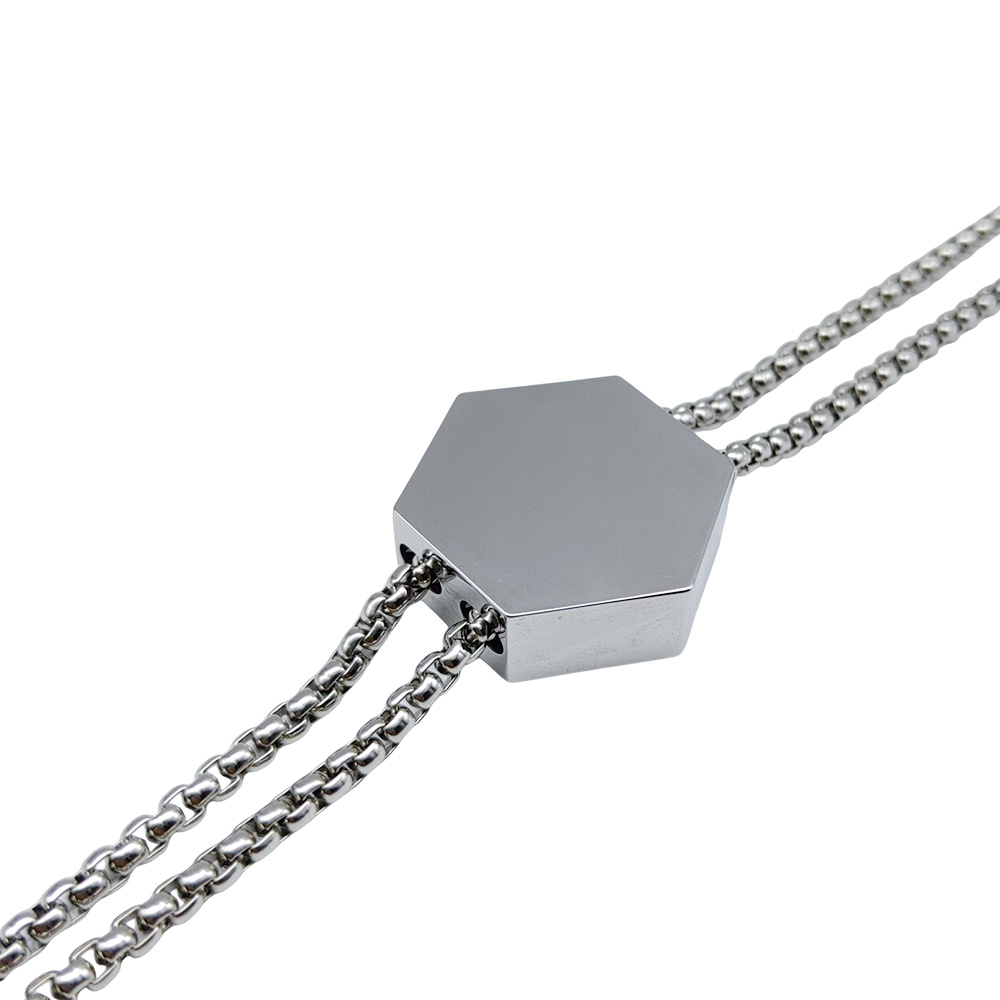
The confirmed base material for this product is zinc alloy. The specified surface treatment is silver electroplating. These are separate specification items: the material identifies the base metal, while the surface treatment describes the finish applied to the part. They should not be combined into a claim that the product is made entirely from silver.
For an OEM project, buyers should approve the appearance of the plated surface under consistent lighting. Silver-tone finishes can appear different under warm indoor lighting, cool daylight, or photography lights. A physical color reference is more reliable than comparing separate images captured under different conditions. The approved sample should define the acceptable appearance for subsequent production.
During development, the buyer and supplier should agree on the intended use, target appearance, inspection method, and any required finish tests. If corrosion screening is part of the purchasing specification, the parties can define a suitable test plan. ASTM B117 describes a salt spray testing practice, but a reference to the method does not mean this product has been tested or passed it. Buyers can review the standard through the official ASTM B117 page and specify acceptance criteria separately.
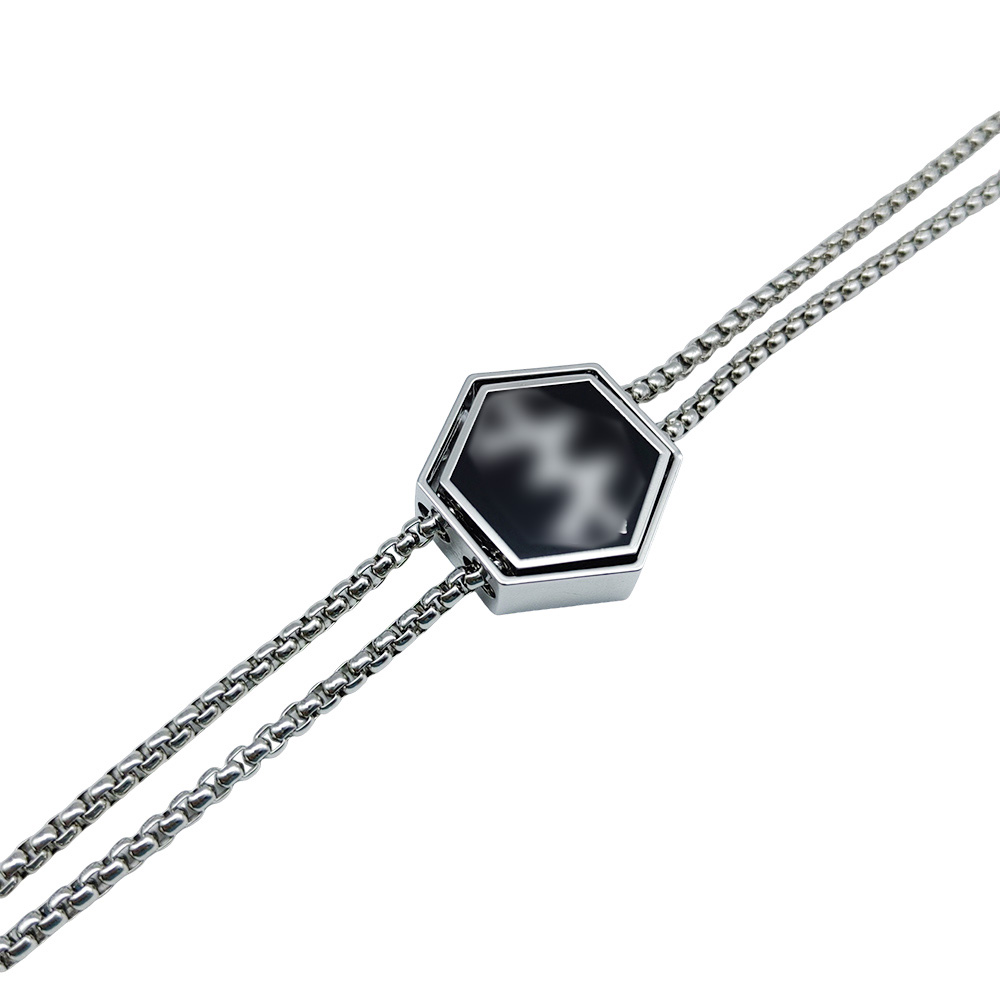
The defining engineering feature is the relationship between the box chain and the press-release slider. A box chain has a particular link profile, and the slider’s internal passage must accommodate that profile while allowing the intended movement. The confirmed chain length is 55 cm, but length alone does not establish compatibility. Chain width, link geometry, surface condition, and the slider’s internal clearance also affect how the assembly behaves.
These checks are proposed inspection steps, not claims that the product has already passed them. The required number of operating cycles, acceptable adjustment force, and retention criteria remain project-specific and should be agreed before production approval.
Do not approve the chain from one sample and the slider from another without testing them as an assembled unit. Even when both components appear correct individually, their interaction can differ after assembly. During prototype development, use the specified box chain with the actual slider and confirm the full adjustment range, locking behavior, and surface condition. Record the approved combination as the reference sample for subsequent QC inspection.
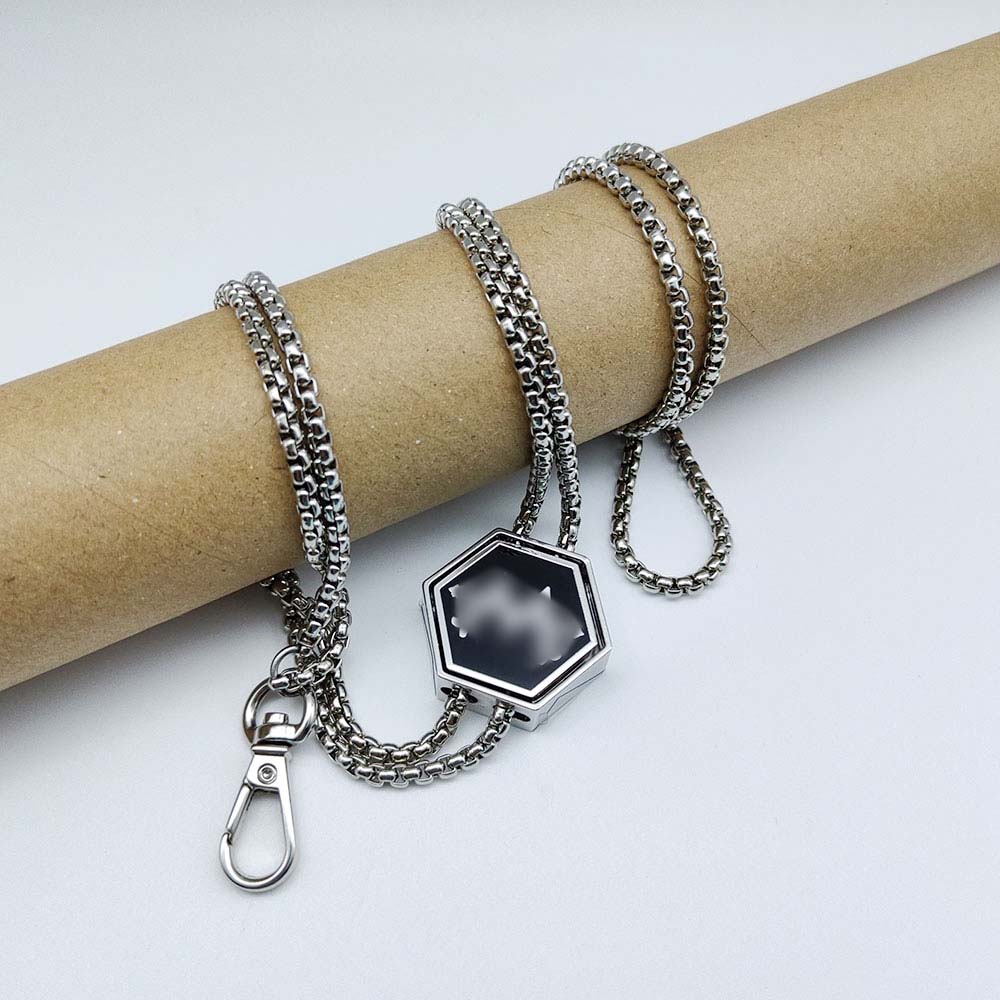
The following comparison focuses on design decisions rather than claiming that one construction is universally superior. The alternatives are general sourcing options; they are not confirmed variants currently offered for this specific product.
| Evaluation Factor | Current Product Specification | Alternative to Discuss | Buyer Decision Point |
|---|---|---|---|
| Chain profile | Box chain | Another chain profile selected for the design | Confirm visual style and slider compatibility. |
| Chain length | 55 cm | A different project-specific length | Approve the finished length and measurement method. |
| Base material | Zinc alloy | Another material, if technically feasible | Compare design needs, weight target, cost, and process compatibility. |
| Surface treatment | Silver electroplating | Another agreed finish | Approve color reference and testing requirements. |
| Adjustment method | Press-release slider | A different adjustment construction | Evaluate usability, retention, and mechanical complexity. |
| Center design | Geometric pendant with black center appearance | A revised shape or visual treatment | Confirm panel material, dimensions, and appearance. |
| End connector | Rotating connection and trigger-operated hook visible in the reference | A connector chosen for the target attachment point | Confirm exact connector type and compatibility. |
| Application | Necklace and compatible bag charm use | A single-purpose design | Decide whether one configuration meets both use cases. |
| Quality reference | To be established during sample approval | A project-specific inspection plan | Define visual, functional, and dimensional acceptance criteria. |
| Packaging | Standard export packaging or an agreed custom option | Retail-ready or brand-specific packaging | Confirm protection, presentation, and packing requirements. |
For buyers comparing a Zipper Slider Necklace with other adjustable jewelry constructions, the name alone is not enough to establish mechanical equivalence. Confirm how the slider releases, how it holds the selected position, and how the chain passes through the mechanism. Product terminology varies between sellers, so functional verification is more useful than relying on a title alone.
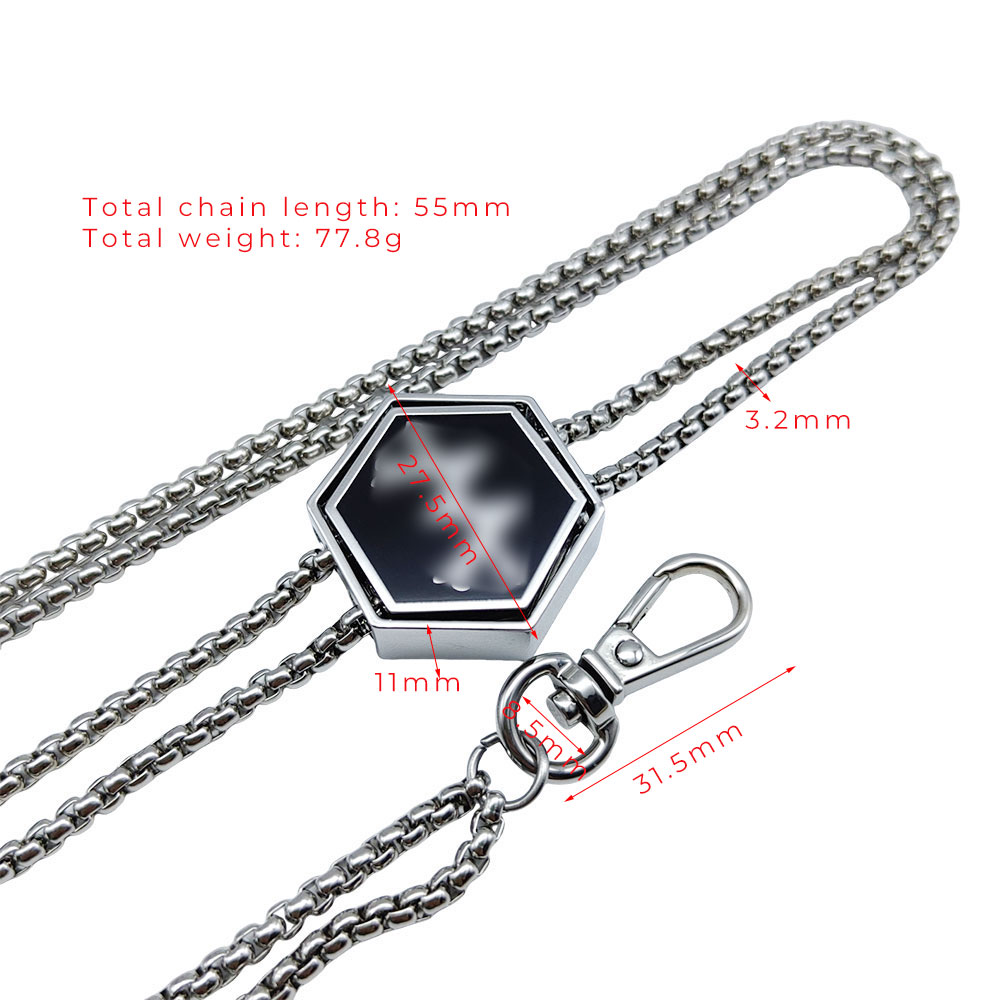
The confirmed chain length is 55 cm. Other dimension labels visible in the supplied reference image are not yet validated against a technical drawing. Before the drawing is used for quotation, tooling, or incoming inspection, the buyer and supplier should agree on what each measurement represents and where it is taken.
| Dimension or Data Point | Current Status | Review Requirement |
|---|---|---|
| Chain length | 55 cm confirmed | Confirm whether measured laid straight, end to end, or by another agreed method. |
| Pendant dimension marked 27.5 mm | Image marking only | Confirm the measured direction and reference points. |
| Pendant thickness marked 11 mm | Image marking only | Confirm whether this represents thickness, depth, or another dimension. |
| Chain width marked 3.2 mm | Image marking only | Confirm the measurement method and actual chain profile. |
| Clasp length marked 31.5 mm | Image marking only | Confirm the exact end connector and measurement points. |
| Connector ring marked 8.5 mm | Image marking only | Confirm whether this is an outer, inner, or nominal dimension. |
| Product weight marked 77.8 g | Image marking only | Verify by weighing the complete approved assembly. |
A technical drawing should identify the datum points, units, tolerances, and any critical fit dimensions. If the slider channel is a functional interface, its clearance and relationship to the chain should receive particular attention. Avoid using an image label as a manufacturing tolerance: a nominal dimension and an allowable tolerance serve different purposes.
Visible pendant dimensions are useful for design approval, while the slider channel, chain profile, connector opening, and assembly interfaces determine function. Mark critical dimensions separately on the drawing. Where a dimension affects movement or retention, agree on the measurement method and acceptance range before tooling or bulk production. Exact tolerances cannot be responsibly assigned until the design and manufacturing process have been reviewed.
DG Buddy approaches OEM development as a specification review rather than a promise that every change can be made without affecting the mechanism. For this product, the confirmed starting point is a 55 cm zinc alloy box chain with silver electroplating and a press-release slider. Changes to the chain profile, slider geometry, pendant appearance, or connector may affect assembly compatibility and should be evaluated together.
Custom logo details, color changes, and material changes can be discussed, but feasibility depends on the design and the required process. The center panel material and exact connector type remain open items. They should be finalized before a production drawing or definitive quotation is treated as approved.
These standard timeframes should be reconfirmed against the approved design, sample requirements, order quantity, and shipping arrangement. Sample time refers to custom or developed samples; it should not be treated as a guarantee for every project without a review of the requirements.
MOQ depends on how the item is classified and quoted. This product combines a chain with an individual adjustment mechanism and connector assembly. Its final MOQ category has not been confirmed, so a buyer should request written confirmation rather than assume a chain-based or individual-hardware quantity.
The standard packaging specification is Pearl Foam + OPP Bag + Export Carton or Customized Packaging. For a product with a moving slider and exposed plated surfaces, the packaging review should consider whether parts can rub against one another in transit. If a brand-specific presentation pack is required, share its dimensions, labeling, and packing instructions before final quotation.
A practical inspection plan should connect the customer’s approved requirements to observable checks. It should not rely on a general claim of quality. For this adjustable slider necklace, the first sample review can be organized into appearance, dimensions, function, assembly, and packaging.
| Inspection Area | Suggested Check | Acceptance Basis |
|---|---|---|
| Appearance | Inspect visible plating, surface marks, edges, and the center pendant. | Approved physical sample and agreed visual criteria. |
| Dimensions | Measure the confirmed chain length and verify other drawing dimensions. | Approved technical drawing and tolerances. |
| Slider function | Press, adjust, release, and observe position retention. | Agreed operating and locking criteria. |
| Chain compatibility | Check movement through the slider without abnormal snagging or visible damage. | Approved sample behavior and agreed inspection method. |
| Connector operation | Check opening, closing, rotation, and assembly where applicable. | Confirmed connector design and project requirements. |
| Packaging | Check whether components are protected from rubbing and movement. | Approved packing instructions. |
During supplier evaluation, ask how the approved sample is retained as a reference, how changes are recorded, and who signs off on deviations. If the chain, slider, or finish changes after approval, the updated assembly should be reviewed before the change is accepted for production.
As a necklace, the product combines the 55 cm box chain with a geometric center pendant and a visible adjustment mechanism. The black center appearance contrasts with the silver-tone metal finish. The adjustment feature can support styling flexibility, but the actual usable adjustment range has not been provided and should be confirmed through sample evaluation.
For bag charm use, compatibility depends on the intended attachment point, the connector geometry, and the way the complete assembly will be handled. The presence of a hook does not establish a rated load capacity or suitability for safety-critical use. Buyers should assess the actual application and avoid specifying the item for a load-bearing purpose unless appropriate performance requirements have been established and verified.
A Bag Charm Chain with Clasp can serve a different visual and functional role from a necklace, even when the two products share chain components. If the same product is intended for both uses, include both use cases in the design brief and test the complete assembly against the requirements of each application.
Buyers developing a coordinated accessory collection may also need matching connection hardware or decorative metal components. The following links lead to related DG Buddy product areas that can support broader sourcing discussions.
Related categories are intended as complementary sourcing resources, not as a claim that every linked item is interchangeable with this product. Confirm dimensions, connection geometry, materials, and finish before combining components in one assembly.
DG Buddy works with buyers who need metal hardware specifications translated into a workable OEM project. The useful starting point is a clear brief: reference images or drawings, target quantity, material and finish requirements, functional expectations, and the intended application. With those inputs, the project team can review which details are already defined and which require sampling or engineering confirmation.
For this design, the confirmed starting specification is a 55 cm zinc alloy box chain with silver electroplating and a press-release slider. The center panel material, exact connector type, drawing dimensions beyond chain length, and MOQ classification remain to be confirmed. Keeping those points visible makes the quotation process more reliable and reduces the risk of approving a product that only resembles the reference image.
DG Buddy offers nearly 20 years of manufacturing experience and supports OEM customization. Free stock samples available; custom sample fees fully deductible from bulk orders. Custom sample fees are credited according to the stated sample policy, and courier charges are borne by the customer.
The confirmed chain length is 55 cm. The finished-length measurement method should be agreed for the technical drawing and incoming inspection.
Zinc alloy is the confirmed material specification. The material of the black center panel has not been confirmed and should be documented before final approval.
The mechanism is intended to release the slider when pressed, allowing its position to be adjusted, and to engage its locking function when released. Buyers should verify movement and position retention on the actual sample.
Yes. Silver electroplating is the confirmed surface treatment for this product. Plating thickness, layer structure, and performance test results have not been provided.
Both are intended applications. Suitability depends on the attachment point and the requirements of the specific use. No load rating or safety-critical performance claim is established by the current specification.
The MOQ classification has not been confirmed because the product combines a chain with a slider and connector assembly. Please request confirmation of the applicable quantity and pricing basis in the quotation.
OEM customization can be discussed for the chain, visible design, color, and selected components, subject to feasibility. The exact customization scope should be confirmed against the drawing, sample, and project requirements.
We maintain quality certification documentation and are happy to provide the current valid certificates upon request during your sourcing evaluation.
If you already have a technical drawing, share it with the required quantity, target finish, application, and any functional criteria for the slider. If you are still evaluating the design, a reference sample or annotated image can help establish the chain dimensions, connector type, and appearance requirements.
Before the quotation is finalized, DG Buddy recommends confirming the center panel material, exact connector specification, remaining drawing dimensions, product weight, MOQ classification, and sample acceptance criteria. This gives both sides a clear basis for development, inspection, and bulk-order approval.
Contact DG Buddy about your OEM project to discuss the approved specification, sampling requirements, and next steps.