
10 Things Professional Bag Brands Check Before Buying Luxury Bag Hardware
Professional bag brands rarely choose luxury bag hardware based on appearance alone. Before placing OEM or bulk orders, buyers usually inspect plating consistency, structural durability, material composition, testing standards, and production stability. Missing even one detail can lead to peeling finishes, broken clasps, color inconsistency, or expensive customer returns.
Table of Contents
- Why Professional Brands Inspect Hardware So Carefully
- 1. Base Material Composition
- 2. Electroplating Quality
- 3. Salt Spray Resistance
- 4. Structural Strength and Load Capacity
- 5. Surface Polishing Details
- 6. Color Consistency Across Production Batches
- 7. Mold Precision and Assembly Accuracy
- 8. Scratch and Wear Resistance
- 9. OEM Production Stability
- 10. Packaging and Shipment Protection
- Factory Experience: Problems Buyers Usually Discover Too Late
- How Buyers Reduce Luxury Hardware Purchasing Risks
- Final Thoughts
- FAQ
Why Professional Brands Inspect Hardware So Carefully
In premium handbags, hardware often becomes the first visible sign of product quality. End customers may forgive minor stitching variation, but they quickly notice fading logos, weak swivel hooks, rough zipper pulls, or uneven plating colors.
For many bag brands, hardware-related complaints usually appear within the first three months after products reach stores. Common problems include:
- Electroplating peeling after humidity exposure
- Spring hooks losing tension
- Logo plates changing color
- Scratches caused during transportation
- Different gold tones between batches
- Broken clasps on heavy leather bags
This is why experienced sourcing teams spend significant time evaluating luxury bag hardware suppliers before approving mass production.
1. Base Material Composition
The first thing professional buyers usually confirm is the actual base material.
Many suppliers advertise hardware as “premium metal,” but experienced buyers ask specific questions:
- Is it zinc alloy, brass, stainless steel, or aluminum?
- What is the exact alloy grade?
- Does the material contain excessive recycled metal?
- Can the supplier provide SGS or material reports?
Zinc alloy remains common in luxury bag hardware because it supports detailed die casting and lower tooling costs. However, poor-quality zinc alloy can contain impurities that create plating bubbles or surface pits.
Brass offers better durability and plating adhesion, especially for luxury logos and locks, but material cost is significantly higher.
Stainless steel provides strong corrosion resistance but increases machining difficulty and polishing time.
Many premium brands actually use different materials for different components instead of relying on one metal type.
2. Electroplating Quality
Electroplating quality directly affects how hardware looks after six months of use.
Professional buyers normally evaluate:
- Plating thickness
- Adhesion strength
- Color uniformity
- Fingerprint resistance
- Edge coverage
- Anti-oxidation coating
One common factory issue is that samples receive better plating than bulk orders. Some suppliers increase plating thickness only for approval samples to reduce later production costs.
Experienced buyers often cut open plated samples or request cross-section thickness testing.
For high-end luxury bag hardware, vacuum plating and multi-layer electroplating are increasingly common because they improve wear resistance and color stability.
Typical Premium Plating Structure
| Layer | Purpose |
| Copper Layer | Smooth surface preparation |
| Nickel Layer | Corrosion resistance |
| Color Layer | Gold, gunmetal, silver, black finish |
| Top Protective Coating | Scratch and oxidation resistance |
3. Salt Spray Resistance
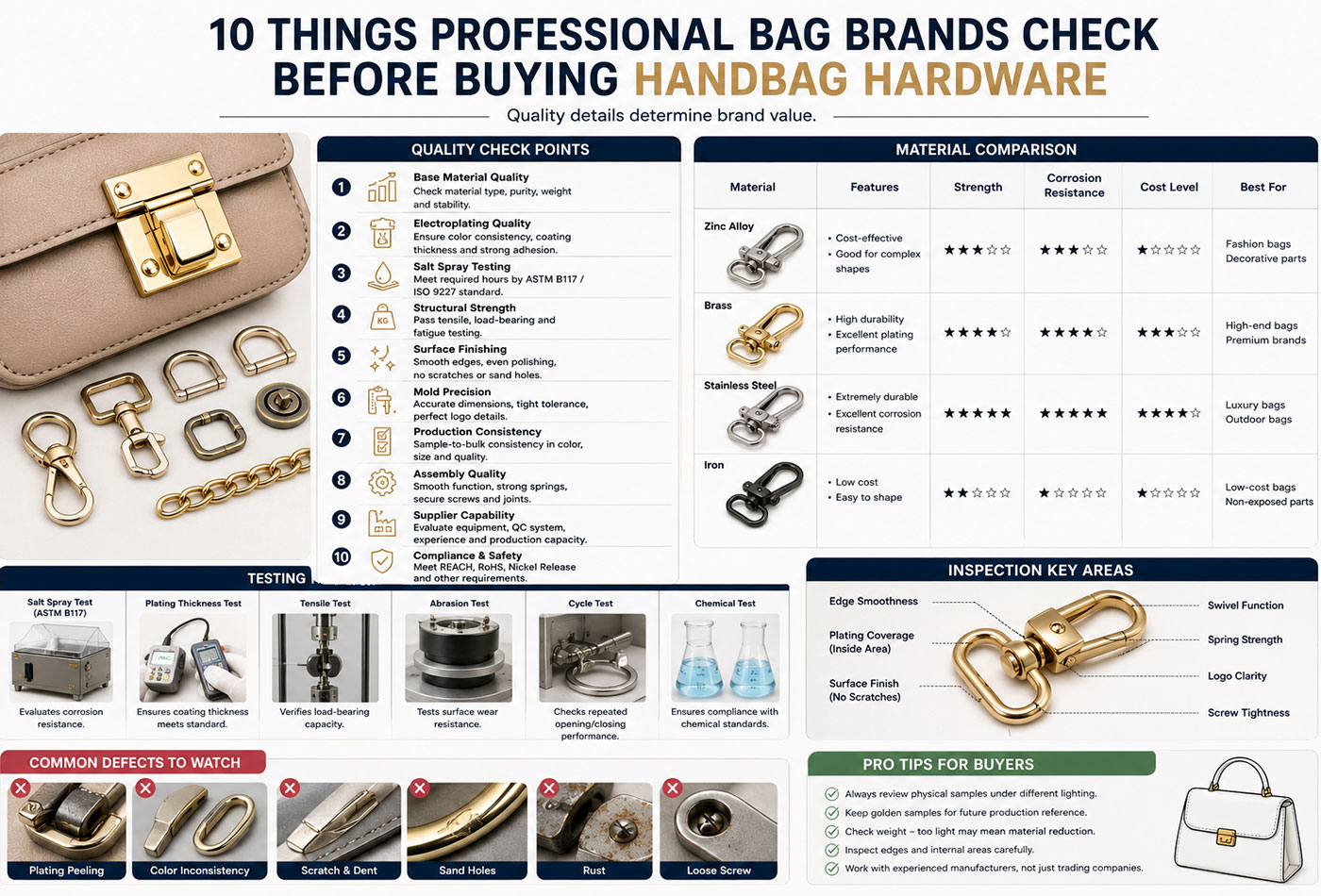
Professional brands usually request salt spray testing before approving bulk production.
Salt spray testing helps simulate long-term exposure to moisture, sweat, humidity, and transportation environments.
In handbag accessories, lower-grade plating sometimes fails within 24 hours.
Higher-end luxury bag hardware often targets:
- 24–48 hours for standard fashion products
- 72–96 hours for premium handbag collections
- More than 100 hours for export luxury projects
However, buyers should understand that extremely high salt spray results do not automatically guarantee better visual quality. Excessive protective coatings can slightly affect color richness.
Experienced factories balance appearance and durability instead of chasing unrealistic laboratory numbers.
4. Structural Strength and Load Capacity
Many bag hardware failures are structural rather than cosmetic.
Heavy leather bags place continuous stress on:
- Swivel hooks
- D-rings
- Magnetic locks
- Chain connectors
- Handle bridges
Professional brands usually perform repeated opening, pulling, and rotation tests.
Weak die-cast structures often crack near thin corners or sharp internal angles.
Factories with real production experience usually redesign hidden internal structures to improve durability without changing the visible appearance.
For example, increasing inner radius transitions inside hooks can significantly reduce cracking risks during repeated stress cycles.
5. Surface Polishing Details
Surface finishing quality strongly affects perceived product value.
Buyers carefully inspect:
- Sharp edges
- Polishing marks
- Sand holes
- Mold lines
- Uneven reflections
- Corner roughness
In many factories, polishing quality depends heavily on worker experience.
Even with automated polishing machines, manual finishing is still necessary for many complex luxury bag hardware components.
This becomes especially important for mirror-finish gold hardware because defects become more visible under retail lighting.
6. Color Consistency Across Production Batches
One of the biggest problems for global handbag brands is plating color inconsistency.
A gold tone approved in March may look different in July if:
- Chemical formulas changed
- Plating temperature shifted
- Different factories handled production
- Raw material composition changed
- Production lines aged
Professional sourcing teams usually keep approved “master samples” for future comparison.
Reliable luxury bag hardware suppliers also maintain plating batch records and color control standards.
This is especially important for brands producing repeat seasonal collections.
7. Mold Precision and Assembly Accuracy
Luxury brands often reject hardware because of small assembly issues that average buyers may overlook.
Typical inspection points include:
- Logo alignment
- Lock symmetry
- Spring response consistency
- Gap uniformity
- Rotation smoothness
- Screw fit accuracy
Poor mold precision usually creates unstable assembly tolerances.
In mass production, even a 0.2 mm deviation can affect closure alignment or create abnormal noise during use.
Factories producing stable luxury bag hardware usually invest heavily in mold maintenance rather than only focusing on new tooling.
This is why many brands choose professional bag hardware suppliers to ensure consistent quality.
8. Scratch and Wear Resistance
Retail customers frequently touch handbag hardware, especially locks and logo plates.
Low-quality surfaces can quickly develop:
- Finger abrasion
- Micro scratches
- Color fading
- Corner wear
Professional buyers often perform simple real-world tests instead of relying only on lab reports.
Common methods include:
- Repeated cloth rubbing
- Artificial sweat testing
- Alcohol wipe testing
- Bag friction simulation
- Repeated opening cycles
Factories with long OEM experience understand that laboratory performance and actual consumer usage can differ significantly.
9. OEM Production Stability
Many suppliers can make attractive samples.
Far fewer can maintain stable quality across 50,000 pieces.
This is where professional brands pay close attention to factory systems:
- Incoming material inspection
- In-process QC
- Plating inspection records
- AQL standards
- Production traceability
- Packaging procedures
One common issue in luxury bag hardware production is subcontracted plating. Some factories outsource plating to multiple workshops, which creates major color variation risks.
Experienced buyers usually ask whether plating is handled in-house or externally.
10. Packaging and Shipment Protection
Even perfectly produced hardware can arrive damaged if packaging protection is poor.
Common shipment-related problems include:
- Metal-to-metal scratches
- Humidity oxidation
- Pressure deformation
- Mixed color contamination
Professional suppliers usually separate hardware using:
- Individual poly bags
- Protective tissue wrapping
- Anti-tarnish paper
- Vacuum packaging
- Layered cartons
For mirror-finish luxury bag hardware, packaging sometimes becomes as important as production itself.
Factory Experience: Problems Buyers Usually Discover Too Late
Many sourcing problems only appear after mass production starts.
One common example involves logo plates with deep engraving. During sample approval, the plating looks smooth because quantities are small. During mass production, deeper logo corners may trap polishing residue or plating chemicals, creating black spots later.
Another frequent issue involves heavy bag chains. Some suppliers reduce internal wall thickness to lower material costs while keeping the external appearance identical. The weakness only becomes visible after customers use the bags for several weeks.
Factories with real OEM experience usually identify these risks before tooling approval.
This is why experienced buyers spend time reviewing engineering drawings instead of only checking appearance samples.
How Buyers Reduce Luxury Hardware Purchasing Risks
Professional sourcing teams usually follow several practical rules:
- Never approve production based only on photos
- Request material and plating reports
- Compare sample quality against bulk production
- Perform independent durability testing
- Inspect packaging standards before shipment
- Confirm whether plating is outsourced
- Keep approved color reference samples
- Review factory QC procedures carefully
For long-term projects, stable communication with the luxury bag hardware supplier often matters more than achieving the lowest unit price.
Factories focused only on low pricing usually reduce hidden production costs first, especially plating thickness, polishing labor, or QC inspection time.
Final Thoughts
Professional handbag brands rarely judge hardware by appearance alone. Durable luxury bag hardware depends on material selection, plating stability, structural engineering, polishing quality, and disciplined production control.
Most costly problems in handbag production do not come from dramatic factory failures. They come from small overlooked details repeated across thousands of units.
For brands planning OEM or private label projects, careful supplier evaluation before tooling approval usually prevents far more problems than post-production inspections later.
If you are sourcing custom bag fittings, logo hardware, chains, hooks, or metal accessories for premium bags, discussing production methods and quality standards early can significantly reduce return risks and improve long-term product consistency.
FAQ
What material is best for luxury bag hardware?
Brass offers excellent durability and plating adhesion, while zinc alloy provides better casting flexibility and lower tooling cost. Many premium brands use both materials depending on the component.
How many hours of salt spray testing are recommended for premium bag hardware?
Most premium handbag projects target 48–96 hours depending on product positioning, shipping environments, and customer usage expectations.
Why does handbag hardware plating peel after several months?
Common causes include poor base material quality, insufficient plating thickness, weak polishing preparation, or inconsistent electroplating processes.
How can buyers check if bulk production matches approved samples?
Buyers usually compare plating color, weight, polishing details, structural dimensions, and perform random durability testing during mass production inspection.
Why do luxury brands care so much about hardware packaging?
High-gloss metal surfaces scratch easily during transportation. Proper packaging prevents oxidation, friction damage, and color contamination before assembly.
If you are developing a new collection or looking for stable OEM manufacturing support:
For pricing and sampling:
According to the official testing standards published by ASTM International, salt spray and corrosion resistance testing play an important role in evaluating metal coating durability for fashion accessories and industrial components: ASTM International Metal Testing Standards