
In the past two years, we’ve received more repeat inquiries about one issue than anything else:
“Why did this buckle change color so fast?”
It’s not a complicated question. But the real answer isn’t something most suppliers will say directly.
We manufacture handbag hardware every day — buckles, rings, push locks, logo plates, chains. Same drawings, similar plating colors, similar prices on the surface. But the durability gap between different factories can be huge.
Let’s talk about what actually causes hardware to fail early.
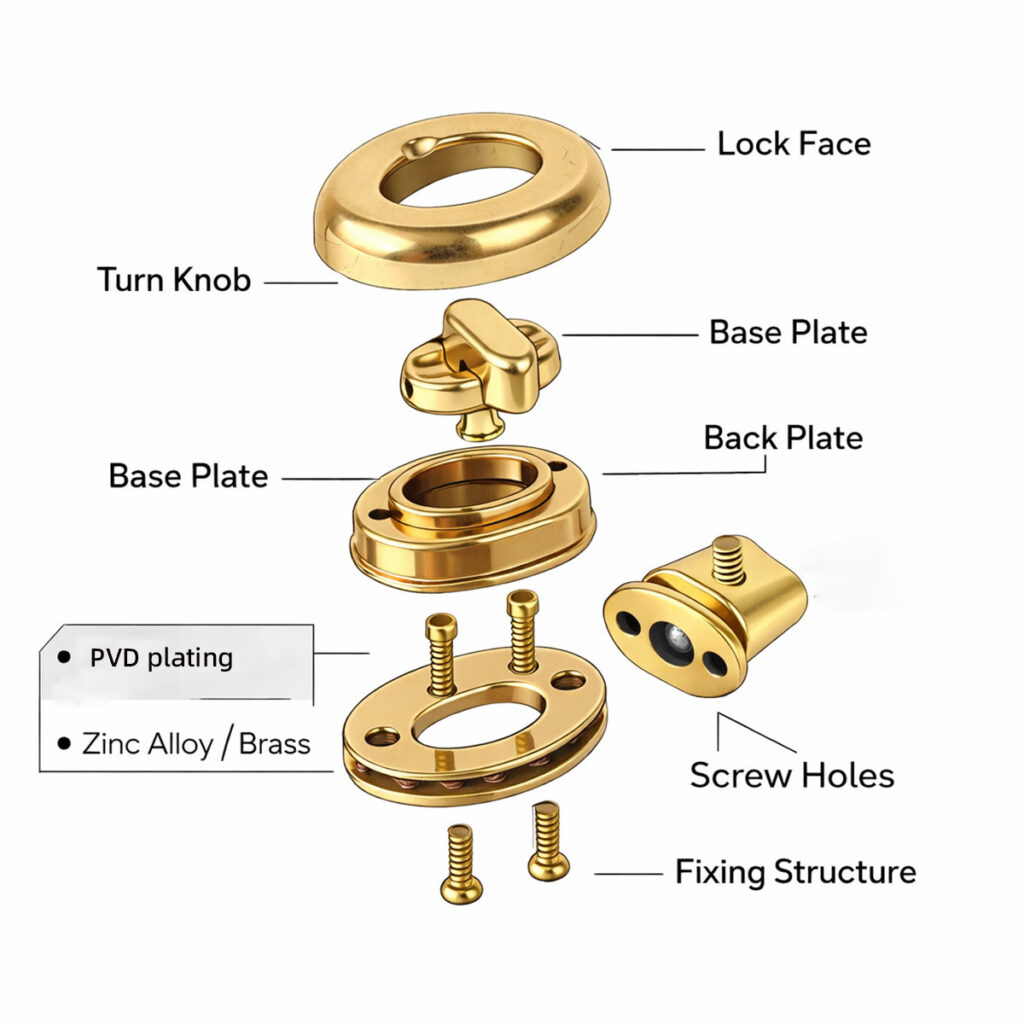
1. It’s Usually Not the Color — It’s the Base Material
When customers see fading or black spots, they often blame the plating. In reality, plating is only the surface. If the zinc alloy underneath is unstable, no coating can fully protect it.
Low-grade zinc alloy often contains:
- Excess recycled scrap
- High lead content
- Impurities that create internal porosity
When the internal structure is porous, moisture enters easily. Once that happens, oxidation starts from inside. You won’t see it on day one — but three months later, discoloration appears.
We’ve cut open failed buckles from the market before. Under the microscope, you can clearly see air holes inside the casting. That’s where problems begin.

2. Electroplating Thickness Is Rarely What It Claims
Many suppliers advertise “thick plating.” But how thick is thick?
Standard decorative plating for handbag hardware is usually between:
- 0.03–0.05 μm for basic finish
- 0.08–0.12 μm for better corrosion resistance
- Higher if it’s premium or export-level
If the plating is too thin, sweat, humidity, and friction will break through quickly.
The difficult part? You cannot judge thickness by color. Two gold buckles can look identical under studio lighting. Only salt spray testing or thickness measurement will tell the truth.
We routinely run 48–72 hour salt spray tests for export orders. It’s not expensive, but many small workshops skip it to save time.
3. Polishing Matters More Than People Think
Before plating, hardware must be polished. If the surface has micro scratches or ripple lines, plating will not fully bond.
Rough polishing causes:
- Uneven coating
- Peeling at corners
- Early fading on edges
Good polishing takes time and labor. Automated tumbling helps, but experienced manual inspection still matters.
In our workshop, edge rounding and surface smoothing are checked twice before parts move to plating. It slows production slightly, but reduces after-sales issues.
4. Sweat Is More Aggressive Than Rain
One interesting pattern we noticed: products used in hot climates fail faster — especially metal chains and logo plates.
Human sweat contains salt and acid. If hardware contacts skin regularly (crossbody chains, waist buckles, decorative plates), plating quality becomes critical.
For brands selling in Southeast Asia, Middle East, or coastal areas, upgrading plating specification is often worth the small cost increase.
5. Price Gaps Usually Reflect Process Control
Buyers often ask why similar-looking hardware can differ by 20–30% in price.
From factory perspective, cost differences usually come from:
- Raw zinc alloy grade
- Polishing time
- Plating thickness
- Quality inspection frequency
- Rejection rate tolerance
If a factory allows more minor defects to pass, they save cost immediately. If they scrap imperfect parts, cost rises — but consistency improves.
There’s no mystery. It’s mostly discipline.
6. What We Suggest to Brand Owners
If you’re sourcing handbag hardware or custom metal logo plates, here are practical steps:
- Request salt spray test data for your exact finish.
- Ask for base material specification.
- Compare edge finishing quality, not just surface shine.
- Keep one sample aside and monitor it for 3 months before bulk reorder.
- Avoid choosing purely by the lowest quote.
Hardware is a small part of a bag’s cost — but it strongly affects perceived quality.
We’ve seen $500 retail bags returned because a $0.40 buckle changed color.
Final Thought
Good metal hardware isn’t about making it look shiny on day one.
It’s about how it looks after being carried daily, touched by hands, exposed to weather, and stored in humid closets.
In our factory, we always tell new clients:
“If you want the lowest price, many suppliers can help you.
If you want stable repeat orders, process control is more important than price.”
If you are developing a new collection or looking for stable OEM manufacturing support:
For pricing and sampling:
And in the long run, stability usually costs less.