
What Is Nickel-Free Handbag Hardware? EU REACH Compliance Guide
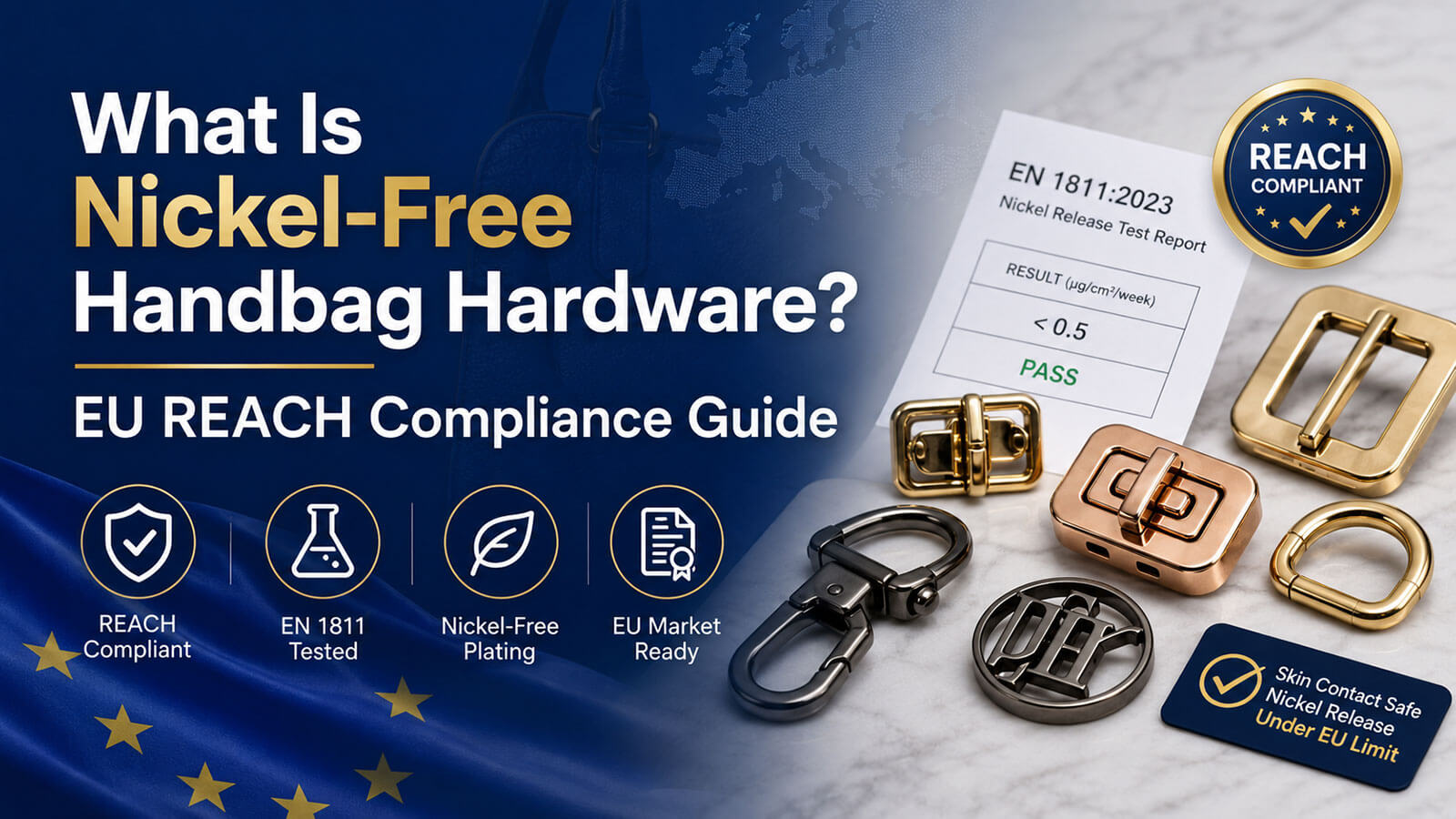
Every season, some EU-bound shipment gets flagged at customs or picked apart in a retailer’s compliance audit over one issue: nickel release from metal trims. Buckles, D-rings, logo plates, and turn locks sit against skin for hours at a time, which is why nickel-free handbag hardware isn’t optional for brands selling into Europe — it’s a legal requirement tied to a specific EU regulation, with a specific test method behind it. This guide explains what nickel-free handbag hardware actually means, how the REACH nickel restriction works, and what a factory has to control in production to pass it.
Quick Answer
Nickel-free handbag hardware is metal hardware whose nickel release stays under the migration limit set by REACH Annex XVII, Entry 27: 0.5 micrograms per square centimeter per week for items in prolonged skin contact, and 0.2 µg/cm²/week for posts inserted into pierced body parts. It doesn’t mean zero nickel content — it means the finished part passes the EN 1811 nickel test measured under this migration limit.
Key Takeaways
- ✔ Nickel-free handbag hardware is defined by a migration limit, not a zero-nickel guarantee
- ✔ The controlling law is the REACH nickel restriction (Annex XVII, Entry 27) — not RoHS
- ✔ Compliance is proven with an EN 1811 nickel test, not a verbal claim
- ✔ Nickel-free zinc alloy is the standard low-risk base metal for die-cast hardware
- ✔ The nickel strike layer under gold or rose gold plating is the most common failure point
- ✔ A reliable nickel-free hardware supplier tests every finish variant, not just one SKU per collection
Table of Contents
- What Is Nickel-Free Hardware?
- The REACH Nickel Restriction Explained
- How to Test for Nickel-Free Hardware: EN 1811
- Does Zinc Alloy Contain Nickel? Material and Plating Sources
- Comparison: Base Metal and Plating Options
- Is RoHS Required for Handbag Hardware?
- Pros and Cons of REACH Compliant Hardware
- Common Mistakes When Choosing a Nickel-Free Hardware Supplier
- Factory Expert Tips: Controlling Nickel Release in Production
- Expert Recommendation
- Conclusion
- FAQ
What Is Nickel-Free Hardware?
What is nickel-free hardware, exactly? It’s a compliance term, not a chemistry term. Almost no die-cast or plated metal component is 100% free of nickel atoms — zinc alloy, brass, and steel can all carry trace nickel from raw ore or recycled scrap. What EU law restricts is how much nickel migrates from the surface onto skin, not whether a single atom of nickel exists anywhere in the part.
This distinction matters for buyers. A supplier who claims “nickel-free” without a lab report is making an unverifiable claim. A supplier who can produce a test result under the legal limit has actually proven it — and can back the claim if a retailer or customs authority ever asks.
The REACH Nickel Restriction Explained
The REACH nickel restriction is set out in Annex XVII, Entry 27, covering nickel metal and its compounds (CAS No. 7440-02-0). It has applied since 2013 and grew out of the earlier EU Nickel Directive. It’s a restriction, not an SVHC listing — nickel doesn’t appear on the REACH Candidate List of Substances of Very High Concern, which is a separate mechanism for substances requiring authorization. Buyers sometimes conflate the two, but for handbag hardware, Entry 27 is the rule that actually applies.
The restriction sets two limits, both tied to how much nickel migrates from the article’s surface, not how much nickel the alloy contains overall. Items in direct, prolonged skin contact — buckles, bag chains, rivet buttons, zip pulls — must stay under 0.5 µg/cm²/week. Posts inserted into pierced body parts have a tighter 0.2 µg/cm²/week limit. Any plated coating also has to hold that limit for at least two years of normal wear, so coating durability is part of the legal requirement, not just an appearance concern.
Knowledge Box: Migration vs. Content
What: REACH measures how much nickel leaches out of the metal into an artificial sweat solution, not the raw nickel percentage in the alloy. Why: Regulators care about what actually reaches skin over time, since that’s what triggers a nickel allergy. How: A lab immerses the part, or a representative section of it, in synthetic sweat for one week and measures nickel concentration released, expressed as a migration limit in µg/cm²/week.
How to Test for Nickel-Free Hardware: EN 1811
How do you test for nickel-free hardware in practice? Compliance with Entry 27 is demonstrated using EN 1811:2023, the current harmonized reference method, which replaced the earlier 2011 version. The update changed the reported unit to µg·cm⁻²·week⁻¹, added rules for masking non-relevant surfaces with wax or lacquer, and clarified that assemblies with multiple components must have each part tested individually.
That last point catches a lot of first-time buyers off guard. A logo plate might pass, while the small rivet holding it in place fails — and the whole assembly is non-compliant because of the rivet. A proper EN 1811 nickel test report specifies exactly which sub-parts were tested, not just one pass/fail line for the finished product.
Does Zinc Alloy Contain Nickel? Material and Plating Sources
Does zinc alloy contain nickel? Not as an intentional alloying element. Zamak, the zinc-aluminum-magnesium-copper alloy used in most die-cast handbag hardware, isn’t formulated with nickel, which is why nickel-free zinc alloy is the standard starting point for compliant hardware programs. The real risk usually sits in the plating stack applied on top of the casting, not the base metal itself.
Knowledge Box: The Nickel Strike Layer
What: Many gold, rose gold, and antique finishes use a thin nickel layer under the top coat to improve adhesion and brightness. Why: This nickel strike layer, not the zinc or brass base, is the most common source of a failed nickel test once the top coat wears thin. How: Compliant nickel-free plating substitutes a nickel-free tie layer, such as copper or a proprietary nickel-free undercoat, before the decorative finish goes on. See our handbag hardware plating types guide for how nickel, chrome, PVD, and chemical-nickel finishes compare.
Knowledge Box: PVD Coating as a Nickel-Free Alternative
What: PVD coating is a vacuum-deposited finish rather than an electrochemical one. Why: Because it doesn’t rely on a nickel strike layer for adhesion, PVD can achieve compliant gold and gunmetal tones without that failure point. How: Our PVD vs electroplating comparison covers the durability and cost tradeoffs between the two processes in more detail.
Comparison: Base Metal and Plating Options
| Option | Nickel Risk | Typical Use |
| Nickel-free zinc alloy (Zamak) with nickel-free plating | Low | Buckles, rings, logo plates, locks |
| Brass with nickel-free plating | Low–Moderate | Chains, premium buckles, rivets |
| Standard nickel-strike gold plating | High | Low-cost decorative finishes (non-compliant for EU) |
| Stainless steel (304/316) | Low | Zipper pulls, snap hooks, high-wear parts |
| PVD-coated hardware | Low | High-durability gold/gunmetal finishes for premium bags |
PVD coating is worth calling out specifically: because it’s a vacuum-deposited finish rather than an electrochemical one, it can achieve nickel-free gold and gunmetal tones without relying on a nickel strike layer at all. Our PVD vs electroplating comparison covers the durability and cost tradeoffs in more detail.
Browse the hardware catalog
Download our full product catalog to explore styles, materials, and specifications for all hardware collections.
⬇ Download catalogCustom OEM manufacturing
Need a unique design? We offer full OEM customization — your logo, finish, and specifications on any hardware.
→ Learn about OEMIs RoHS Required for Handbag Hardware?
Is RoHS required for handbag hardware? No — and this is where a lot of sourcing documents get it wrong. RoHS (Directive 2011/65/EU) restricts substances like lead, cadmium, and mercury, but its scope is electrical and electronic equipment — circuit boards, cables, connectors. A metal buckle or bag chain isn’t electrical equipment, so RoHS doesn’t apply to it.
The regulation that actually governs REACH compliant hardware for bags is REACH itself — specifically the nickel restriction covered above, plus separate REACH restrictions on lead and cadmium in similar accessory categories. Some buyers still ask suppliers for a “RoHS certificate” out of habit; a supplier who understands the distinction should redirect them to the correct REACH test report instead of just going along with the wrong request.
Pros and Cons of REACH Compliant Hardware
Pros: Legal market access to the EU and UK; lower nickel allergy complaint and return rates; stronger retailer audit outcomes; a genuine differentiator for brands marketing “hypoallergenic” hardware.
Cons: Nickel-free plating chemistries can cost more per part than standard nickel-strike processes; some nickel-free finishes are marginally less scratch-resistant than a traditional nickel undercoat, so base metal and top-coat thickness need to compensate; testing adds lead time and cost per SKU, especially when a brand wants every finish color tested separately.
Common Mistakes When Choosing a Nickel-Free Hardware Supplier
- Accepting a verbal “nickel-free” claim without an EN 1811 nickel test report tied to the specific SKU and finish
- Assuming one test result covers every color variant — different platings can have different release rates
- Testing only the main body and skipping small components like rivets, springs, and screws
- Confusing RoHS certificates with the REACH nickel restriction
- Not re-testing after switching to a new nickel-free hardware supplier, since a compliant result from a previous factory’s plating line doesn’t transfer
Factory Expert Tips: Controlling Nickel Release in Production
From our OEM production experience, nickel control starts before plating, not after. We specify nickel-free plating chemistries at the plating-line setup stage rather than trying to catch problems in final QC, because reworking a finished batch to remove a nickel strike layer isn’t realistic — the part has to be replated from scratch.
In practice, this means running separate plating tanks for nickel-free zinc alloy and brass product lines, so there’s no cross-contamination risk from shared equipment. We also test small hardware sub-components — rivets, spring gates, screws — individually rather than assuming they inherit the compliance of the main casting, since a screw vendor is often a different factory with a different plating process entirely. Explore compliant options in our handbag buckle hardware and custom metal logo tags categories.
Expert Recommendation
If your product ships to the EU or UK and includes any metal component in prolonged skin contact — which covers most handbag hardware — an EN 1811 nickel test isn’t optional, it’s a legal requirement. Test at the SKU and finish-color level, not once per collection.
If you sell exclusively in markets without an equivalent nickel restriction, testing may be a brand differentiator rather than a legal one — but most global retailers now require it as a baseline regardless of destination market, since running one compliant line is simpler than segregating EU-bound and non-EU-bound stock.

Conclusion
Nickel-free handbag hardware isn’t a marketing label — it’s a specific, testable claim tied to the REACH nickel restriction under Annex XVII, Entry 27, and verified through EN 1811. Getting it right means controlling the plating process at the source, testing individual sub-components, and keeping documentation current for every finish variant sold into the EU. If you’re developing a new handbag hardware collection and need a nickel-free hardware supplier that builds compliance in from the design stage, our team can walk through custom OEM hardware manufacturing options and share current EN 1811 test reports for your selected finishes. Get in touch for a nickel-free hardware quote.
FAQ
What is nickel-free hardware?
It’s metal hardware that releases less nickel than the REACH Annex XVII migration limit when tested to EN 1811 — 0.5 µg/cm²/week for general skin contact, 0.2 µg/cm²/week for piercing posts — not hardware that contains zero nickel atoms.
Is RoHS required for handbag hardware?
No. RoHS covers electrical and electronic equipment. Metal hardware like buckles and chains falls under REACH, not RoHS, even though buyers sometimes request RoHS certificates by habit.
How much nickel is allowed under REACH?
REACH doesn’t cap nickel content directly — it caps migration. Items in prolonged skin contact must release no more than 0.5 µg/cm²/week, and posts for pierced body parts must stay under 0.2 µg/cm²/week, both measured under EN 1811.
Does zinc alloy contain nickel?
Standard Zamak zinc alloy isn’t formulated with nickel as an alloying element, which is why nickel-free zinc alloy is a common low-risk starting point — though the plating layer on top matters more than the base metal for final compliance.
How do I find a reliable nickel-free hardware supplier?
Ask for an EN 1811 nickel test report tied to the exact SKU and finish color you’re ordering, not a general compliance statement. A supplier that tests sub-components like rivets and screws individually, and can explain how their plating line avoids a nickel strike layer, is a stronger sign of real compliance than a certificate alone.
Ready to source your handbag hardware?
Explore our full product range, request a custom quote, or reach out directly — we respond fast.