
D-Ring vs O-Ring vs Trigger Snap: A Hardware Guide for Bag Designers
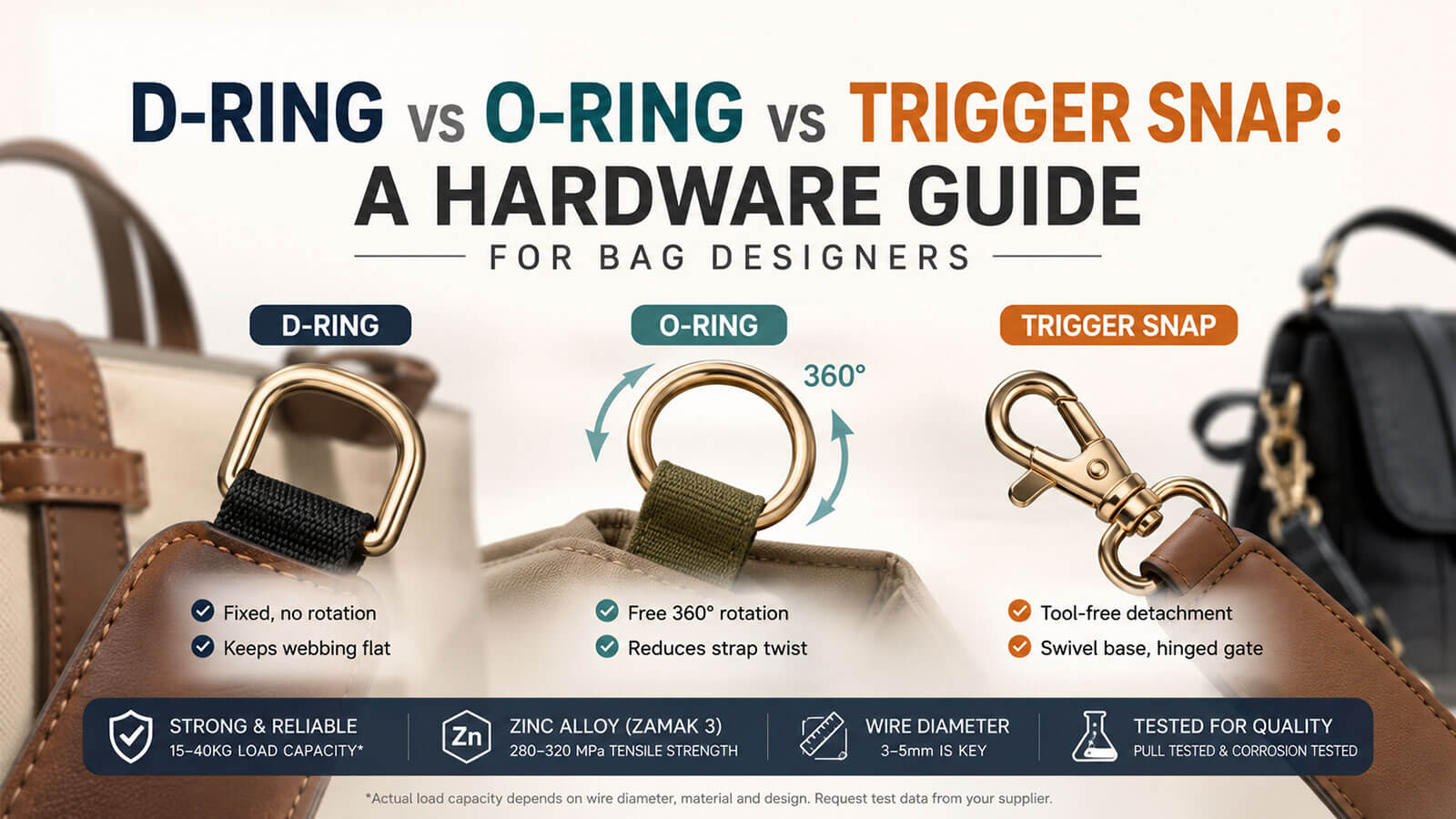
Every bag strap needs a connection point, and most designers default to whatever hardware looks right on a mood board. That approach works until a sample fails a pull test, or a buyer asks why the strap swivels when it shouldn’t. This bag strap hardware guide breaks down how a D-ring, an O-ring, and a trigger snap hook each work, where each belongs, and how to specify them correctly for OEM production.
Quick Answer
What’s the real difference in a D-ring vs O-ring bag hardware comparison? A D-ring’s flat edge lets a strap or loop sit flush without shifting, making it ideal for fixed attachment points. An O-ring’s round profile allows free rotation, so it suits swivel connections. A trigger snap hook adds a spring-loaded gate, letting users detach the strap without tools.
Key Takeaways
- ✔ D-rings resist rotation and hold webbing flat — best for fixed strap loops and adjustable buckle systems
- ✔ O-rings rotate freely, reducing strap twist on shoulder bags and crossbody styles
- ✔ Trigger snap hooks allow tool-free strap removal, common on convertible and interchangeable-strap bags
- ✔ Zinc alloy die casting (Zamak 3) is the standard process for rings and hooks, with tensile strength around 280–320 MPa
- ✔ Wire diameter, typically 3–5mm for mid-size hardware, determines load capacity more than the ring’s shape
Table of Contents
- What Is a D-Ring and When to Use One
- What Is an O-Ring and When to Use One
- What Is a Trigger Snap Hook for Bags
- D-Ring vs O-Ring vs Trigger Snap Comparison Table
- Choosing the Right Hardware by Bag Type
- Pros and Cons of Each Hardware Type
- Common Mistakes When Specifying Ring and Hook Hardware
- Factory Expert Tips
- Expert Recommendation: Which One Should You Choose?
- FAQ
What Is a D-Ring and When to Use One
A D-ring is a closed metal loop shaped like the letter D, with one flat side and one curved side. The flat side keeps webbing or leather straps from bunching or twisting, which is why D-rings dominate fixed attachment points — the small loop sewn at the top of a tote handle, or the anchor point on an adjustable strap buckle system.
Most zinc alloy D-ring hardware used in bag production comes in 10mm, 15mm, 18mm, 25mm, and 38mm widths, sized to match common webbing widths, and functions as a permanent webbing strap attachment rather than a detachable one. Decorative visible hardware is typically die-cast from zinc alloy, while structural, load-bearing points on backpacks and luggage use stamped stainless steel wire instead. Our zinc alloy types guide covers how alloy composition affects casting detail and finish quality for parts this small.
What Is Zamak 3 and Why It Matters for Rings and Hooks
Zamak 3 is the most common alloy used in zinc alloy die casting for handbag hardware, prized for its balance of cost and strength. It offers roughly 280–320 MPa tensile strength and casts cleanly into fine detail, which matters for logo-stamped rings and hooks. Why it matters: a ring cast in inconsistent alloy can develop porosity that weakens the load-bearing curve under repeated strap tension, especially at the weld or seam point.
To learn more about our material standards and the science behind our hardware, please check out our full guide here: Zamak Zinc Alloy for Handbag Hardware Guide.
What Is an O-Ring and When to Use One
An O-ring is a fully round, uniform-diameter loop. Because there’s no flat edge, the strap or connector attached to it can rotate freely around the full circumference. That rotation is exactly what you want on a shoulder strap swivel point, where the bag needs to hang naturally without the strap twisting as the wearer moves.
O-rings are usually specified with a wire gauge between 3mm and 6mm depending on load requirements, and outer diameters from around 20mm up to 45mm for larger tote or luggage applications. A common production spec — the oval variant of this hardware, our spring gate ring hardware, adds a hinged gate section so it can also function as a quick-connect point rather than a permanently closed loop.
What Is a Trigger Snap Hook for Bags and How It Works
A trigger snap hook for bags, sometimes called a lobster clasp or swivel snap hook, is a spring-loaded fastener with a hinged gate that opens when the user presses a small lever (the “trigger”). Releasing the trigger snaps the gate shut, locking the connection. Most bag-grade trigger snaps include a swivel eye hook at the base, letting the whole hook rotate independently of the gate mechanism.
What Is a Spring Gate and How Trigger Snaps Lock Safely
The spring gate is the internal coiled spring that keeps the trigger’s locking pin pressed into the closed position by default. Why this matters for bag hardware: a weak or corroded spring is the most common field failure point, causing the gate to pop open under bag weight rather than user intent. How it’s tested: reputable factories run repeated open-close cycle tests — commonly 5,000 to 10,000 cycles — alongside corrosion testing to confirm the spring retains tension after the electroplating finish is applied.
Trigger snaps are the go-to choice anywhere a strap needs to detach without tools — interchangeable crossbody straps, removable pouches, and keychain attachments. Browse our swivel snap hook bag hardware collection for standard sizes from 15mm to 38mm.
D-Ring vs O-Ring vs Trigger Snap Comparison Table
| Hardware Type | Typical Material | Movement | Common Bag Use | Approx. Load Rating* |
| D-Ring | Zinc alloy (decorative) or stainless steel (structural) | Fixed, no rotation | Buckle strap loops, fixed handle anchors | 15–40kg depending on wire gauge |
| O-Ring | Zinc alloy, brass, or stainless steel | Free 360° rotation | Swivel strap points, chain connectors | 10–35kg depending on diameter |
| Trigger Snap Hook | Zinc alloy body, steel spring | Swivel base, hinged gate | Detachable straps, keychains, pouches | 8–25kg depending on hook size |
The D-ring vs O-ring weight capacity gap comes down to wire diameter, not shape — a thicker gauge outperforms a wider ring every time. Always request the factory’s specific test data rather than assuming published averages apply to your part.
Browse the hardware catalog
Download our full product catalog to explore styles, materials, and specifications for all hardware collections.
⬇ Download catalogCustom OEM manufacturing
Need a unique design? We offer full OEM customization — your logo, finish, and specifications on any hardware.
→ Learn about OEMChoosing the Right Hardware by Bag Type
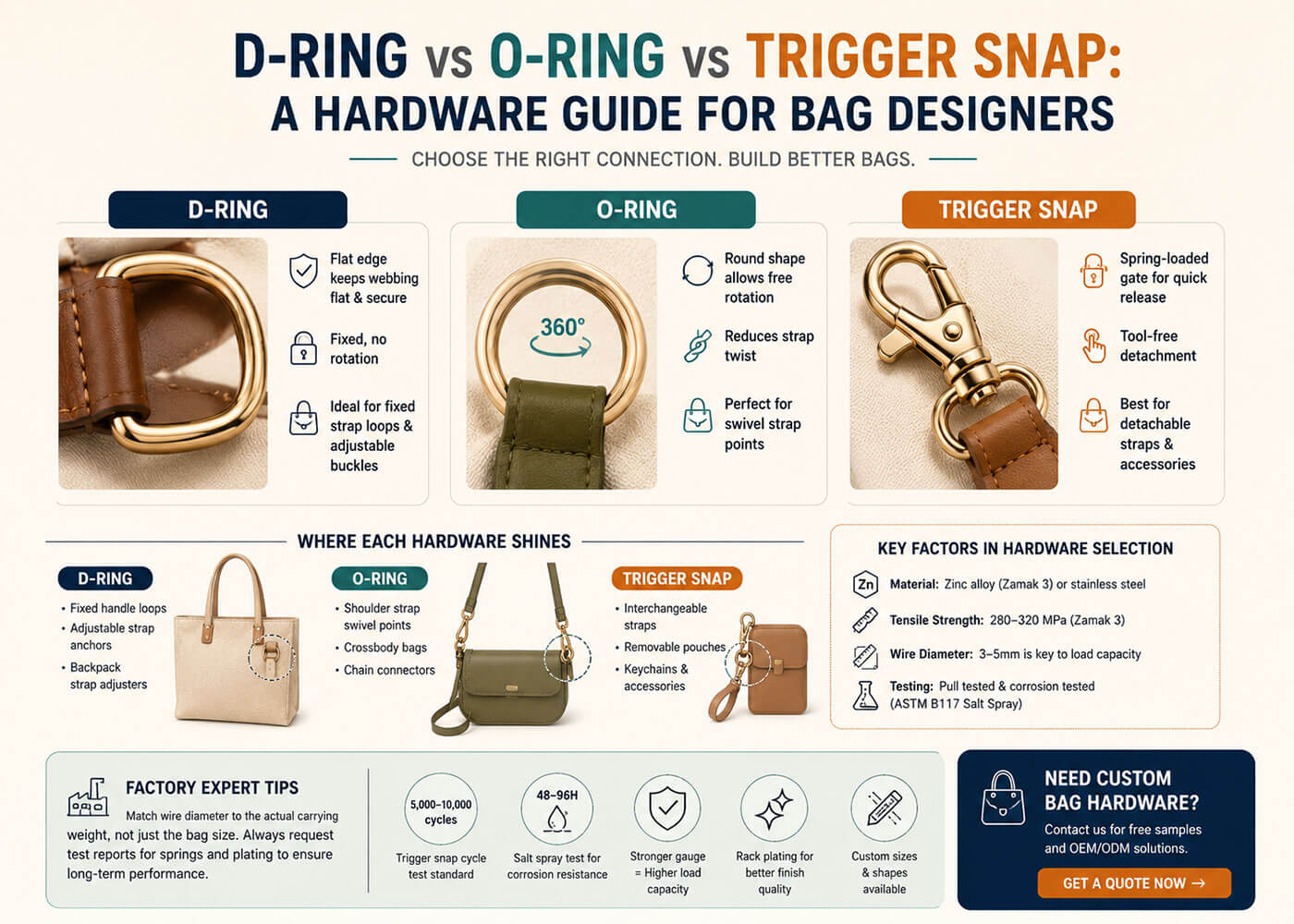
Which hardware fits a given bag design depends on how the strap needs to behave, not just how it looks. Structured totes with fixed handles generally call for D-rings at the sewn loop, since a flat mounting edge keeps the handle from rotating out of position. The best hardware for an adjustable bag strap is usually a D-ring paired with a slide buckle, since the flat edge keeps the webbing from folding as it’s pulled through. Crossbody and shoulder bags benefit from O-rings at the swivel point so the strap hangs naturally without twisting during wear.
Backpacks need load-bearing bag hardware that combines all three: D-rings anchor the shoulder strap adjusters, O-rings connect the sternum strap, and a trigger snap secures a removable accessory pouch or keychain clip. Our hardware selection guide by bag type covers additional components like turn locks and handle attachments for the rest of the build.
Pros and Cons of Each Hardware Type
D-Ring
Pros: holds webbing flat, low cost to tool, wide size range. Cons: cannot rotate, so it’s the wrong choice for any point where the strap needs to swing freely — using one there causes visible strap twist within weeks of normal wear.
O-Ring
Pros: smooth free rotation, simple round profile suits both structural and decorative use. Cons: without a gate, it must be sewn or riveted in permanently, which limits repair options if the ring itself fails.
Trigger Snap Hook
Pros: tool-free detachment, adds functional versatility for interchangeable straps. Cons: more moving parts means more potential failure points — spring fatigue and gate misalignment are the two most common warranty issues we see in field returns.
Common Mistakes When Specifying Ring and Hook Hardware
- Specifying an O-ring where a D-ring is needed, causing the strap loop to twist and bunch at the mounting point
- Under-sizing wire diameter to save on material cost, which reduces load capacity below the bag’s actual carrying weight
- Skipping salt spray test verification on trigger snap springs, leading to gate failure after a few months of humid-climate use
- Mixing electroplating finish tones across hardware pieces on the same bag, which becomes obvious once plating starts to wear unevenly
- Assuming all trigger snaps swivel — some budget versions use a fixed eye, which limits strap movement unexpectedly
Factory Expert Tips
As an OEM bag hardware manufacturer, our production experience shapes a few standing recommendations: we cast most D-rings and O-rings in Zamak 3 for visible hardware and switch to 304 stainless steel wire for structural rings on heavy-load bags like laptop backpacks. For trigger snaps, we recommend requesting the spring’s cycle-test report before finalizing a mold — a supplier that can’t produce this data usually hasn’t tested it.
Buyers often ask us how to choose bag ring hardware for OEM production, and the answer usually starts with matching wire gauge to real carrying weight rather than choosing by appearance alone. On finishing, rack plating preserves sharp detail on logo-stamped rings better than barrel plating, which we cover in our rack vs barrel plating guide. If you’re budgeting a new mold for a custom ring or hook shape, our mold cost breakdown outlines typical tooling fees by material.
Expert Recommendation: Which One Should You Choose?
Choose a D-ring when the strap or webbing needs to stay flat and stationary — buckle anchors, fixed handle loops, and adjuster straps. Choose an O-ring when the connection point needs to rotate freely, such as a shoulder strap swivel or a chain-to-body link. Knowing when to use a trigger snap hook on a bag strap comes down to one question: does the end user need to detach it themselves? If yes, that’s your answer. If you’re unsure, a hybrid approach — O-ring sewn into the seam with a trigger snap hook attached to it — covers both rotation and detachability in one connection point, which is the configuration we produce most often for crossbody bags.
Conclusion
D-rings, O-rings, and trigger snap hooks each solve a different mechanical problem, and getting the choice right during the design phase saves you from costly rework after sampling. Match the hardware to how the strap actually needs to move, verify wire gauge against your bag’s real carrying weight, and don’t skip corrosion and cycle testing on moving parts like trigger springs. If you’re finalizing a tech pack and need a custom bag hardware manufacturer to support OEM production, explore our bag ring hardware collection or reach out through our contact page for a free sample and quote.
FAQ
What is the difference between D-ring and O-ring for bags?
A D-ring has one flat edge that keeps webbing or straps from rotating, making it suited to fixed attachment points. An O-ring is fully round, allowing the attached strap or chain to rotate freely, which suits swivel points like shoulder strap connections.
When should I use a trigger snap hook on a bag strap?
Use a trigger snap hook whenever the end user needs to attach or remove the strap without tools — convertible bags, interchangeable straps, and keychain attachments are the most common cases. Fixed rings are better for permanent, sewn-in connection points.
What is the D-ring vs O-ring weight capacity difference?
It depends primarily on wire diameter rather than shape. A D-ring or O-ring made from 4–5mm zinc alloy or steel wire typically handles 15–40kg of static load, while thinner 3mm wire versions are better suited to lightweight accessories under 10kg.
What’s the best hardware for an adjustable bag strap?
A D-ring paired with a slide or ladder-lock buckle is the standard choice, since the D-ring’s flat edge keeps webbing from folding or jamming as the strap length is adjusted.
Does trigger snap hardware need corrosion testing?
Yes. Because the spring mechanism is a moving part, it’s more prone to performance loss from corrosion than a solid ring. Reputable manufacturers test plated hardware to standards such as ASTM B117 for salt spray corrosion resistance, typically running 48–96 hour test cycles.
Ready to source your handbag hardware?
Explore our full product range, request a custom quote, or reach out directly — we respond fast.