
Bag Hardware Names: A Complete Guide to Handbag Hardware Types by Function
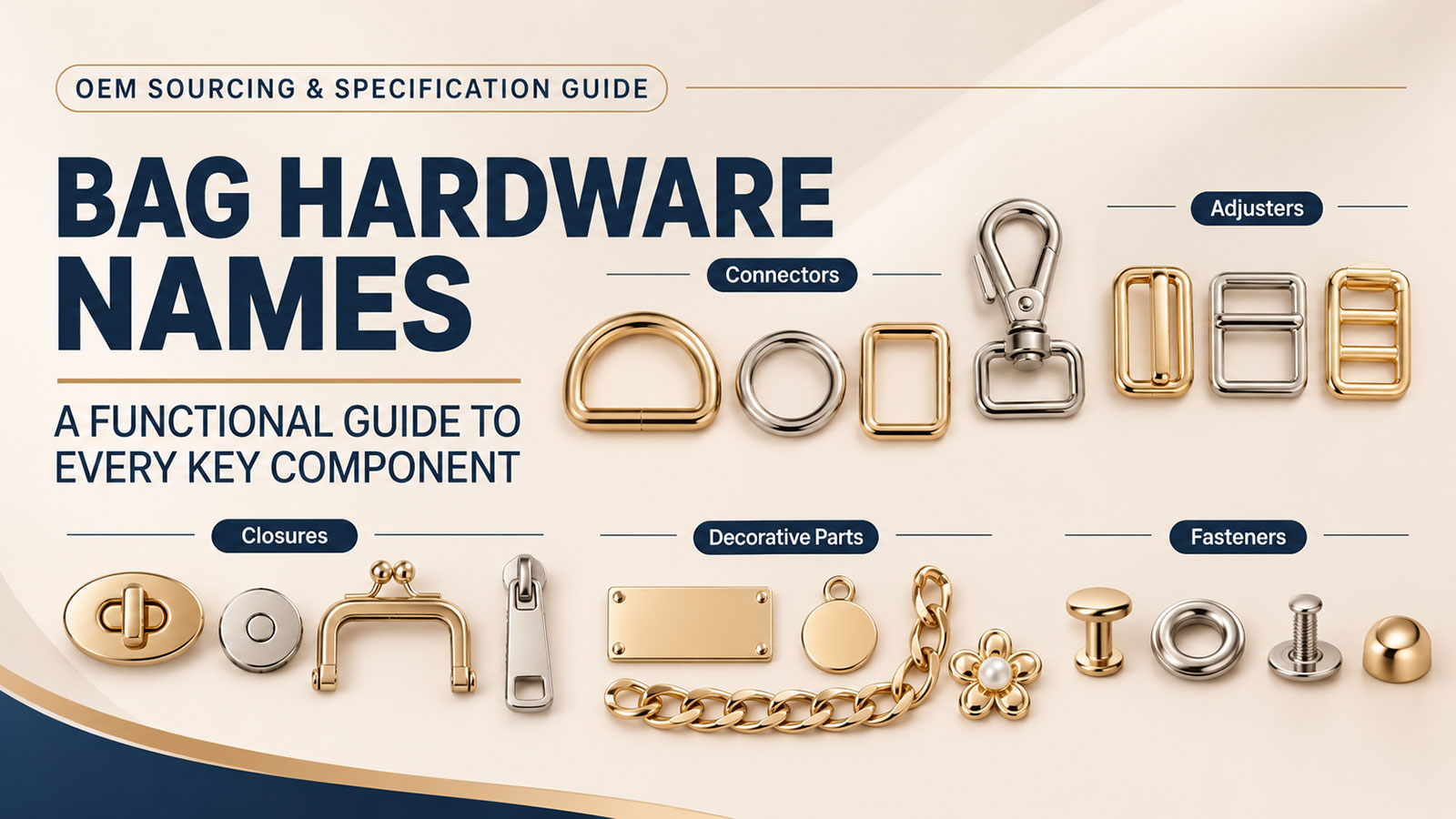
Ask three bag developers to name the metal loop on a strap and you will hear three answers: D ring, half ring, purse ring, or 手袋 D 扣. None of them is wrong, and that is exactly the problem. A name that means one thing to a designer can mean another part entirely on a factory floor, and the gap only shows up when a sample arrives. This guide sets out bag hardware names by function, with the dimensions worth writing down.
Quick Answer
Bag hardware names fall into five functional families: connectors, adjusters, closures, decorative parts, and fasteners. Most naming errors happen because a part is named by shape instead of by what it does. The reliable formula is the English name plus the common Chinese factory term plus three numbers: inner dimension, wire or wall thickness, and finish.
Key Takeaways
- Every bag hardware component has one primary job: connect, adjust, close, decorate, or fasten.
- Specify the inner dimension, never the outer size. Outer size shifts with wire diameter and plating.
- “D ring” alone is an incomplete name: orientation, inner width, wire diameter, and welded or non-welded all change the part.
- Chinese factory terms such as 日字扣, 狗扣, and 鸡眼 vary between regions, so pair the word with a photo and a measurement.
- Electroplating adds measurable thickness, so a 12–20 micron stack can change how a strap sits inside a ring.
- Brands that publish an internal glossary usually spend fewer sample rounds and argue less at final inspection.
Table of Contents
- Why Consistent Bag Hardware Terminology Matters
- Handbag Hardware Types: The Five Functional Families
- Bag Hardware Names: English and Common Chinese Factory Terms
- D Ring vs Rectangle Ring and Other Confused Names
- How to Measure Hardware: Inner Width, Outer Size and Opening Width
- Quick Selection Reference: Hardware Combinations by Bag Type
- Material and Finish Vocabulary Buyers Should Recognise
- Pros and Cons of Building a Brand Hardware Glossary
- Common Mistakes When Naming and Specifying Hardware
- Factory Expert Tips from OEM Production
- Expert Recommendation
- Conclusion
- FAQ
Why Consistent Bag Hardware Terminology Matters
Naming discipline is not a paperwork habit; it is a cost control measure. In our experience quoting custom hardware, most rework does not start with a bad design. It starts with a purchase order that names a part correctly by shape but says nothing about orientation, inner size, or finish, so the factory fills the gap with its own default.
One example repeats every season. A development team writes “strap slider 20mm” and attaches a photo of a 日字扣 with a moving centre bar. The factory quotes a fixed-bar tri-glide of similar outer shape. Both parts are called sliders in the trade, both are metal, both measure about 20mm outside. Only one of them adjusts a strap.
The second failure mode is measurement drift. A supplier confirms a “25mm D ring”, which turns out to be 25mm outer height with a 19mm inner width. The 20mm strap that should thread through it binds at the fold, and the sewing line discovers the problem after the leather is cut. Naming did not fail; the number attached to the name did.
The third is language. Chinese factories use short working terms that developed on the shop floor: 狗扣 for a swivel snap hook, 鸡眼 for an eyelet, 口金 for a clasp frame. These are efficient inside one factory and ambiguous between two, especially when suppliers in different provinces use one word for different parts.
Knowledge Box: Why “D Ring” Is Not a Complete Specification
A D ring name only describes the silhouette. Four other variables decide whether the part works: inner width (does the strap thread with clearance), wire diameter (does it hold the load), welded or non-welded construction (does the gap open under pull), and orientation (is the flat bar sewn into a leather tab, or does the ring hang free on a swivel). Two rings that look identical in a catalogue photo can differ on all four.
Handbag Hardware Types: The Five Functional Families
Factories, designers, and buyers rarely use the same words for these parts: purse hardware names, bag fittings, and metal accessories all turn up in a single brief. The functional groups below do not change with the vocabulary, which is what makes them useful.
Grouping parts by function rather than by shape solves most naming arguments before they start. The five families below cover the practical range of handbag hardware types, and each one maps to a different person who owns the decision: connector and adjuster parts belong to the pattern maker, closures to the design team, and fasteners to production engineering.
| Family | Common Chinese term | Job in the bag | Typical parts | Buyer decision it drives |
|---|---|---|---|---|
| Connectors | 连接件 | Join strap to body, strap to strap, or chain to ring | D ring, O ring, rectangle ring, square ring, spring gate O ring, jump ring, swivel snap hook | Inner size, wire diameter, welded or openable |
| Adjusters | 调节件 | Change strap length or hold a strap tail | Strap slider (日字扣), ladder lock, tri-glide, roller buckle, strap keeper | Webbing or leather width, friction, moving or fixed bar |
| Closures | 闭合件 | Open and close the bag mouth | Turn lock, twist lock, magnetic snap, spring snap, clasp frame (口金), zipper slider and pull | Leather thickness, closing force, security level |
| Decorative parts | 装饰件 | Carry branding and visual finish | Logo plate, metal tag, studs, decorative chain, charm hook | Logo method, colour consistency, surface protection |
| Fasteners | 加固件 | Hold hardware and panels together | Double cap rivet, eyelet and grommet, screw post with washer, bag feet | Post length, grip strength, reinforcement patch |
The table doubles as a checklist for a tech pack. If a part cannot be placed in one family, it usually means the brief is describing an appearance rather than a function, and the factory will have to guess the mechanism. Note also that a few parts serve two families at once, such as a spring gate O ring that both connects and opens.
Closures are where the types of bag buckles and clasps overlap most, because one part can be named for its shape in a catalogue and for its action on a factory floor. That overlap is also why lock naming deserves its own comparison rather than a single glossary row.
Knowledge Box: Why Connectors and Fasteners Get Confused
Connectors move; fasteners anchor. A D ring takes the strap and rotates slightly in use, so it must be sized for clearance and load. A rivet or eyelet passes through leather and stays put, so it must be sized for grip and leather compression. When a buyer specifies a “25mm ring” to replace a riveted attachment, the result is often a hole that is too large for the rivet post and a fixing point that loosens within a season.
Bag Hardware Names: English and Common Chinese Factory Terms
The reference table below is the part we ask buyers to attach to a tech pack. It is not an official standard; Chinese working terms differ between Dongguan, Guangzhou, and Zhejiang workshops. Used together with a photo and a dimension, though, it removes the ambiguity that a photo alone cannot settle.
Read the Chinese column as shop-floor shorthand, not as translation. When a term conflicts with the photo, the photo and the dimension win. If your team still lacks shared bag fittings terminology, start by agreeing on these high-frequency rows rather than the whole list, since most confusion sits in rings, hooks, and adjusters. A zipper end clip is a useful test case: the name changes with the zipper type, and buyers often receive a pull instead.
For a system view of how the parts are specified together, including finish families and shared plating batches, see our guide to building a matching handbag hardware set.
| English name | Chinese factory term | Function | Where it appears |
|---|---|---|---|
| D ring | D 字扣 / D 扣 | Connector with one flat side | Strap anchor, leather tab |
| O ring | O 字扣 | Closed round connector | Strap junction, chain end |
| Rectangle ring | 方扣 (长方) | Connector with square corners | Modern strap anchor |
| Square ring | 正方扣 | Even-sided connector | Strap, belt loop |
| Spring gate O ring | 弹簧 O 扣 | Openable connector | Detachable strap, key ring |
| Jump ring | 单圈 / 开口圈 | Small soldered or open link | Chain repair, charm attach |
| Swivel snap hook | 狗扣 / 旋转狗扣 | Rotating hook for detachable straps | Crossbody strap end |
| Lobster clasp | 龙虾扣 | Trigger-release hook | Chain strap, small leather goods |
| Trigger snap hook | 按压狗扣 | Press-gate hook with swivel eye | Wrist strap, lanyard |
| Strap slider | 日字扣 | Adjuster, often with moving bar | Shoulder strap |
| Ladder lock | 梯扣 / 调节扣 | Friction adjuster for webbing | Backpack strap |
| Tri-glide | 口字扣 | Keeper that redirects webbing | Strap tail control |
| Roller buckle | 滚轴扣 | Buckle with a free-turning roller | Belt-style strap |
| Strap keeper | 皮带圈 / 穿带耳仔 | Loop that holds a loose tail | Shoulder strap |
| Turn lock | 转锁 | Rotating closure with a post | Flap of a structured bag |
| Twist lock | 扭锁 | Rotating closure, twist action | Front flap panel |
| Clasp frame | 口金 | Framed kiss-lock opening | Clutch, coin purse |
| Magnetic snap | 磁扣 / 磁石扣 | Hidden magnet closure | Flap, pocket |
| Spring snap | 弹簧扣 / 四合扣 | Press-together metal snap | Pocket, lining |
| Zipper slider | 拉头 | Runs the zipper chain | Bag mouth, pocket |
| Zipper pull | 拉牌 | Grip attached to the slider | Visible branding point |
| Zipper end clip | 拉链尾夹 | Terminates a zipper end | Open-end zipper |
| Logo plate | 五金 logo 牌 / 铭牌 | Metal brand plate | Front panel, strap |
| Double cap rivet | 双面撞钉 / 帽钉 | Two-cap fastener through leather | Strap end, pocket corner |
| Eyelet and grommet | 鸡眼 / 气眼 | Rimmed hole through leather | Drawstring opening, vent |
| Screw post and washer | 螺丝柱 + 介子 | Removable fixing | Strap anchor, plate fixing |
| Screw-in D ring | 螺丝 D 扣 | D ring with removable pin | Bag making, repair |
| Bag feet | 脚钉 / 底钉 | Base protection stud | Bottom panel |
| Bag chain | 五金链 | Decorative or load-bearing chain | Strap, trim |
| Handle holder | 手挽扣 / 耳仔扣 | Loop that takes a top handle | Top handle attachment |
Knowledge Box: How to Read a Supplier’s Term List
When a supplier sends a price list, the part names are usually marketing labels rather than engineering labels. Two checks keep the list usable. First, ask for the inner dimension of any ring or slider, not the “size”. Second, ask whether the quoted part is die-cast or wire-formed, because that single answer explains most of the price gap between two identical-looking rows. A term list without dimensions is a catalogue, not a specification.

🛠️ OEM/ODM Custom Hardware Solutions
Have a specific engineering drawing or custom design for luxury leather goods? Collaborate directly with our master engineers to transform your sketches into premium brass or zinc alloy components.
Start Your Custom Project →📂 Digital Product Catalog Access
Explore our comprehensive range of high-end handbag accessories, metal logo,turn locks, buckles, and chains. Download the full specifications and options catalog for your sourcing library.
Download Full Catalog ↓D Ring vs Rectangle Ring and Other Confused Names
Several pairs of hardware names sound interchangeable and are not. The differences are mechanical, and each one shows up in wear, in fit, or in the number of sample rounds a project needs. The five comparisons below cover the questions buyers send us most often.
D Ring vs Rectangle Ring
A D ring has one straight bar and one curved bar; the straight bar sits flat against the bag body so a strap cannot twist. A rectangle ring has four straight bars and holds the strap at a fixed angle with sharper corners. On soft leather, the D ring stays quieter; on structured bags and boxy totes, the rectangle ring keeps a cleaner line. Neither is stronger by shape alone.
The engineering difference is stress distribution. The curve of a D ring spreads load across a wider arc, which suits high-load carry points such as shoulder strap anchors. Rectangle rings concentrate load at the corners, so corner radius matters: below roughly 2mm internal radius, our pull tests show earlier deformation. If a design calls for square corners, increase wire diameter or wall thickness.
Lobster Clasp vs Swivel Hook
A lobster clasp opens by pressing a small lever, and it holds a fine chain or a small ring securely with a compact body. A swivel snap hook opens by pushing a spring gate, and its rotating eye lets a strap turn without twisting. Lobster clasps suit light decorative chains; swivel snap hooks suit load-bearing detachable straps that a user clips on daily.
The confusion comes from regional trade language. In some markets a swivel snap hook is simply called a dog hook or dog clip, and a lobster clasp is called a trigger clasp. When the name alone is unclear, ask for the gate mechanism: a lever that must be pressed, or a gate that slides inward against spring pressure.
Strap Slider vs Slide Buckle vs Tri-Glide
This trio causes the most rework of any adjustment part. A strap slider, often called a 日字扣 or slide buckle, holds and adjusts a strap through two bars and usually has a moving centre bar. A tri-glide is a single frame that only redirects webbing, with no adjustment function. Both are sold as “sliders”, and only one of them changes length.
A simple test settles it. Look for the bar the strap wraps around. If that bar can move, the part adjusts; if the frame is rigid, the part only keeps a strap flat. A tri-glide is normally paired behind a ladder lock or slider to control the loose tail, not to replace it.
Eyelet, Grommet and Rivet
An eyelet and a grommet are two halves of the same job: a rimmed hole. An eyelet is the flanged tube, a grommet is the ring that rolls over it, and together they protect leather from abrasion at a cord opening. A double cap rivet looks similar in a parts bag but has a different purpose: it joins two layers permanently, with a decorative cap on both sides.
Mixing them up is expensive because hole size is irreversible. An eyelet needs a hole close to its barrel diameter; a rivet needs a hole matched to its post. Enlarging a punched hole to recover from the wrong part usually means a new panel, so confirm the part name and the post or barrel diameter before the clicker press runs.
Turn Lock vs Twist Lock
Closure naming is where handbag lock types get muddled most often, so it deserves a separate pass. Turn locks and twist locks both close a flap with a rotating plate, and factories often use the two names for one part. The practical difference lies in the locking action and the strike plate design, not the name. What a buyer should specify is the closure action, the flap thickness range, and the alignment tolerance between the plate and the post.
A magnetic snap sits outside this pair entirely, which is where naming errors creep in. It looks like a metal closure on the parts tray but holds by magnet rather than by any mechanical latch, so it cannot be substituted for a turn lock without changing how the flap feels and how securely it stays shut.
Knowledge Box: Why One Part Has Five English Names
Hardware names spread through trade, not through standards, so a swivel snap hook is a dog hook in one catalogue, a swivel hook in another, and a spring hook in a third. None of this is a supplier trick. For buyers, the reliable countermeasure is to accept name variation and insist on function, dimension, material, and finish. Those four fields travel between languages without losing meaning, which names never do.
How to Measure Hardware: Inner Width, Outer Size and Opening Width
Measure the dimension the strap, cord, or post actually touches. In practice that means inner width for rings, slot width for sliders, gate opening for hooks, and post length for fasteners. Outer size is useful for drawings and packaging, but it rarely decides whether the hardware works, which is why so many naming disputes turn into measurement disputes.
Inner Diameter vs Outer Dimension
For a D ring, the working dimension is the inner width between the flat bar and the inner curve of the arc, plus the inner height. For an O ring, use the inner diameter. A ring described as 25mm is ambiguous until someone states whether that number is inside or outside; on a 4mm wire, the two values differ by 8mm, enough to change the strap size entirely.
How to Measure D Ring Size
Use a digital caliper, not a ruler, and measure three features on the same part: inner width at the widest point, inner height from flat bar to arc, and wire diameter at the midpoint of the curved side. Record all three in millimetres to one decimal. Then check the strap: inner width should exceed strap width by roughly 1–2mm so the leather threads without binding.
Opening Width and Gate Clearance
For openable parts, opening width decides what the hardware can accept. A spring gate O ring must open wide enough to pass over the ring or chain link it connects to, with enough clearance to close cleanly. A snap hook gate must clear the D ring wire plus plating. A gate that only just fits will feel stiff and wear its contact point quickly.
Post Length, Leather Thickness and Fit
Fasteners are chosen by post length, which must match the compressed leather stack at the fixing point, including lining and reinforcement. As a working rule in our workshops, choose a post that leaves about 1.5–2mm protruding beyond the stack, then confirm on a sewn sample, because leather compresses under the press. Our note on hardware tolerance and assembly fit explains how these small gaps compound at final assembly.
Knowledge Box: Why Measured Size Changes After Plating
Electroplating deposits metal on the surface, so a plated ring is slightly thicker and slightly smaller inside than the raw casting. A typical stack of copper, nickel, and colour layers totals roughly 12–20 microns, which is about 0.01mm per side. That sounds negligible until a strap already has 0.5mm clearance and the assembly is expected to move freely. Always measure the finished, plated part.
Quick Selection Reference: Hardware Combinations by Bag Type
Most bag constructions use a recognisable combination of parts, and backpack hardware names are a good example of how predictable that pattern is: two anchors, a ladder lock, and a keeper in almost every build.
Starting from a known combination saves a round of sampling. The table below is a starting reference from common OEM production scenarios, not a rule. Adjust it for load, leather thickness, and brand positioning before the tech pack is issued.
| Bag type | Connectors | Adjusters | Closures | Fasteners and feet | Watch point |
|---|---|---|---|---|---|
| Crossbody bag | D rings, swivel snap hooks | Strap slider plus keeper | Zipper or magnetic snap | Double cap rivets, screw posts | Hook gate must clear the D ring wire |
| Structured tote | Rectangle rings or handle holders | Short slider on shoulder strap | Turn lock or twist lock | Bag feet, screw posts | Lock alignment on a rigid flap |
| Backpack | D rings, loop anchors | Ladder lock plus tri-glide | Zipper with metal pull | Rivets at stress points, eyelets | Webbing width tolerance at the ladder lock |
| Clutch or minaudière | Small O rings, jump rings | Rarely used | Clasp frame or hidden magnet | No feet, decorative studs | Frame curvature must match the pattern |
| Wallet or small leather goods | Small D rings on the zip pull | None | Spring snap, zipper | Short-post rivets, small eyelets | Thin leather needs short posts |
| Luggage or duffel | Heavy D rings, welded O rings | Wide slider, roller buckle | Zipper with reinforced end | Large feet, long-post rivets | Load rating at the strap anchor |
Two patterns stand out. First, crossbody and backpack designs almost always fail at the same place: the interface between the hook and the ring, not the strap itself. Second, structured bags with turn locks live or die on flap alignment, which is a tolerance question decided long before the finish is chosen.
Material and Finish Vocabulary Buyers Should Recognise
Material words carry hidden decisions. “Zinc alloy” and “Zamak” describe the same family of casting alloy, while “iron” and “steel” are used loosely in catalogues to mean stamped or wire-formed parts. Knowing which process produced a part tells you more about its behaviour than the colour name on the swatch card.
| Base material | Typical parts | Strength | Corrosion without plating | Forming process | Cost tier |
|---|---|---|---|---|---|
| Zinc alloy (Zamak 3 / 5) | Turn locks, logo plates, D rings, sliders | Moderate; roughly 280–350 MPa tensile depending on grade | Poor, oxidises quickly | Die casting, complex shapes | Low to mid |
| Brass | Rings, plates, clasps, buckles | Good | Moderate, patinas naturally | Stamping, machining | Mid to high |
| Iron and steel | Wire rings, rivets, eyelets, stamped buckles | High for wire and sheet forms | Poor, rusts if plating breaks | Wire forming, stamping | Low |
| Stainless steel (304 / 316) | Heavy D rings, luggage hardware | High | Good without plating | Wire forming, CNC | High |
| Aluminium | Lightweight buckles, hooks | Low to moderate | Moderate; anodising common | Die casting, machining | Mid |
In our own production, zinc alloy covers most visible die-cast parts such as turn locks, logo plates, and strap sliders, because tooling cost is low and detail reproduces well. We typically reserve stainless steel for load-bearing anchors on luggage and outdoor bags, where the part must survive without relying on plating. ODM projects often use both in one collection.
The decision table below answers the second question buyers ask after choosing a metal: which finish, and what to demand in writing. Read it at quoting stage, because finish specifications are difficult to tighten once a purchase order is issued.
| Finish | Trade colour names | Process | Main durability driver | Suits these hardware names | Ask the supplier for |
|---|---|---|---|---|---|
| Bright gold electroplate | Light gold, champagne gold, 18K gold | Rack or barrel electroplating over nickel | Nickel underlayer thickness | Logo plate, turn lock, buckle | XRF thickness report plus salt spray hours |
| Silver-tone electroplate | Nickel, chrome, rhodium | Electroplating | Stack thickness and surface polish | Rectangle ring, slider, zipper pull | Adhesion test result and colour reference |
| Dark electroplate | Gunmetal, black nickel, matte black | Electroplating, sometimes with lacquer | Lacquer quality on dark dyes | D ring, snap hook, rivets | Rubbing test and touch-up policy |
| Antique finish | Antique brass, antique copper | Plating with mechanical or chemical darkening | Consistency of the darkened recess | Logo plate, O ring, decorative chain | Approved physical sample, not a photo |
| PVD coating | PVD gold, PVD gunmetal | Vacuum deposition | Coating density and substrate polish | High-wear hook, buckle, turn lock | Wear test data, not micron thickness alone |
| Painted or electrophoretic | Painted colours, matte white | Spray or e-coating over casting | Chip resistance at edges | Decorative tag, fashion slider | Edge chipping test on sharp profiles |
Two conclusions follow. For visible parts that get touched daily, the plating stack decides how the part ages, and the colour name decides nothing. For hidden structural parts, base metal decides failure behaviour, so a cheaper alloy shifts risk from the budget line to the returns line.
Finishing vocabulary matters just as much. Rack plating hangs parts individually and gives even colour on visible faces, while barrel plating tumbles small parts and suits hidden components. PVD is a vacuum coating that behaves differently from electroplating at similar thickness. Durability claims should be tied to a test, usually a salt spray run to ASTM B117, rather than to a colour name.
Compliance language belongs in the same conversation. Buyers selling into the European Union need to know how the REACH regulation applies to plating chemistry and surface treatments, and should ask for third-party reports such as those from SGS testing services rather than accepting a statement on a quotation.
Knowledge Box: What a Salt Spray Result Actually Says
A salt spray test places plated hardware in a fog of salt solution and records how long it takes for corrosion to appear. The number matters because it is repeatable, and because it exposes thin plating faster than real use does. It does not prove a finish will stay bright for years in a humid climate, and results are not comparable between labs unless duration, concentration, and acceptance criteria are stated.

Pros and Cons of Building a Brand Hardware Glossary
A shared hardware glossary is a small document with an outsized effect on development speed, but it is not free to maintain and it does not suit every team. Here is the honest balance from projects where buyers adopted one.
Pros
- Fewer sample rounds, because the first drawing already contains the right part name and inner dimension.
- Cleaner quotations: suppliers price a specified part instead of a guessed one.
- Faster QC, since inspectors check against a written dimension rather than a photo.
- Reusable across seasons, when a collection adds sizes rather than new parts.
- Clearer internal ownership between design, merchandising, and production.
Cons
- It takes real work to build, typically a few days of matching photos, names, and measurements.
- It can become outdated if new parts are added without updating the file.
- Over-specification is a genuine risk; teams start writing 0.05mm tolerances on decorative parts.
- Suppliers still use their own working language, so translation effort does not disappear entirely.
Common Mistakes When Naming and Specifying Hardware
Most of the failures we see at sample approval trace back to six habits. All of them are cheap to fix at the tech pack stage and expensive to fix after the leather is cut.
- Naming by shape only. “Square ring” tells the factory nothing about whether it is welded, what wire diameter it carries, or how it mounts.
- Giving outer size as the strap size. A 25mm outer ring may have a 17mm inner opening, which will not take a 20mm strap.
- Omitting orientation. A D ring sewn into a leather tab must have its flat bar against the seam; a loose ring does not. Both are quoted the same way.
- Assuming finish names are universal. “Light gold” from one plating line is not “champagne gold” from another, so a physical approved sample or a lab value is the only reliable reference.
- Skipping the assembly check. Each part passes on its own, then the hook will not close over the ring because plating and tolerance were never considered together, or a double cap rivet is pressed onto a leather stack that already compressed.
- Letting the terms list drift. When the glossary stops being updated, new team members revert to photo naming and the old problems return within a season.
Factory Expert Tips from OEM Production
From OEM production experience, three habits separate buyers who approve samples in one round from those who need four. None of them requires engineering training, and all of them cost less than a remake.
First, send a dimensioned photo rather than a clean catalogue image. Photograph the part on a cutting mat with the inner width and wire diameter marked in by hand, and the factory will interpret it correctly even if the English name is unusual. A picture with numbers crosses languages better than any glossary.
Second, order the sample set as a system, not part by part. Rings, hooks, sliders, and rivets share a finish family only when plated in one batch with one rack setup. Mixed batches are the usual reason a set looks “off” even when each part meets its own spec.
Third, write the failure mode into the spec. Instead of “smooth operation”, state that the hook must close over the ring without contact and that the gate must return fully after 500 open-close cycles in the sample test. Suppliers can design toward a stated behaviour; they can only guess at an adjective.
Knowledge Box: Why Chinese Factory Terms Drift Between Regions
Working terms developed in factories that specialised in different product types. A workshop that mostly supplied bag frames used 口金 for every framed closure, while a workshop serving fashion bags reserved the same word for clutch frames only. This is why an experienced buyer asks for the part’s function and dimension rather than trusting a translated term, and why the same part can appear under two Chinese names in one supplier’s price list.
Expert Recommendation
Build a glossary if your team develops more than a handful of styles a year, if several suppliers are quoting the same parts, or if your QC team inspects against drawings rather than photographs. In those cases, a two-page sheet with English name, Chinese term, photo, inner dimension, and finish reference pays for itself in one season.
Do not build one if you are sourcing a single stock part, assembling a ready handbag hardware kit for a capsule line, or if your supplier already maintains a dimensioned catalogue you can adopt and annotate. In that situation, a photo with three numbers written on it solves the same problem faster. Between the two extremes, the sensible middle is a short internal list of the 20 parts you use most often.
Conclusion
Bag hardware names are a working language, not a fixed standard. Function groups the parts into five families, dimensions make the names usable, and materials explain why two identical-looking parts behave differently. Get those three layers into the tech pack and most of the ambiguity disappears before sampling begins.
If your team is standardising hardware for a new collection, start with our hardware catalogue to match part names to inner dimensions, or send us your specification with photos and measurements and we will confirm the closest production part before sampling.
FAQ
What is a strap slider and how is it different from a buckle?
A strap slider is a frame with two parallel bars that holds a strap and lets the wearer change its length, usually by sliding the strap through. A buckle, in bag hardware terms, closes or connects a strap rather than only adjusting it. Sliders adjust length; buckles connect, release, or fasten.
What is a tri-glide buckle used for?
A tri-glide buckle is a plain rectangular frame with a centre bar and no locking action. It redirects webbing or keeps a loose strap tail flat behind an adjuster. It does not change strap length on its own, which is why it is normally paired with a slider or ladder lock rather than used alone.
What is the difference between a D ring and a rectangle ring?
A D ring has one flat bar and one curved side, which keeps a strap from twisting and spreads load across an arc. A rectangle ring has four straight bars and holds the strap at a fixed angle. D rings suit soft leather and load-bearing anchors; rectangle rings suit structured, boxy designs.
How do I measure a D ring for a bag strap?
Measure the inner width between the flat bar and the inner curve, the inner height, and the wire diameter with a caliper on the finished, plated part. Choose an inner width about 1–2mm wider than the strap so it threads smoothly. State clearly whether any quoted number is inner or outer.
Is a swivel snap hook the same as a lobster clasp?
No. A swivel snap hook uses a spring-loaded gate and a rotating eye, and carries load on detachable straps. A lobster clasp uses a small pressed lever and suits fine chains and light decorative use. Both are hooks, but the gate mechanism and load capacity differ, so they are not interchangeable in a spec.
What are bag hardware names called in Chinese factories?
Factories use short working terms: D ring is D 字扣, swivel snap hook is 狗扣, strap slider is 日字扣, eyelet is 鸡眼, and a clasp frame is 口金. Terms vary by region, so always confirm with a photo and an inner dimension rather than relying on the translation.
Does the finish name tell me anything about durability?
Not on its own. “Light gold” or “gunmetal” describes colour, while durability depends on the plating stack, the base metal, and the process used. Ask for thickness data from an XRF reading and a salt spray result with stated test conditions, not just a colour swatch.
Ready to source your handbag hardware?
Explore our full product range, request a custom quote, or reach out directly — we respond fast.