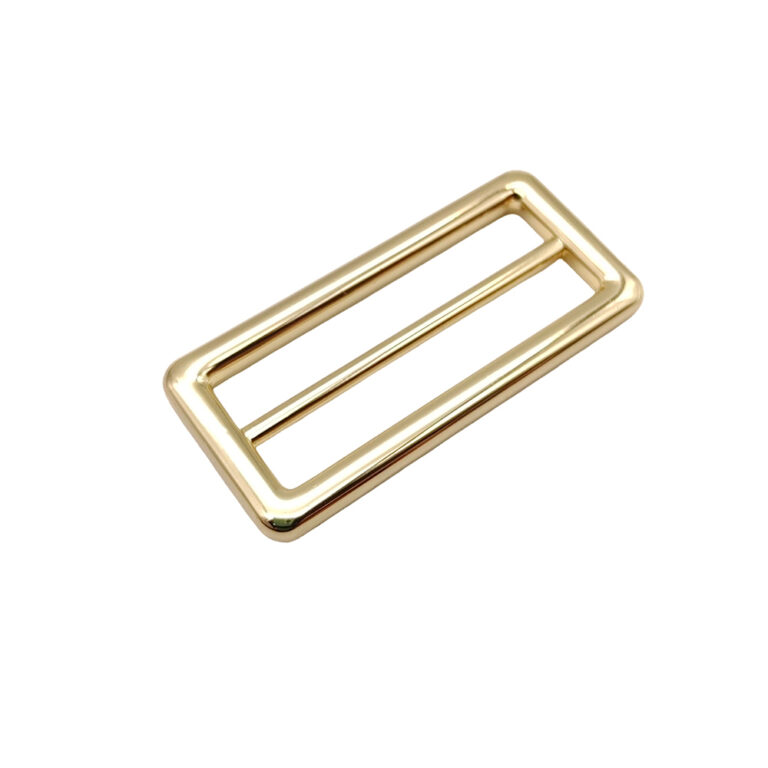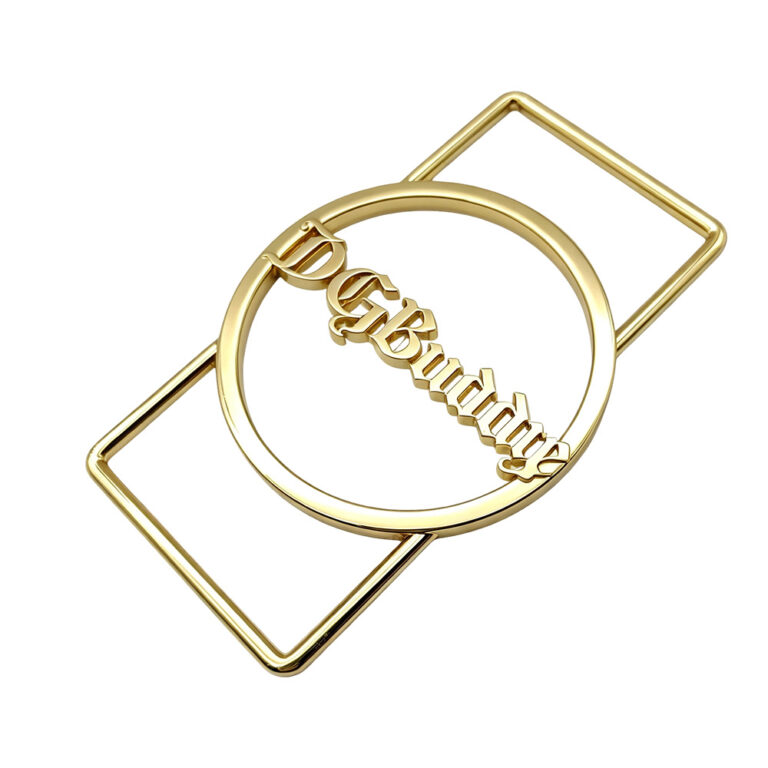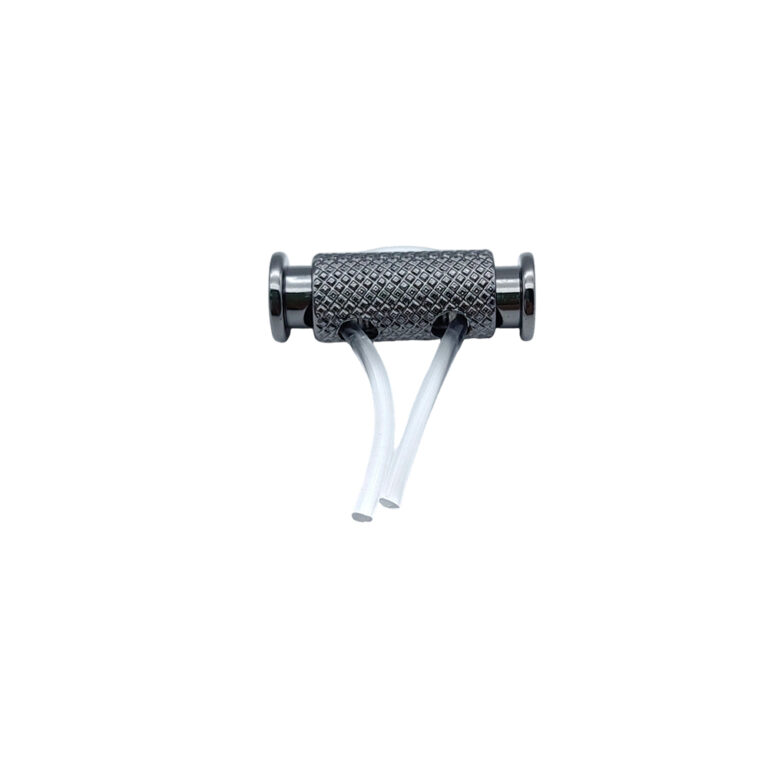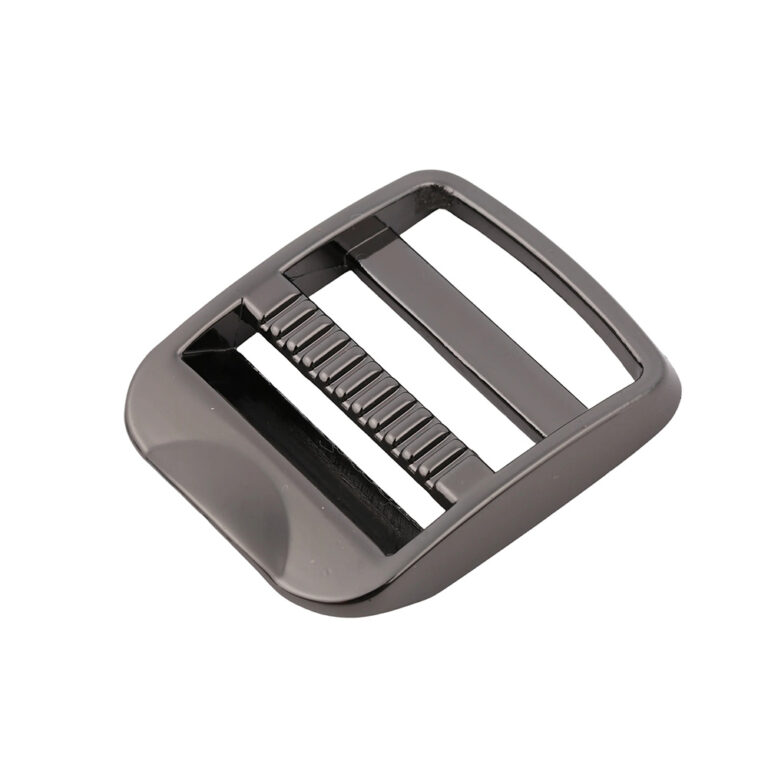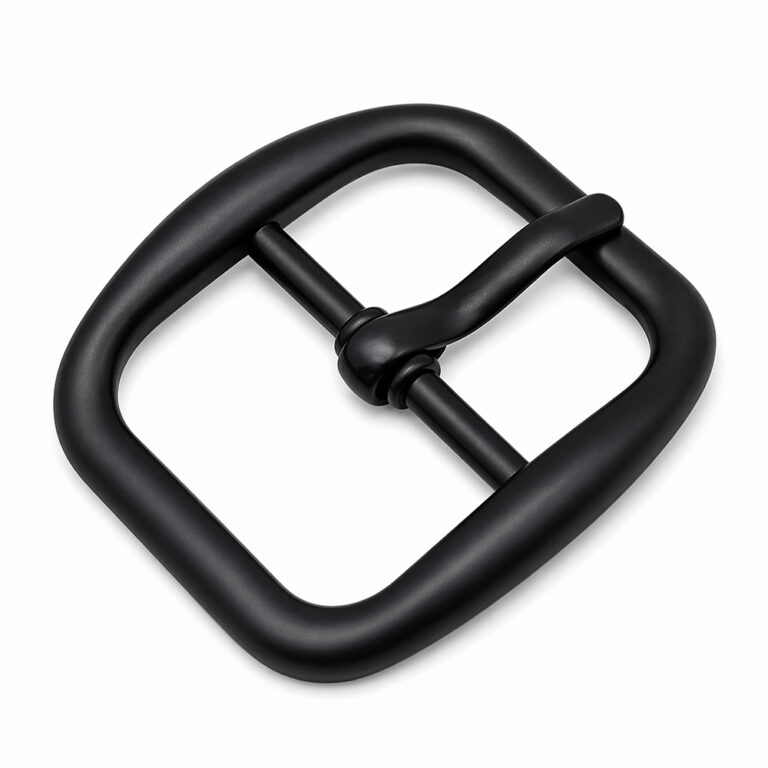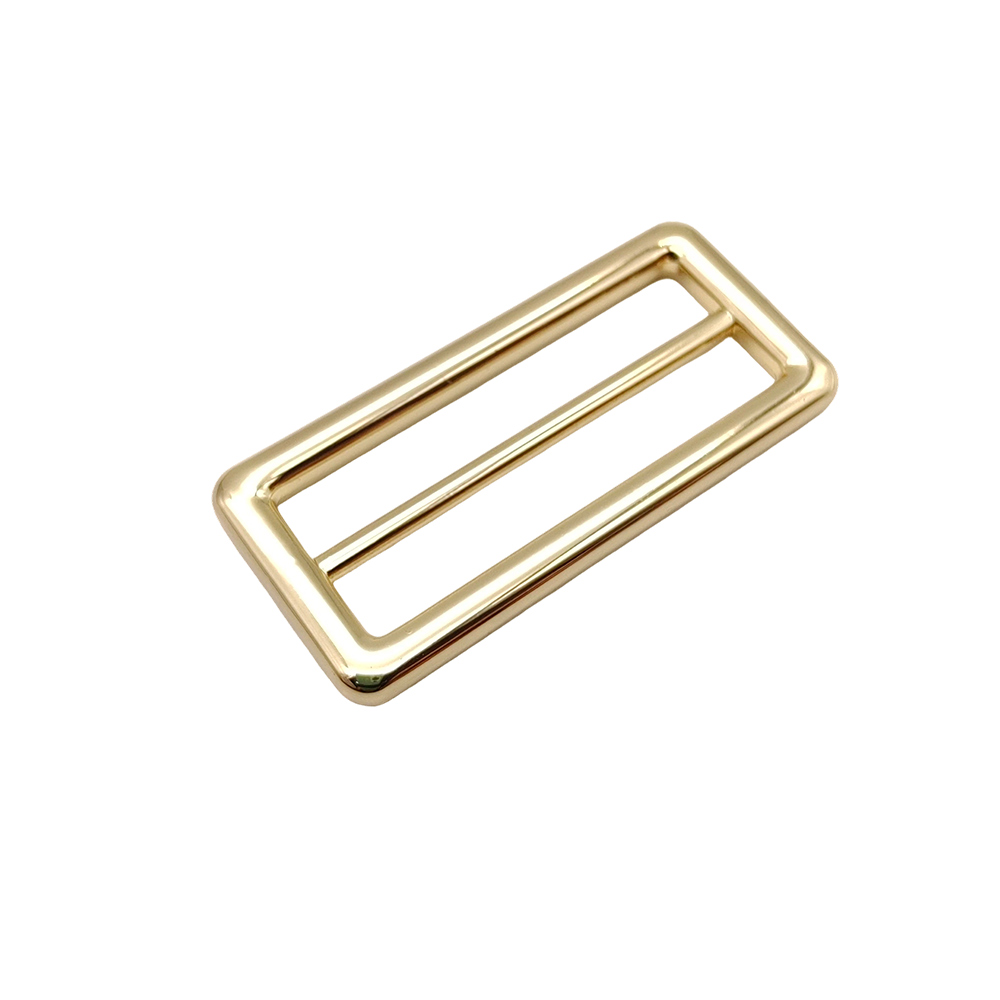
What is a Custom Zinc Alloy Triglide Slider? DG-RS050 is a rectangular strap adjustment component with a centered crossbar and two slots. It allows webbing to pass through, return, and lock into position while the wearer adjusts strap length. The zinc alloy body is produced by die casting, then polished before electroplating to support a consistent finish across the frame and curved interior edges.
The pictured version has a 4.9 mm wire diameter, an approximately 49.5 mm interior length, and a measured weight of 23.2 g. It is intended for handbag, crossbody, backpack, and belt strap development where buyers need a load-bearing buckle with a clean, symmetrical appearance. Stock supply and light customization are available for brands, OEM factories, and sourcing teams.
A triglide slide, also called a tri-glide slide, rectangle slider, or strap adjuster buckle, is different from a simple single loop. Its Center Bar divides the rectangular frame into two passages. The webbing normally travels through one slot, around the bar, and back through the second slot. Tension increases friction at the return section, so the strap can be shortened or lengthened without adding a separate locking mechanism.
For a product manager, the important question is not only whether the buckle looks correct. The inner clearance must match the actual Webbing thickness and width. If the passage is too tight, assembly becomes slow and the edge of the webbing may fold. If it is too open, the strap can migrate under use. In our factory, we review the customer’s webbing construction, finished width, thickness, and intended load before confirming a production drawing.
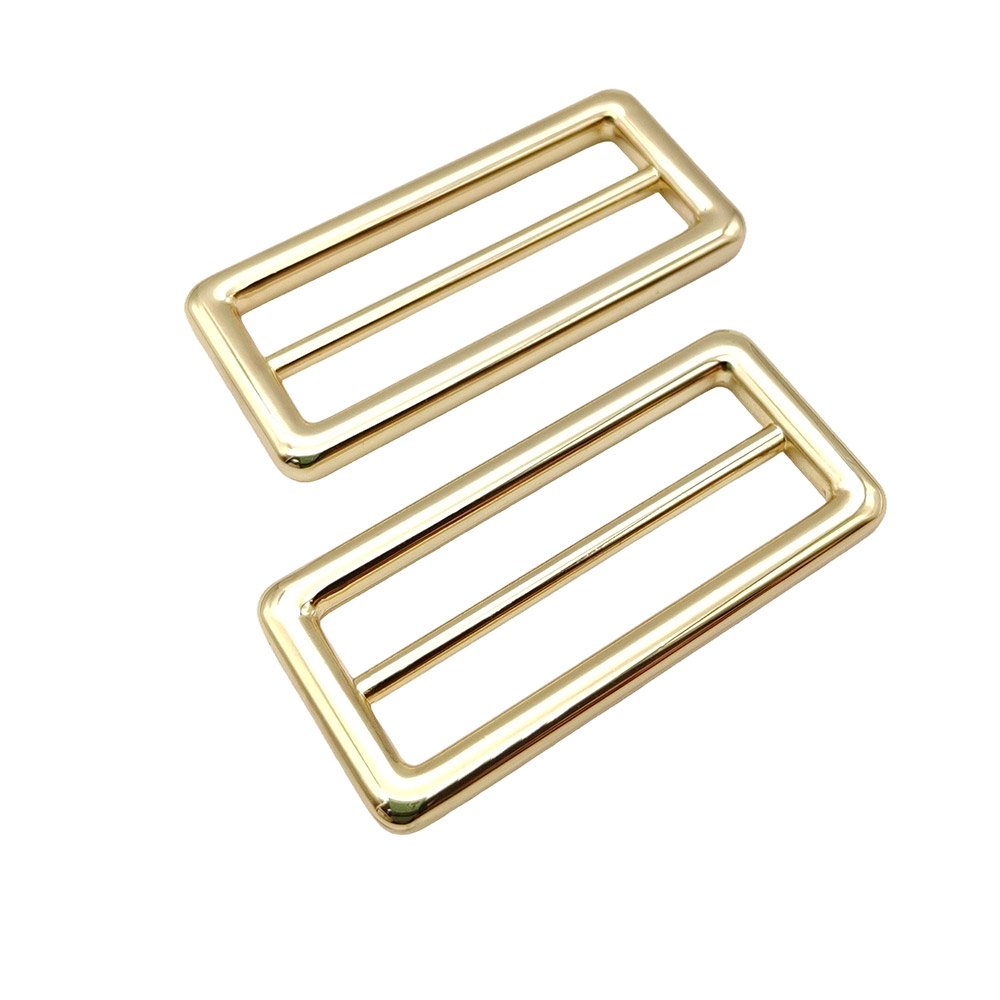
A triglide slide is a two-slot strap adjuster with a central bar. It is commonly used where the same strap must both connect to a product and provide adjustable length. The term “triglide” describes the path of the strap around the center bar, while “rectangle slider” describes the visible frame shape.
A single loop has one opening and usually serves as a fixed connector or guide. A triglide has a second passage and a center bar, giving the user a controlled return path. The additional geometry improves adjustability but requires closer control of Interior Width Tolerance and bar alignment.
A cam buckle uses a moving cam or spring-loaded locking surface to hold the strap. It is useful when fast release or stronger mechanical locking is required. A triglide is usually preferred for clean fashion hardware, lower visual complexity, and continuous strap adjustment on handbags or crossbody products.
| Hardware type | Adjustment method | Typical design priority | Common use |
|---|---|---|---|
| Triglide slide | Webbing friction around a center bar | Appearance, smooth adjustment, controlled clearance | Handbags, crossbody straps, backpacks |
| Single loop | Fixed routing through one opening | Simple connection and compact form | Strap ends, handles, decorative links |
| Cam buckle | Spring or cam pressure | Fast locking and release | Outdoor gear, utility straps, luggage |
Material selection should follow the product’s load, finish, target cost, and tactile expectation. Zinc Alloy is suitable for detailed rectangular profiles because Die Casting can form the frame and Center Bar in a repeatable production process. It also supports a substantial hand-feel without requiring the same material volume as some solid-machined alternatives. Brass remains attractive when a designer specifically wants its warmer base color, density, or traditional machining response.
| Decision factor | Zinc Alloy DG-RS050 | Brass alternative |
|---|---|---|
| Forming method | Die Casting is efficient for repeatable frame geometry | Often stamping, casting, or machining depending on design |
| Surface appearance | Polishing followed by Electroplating can create gold and other finishes | Natural warm tone or plated finish, depending on specification |
| Detail control | Suitable for rounded corners and centered-bar geometry | Suitable where density or a specific metal character is required |
| Weight planning | 23.2 g for the pictured version | May be heavier at comparable volume |
| Cost planning | Often practical for stock and light custom programs | Can carry a higher material cost |
| Best buyer question | Can the casting density and plating remain consistent? | Is the material character worth the added cost and weight? |
| Strap compatibility | Must be checked against wire diameter and inner clearance | Must also be checked against the same webbing dimensions |
| Brand matching | Multiple plating finishes can be sampled before approval | Finish depends on base material and treatment route |
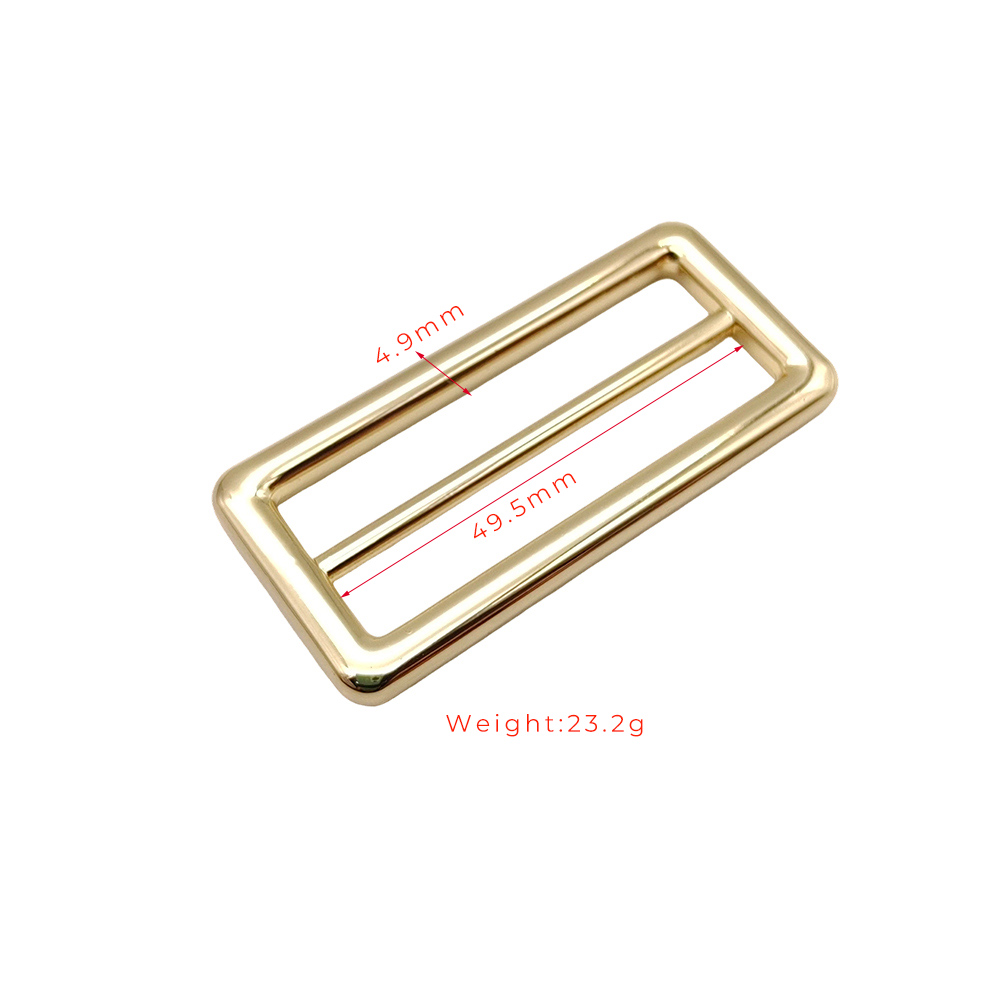
The image identifies an approximately 49.5 mm interior length, a 4.9 mm wire diameter, and a 23.2 g weight. These figures are useful for initial product screening, but a buyer should not treat one visible dimension as a complete fit specification. Overall width, clear slot width, frame thickness, corner radius, and the exact return path should be confirmed against a technical drawing before mass production.
In practical development, the most common mistake is matching the nominal webbing width while ignoring its finished thickness. Woven webbing, folded leather, coated tape, and padded strap constructions can occupy very different clearances. During Prototype Development, we recommend testing the actual production webbing rather than a nominal supplier sample.
| Drawing item | Why it matters to the buyer |
|---|---|
| Interior length: approximately 49.5 mm | Helps establish the usable scale of the rectangular opening and the strap return area. |
| Wire diameter: approximately 4.9 mm | Influences frame strength, visible proportion, and the clearance available around the webbing. |
| Center bar position | Controls slot symmetry and affects how balanced the finished handbag strap looks. |
| Corner radius | Reduces sharp contact points that may catch or abrade the webbing. |
| Interior width tolerance | Determines whether the strap moves smoothly or slips too easily under tension. |
| Frame thickness | Affects rigidity, casting fill, weight, and the visual scale of the hardware. |
| Product weight: 23.2 g | Helps the designer balance structural feel against the comfort of a wearable strap. |
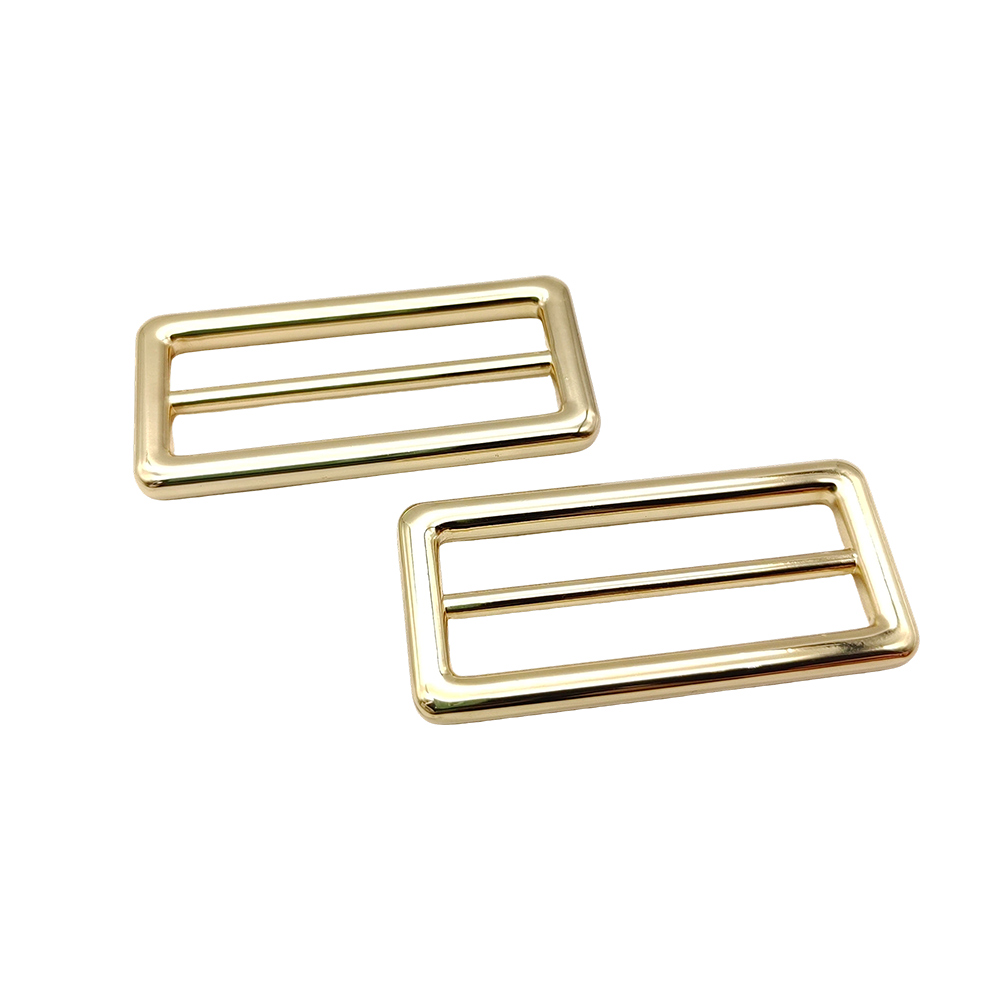
DG-RS050 can be evaluated for Luxury Handbag straps, crossbody bags, backpacks, belt accessories, and adjustable fashion-webbing systems. It is a load-bearing component rather than a purely decorative accent, so its finish must be judged together with fit and tension performance. For a visible front-facing design, the centered bar and rounded rectangular outline can also help maintain a deliberate, symmetrical hardware language across a collection.
A typical buyer story begins with a European fashion brand developing a crossbody bag in two webbing constructions: a narrow woven strap for the summer line and a thicker coated strap for the winter line. The same slider appearance looked suitable on both samples, but the thicker strap moved slowly through the original opening. The development team solved the issue by checking the finished strap thickness, adjusting the interior tolerance, and approving a separate size rather than forcing one buckle to serve both constructions. This is why a supplier should review the application before confirming the production version.
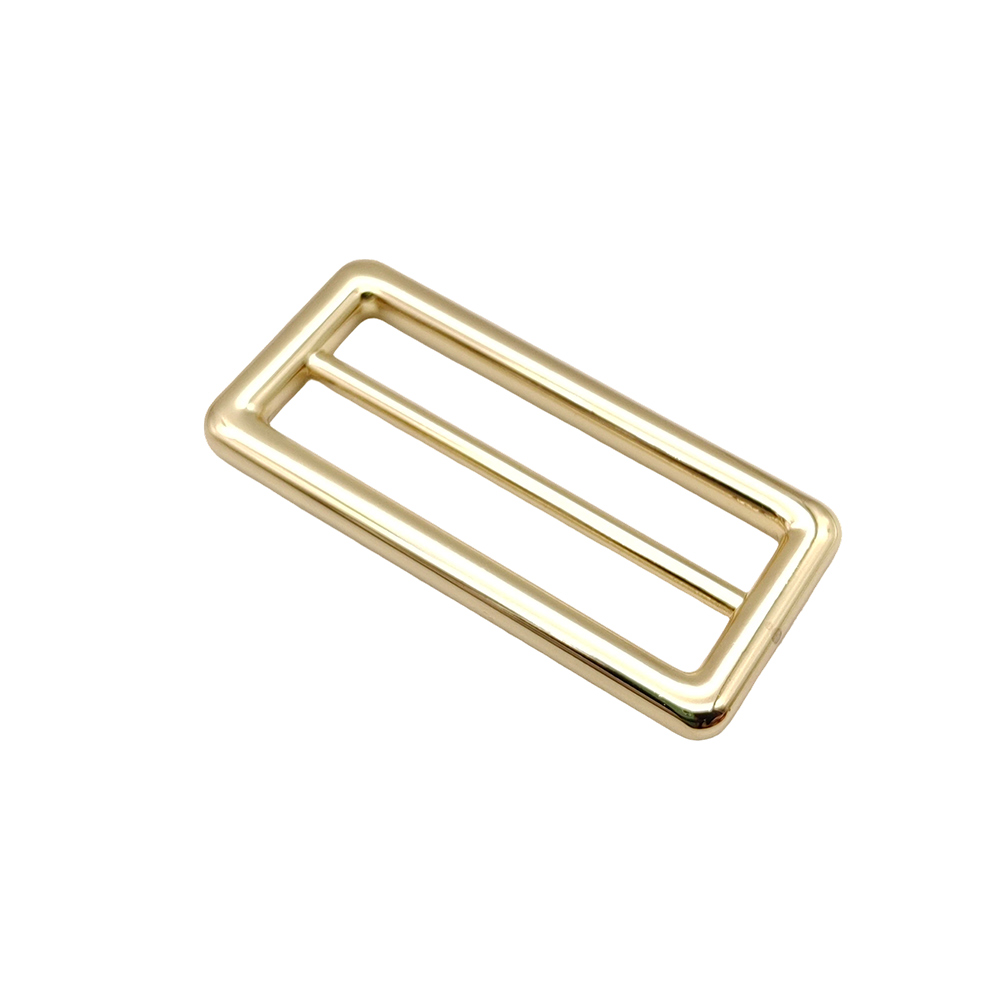
Factory experience matters most on curved, visible hardware. The production route begins with raw Zinc Alloy material selected for the planned casting geometry. During Die Casting, the mold must fill the rectangular frame and Center Bar without creating weak sections or visible flow defects. Trimming removes excess material around the casting gate. Grinding then controls parting lines and edges, while several Polishing stages prepare the curves and recessed areas for an even surface.
After cleaning and inspection, Assembly requirements are checked where applicable. Electroplating follows the approved surface route. On curved surfaces, insufficient preparation can make color variation more obvious, so polishing and plating conditions are evaluated together rather than treated as unrelated steps. Salt Spray Testing may be arranged according to the customer’s project requirements. Finally, QC Inspection checks dimensions, bar centering, visible finish, edge condition, and packing quantity. This sequence is intended to reduce avoidable returns caused by appearance approval being separated from functional testing.
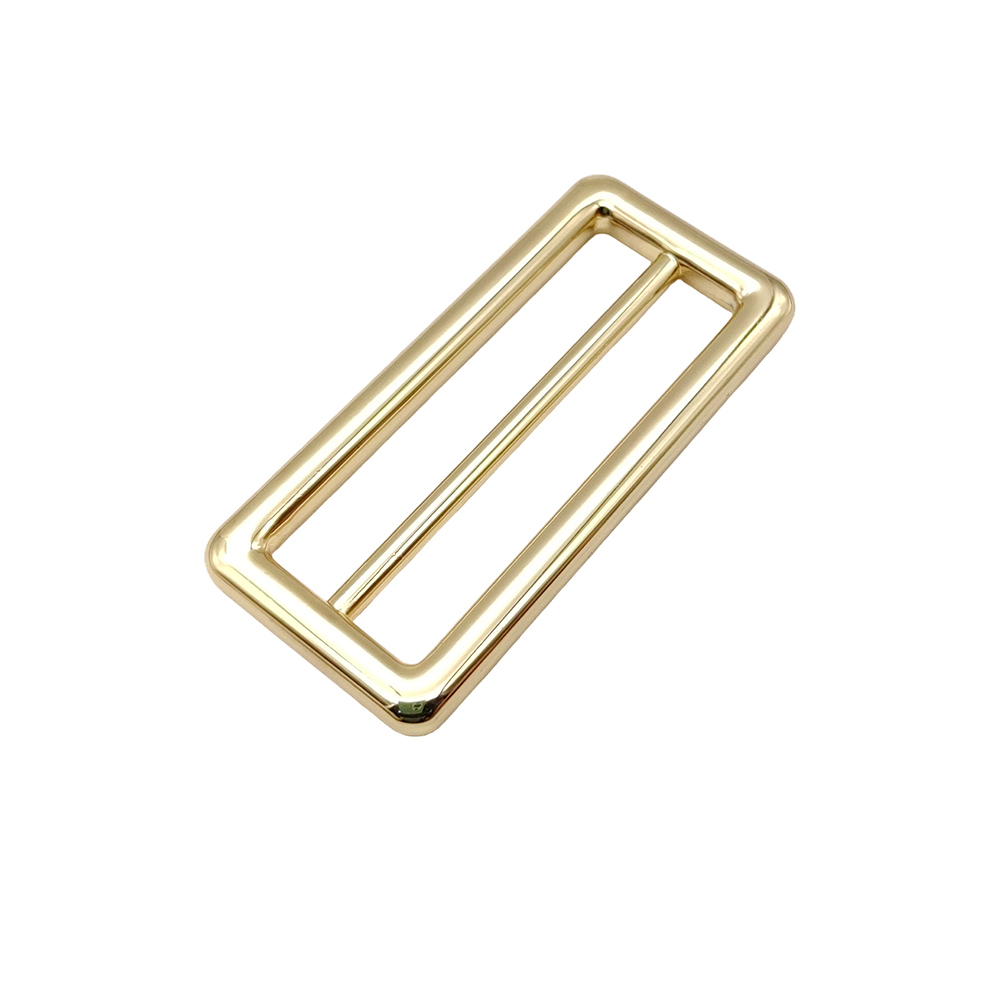
This product is suitable for brands that need a standard rectangle slider with practical customization options. Stock versions are useful when the webbing and finish already match the design brief. Light customization is more appropriate when the brand needs a different interior size, plating finish, or packaging presentation. A Custom Mold is justified when the bar position, frame proportion, logo treatment, or proprietary clearance cannot be achieved by modifying a stock version.
It may not be the right starting point for buyers seeking a heavy-duty industrial tie-down buckle, a quick-release cam mechanism, or a completely new locking system. Those applications require different load and release criteria. For handbag and fashion-strap programs, the decision should be based on fit, finish, wear testing, and supply consistency rather than the outside silhouette alone.
DG Buddy can review OEM and ODM requirements for this strap hardware. Depending on the drawing and order plan, options may include a Custom Mold, laser logo, embossed logo, debossed logo, oil filling, and selected Electroplating finishes. Private Label preparation can extend to barcode labels, hang tags, retail boxes, and customer-specified packaging. Logo feasibility should be checked against the available flat or visible surface; forcing fine artwork onto a small curved area can reduce legibility.
For packing, the fixed standard is Pearl Foam + OPP Bag + Export Carton. Customized Packaging Available can be arranged when the customer provides the required packing method, label artwork, barcode data, or Retail Box specification. Free stock samples are available; custom sample fees fully deductible from bulk orders. Courier charges are borne by the customer.
Electroplated hardware should be protected from humidity, sweat, acidic residues, and direct contact with wet leather or unfinished dyed materials. During storage, keep the components dry and separated so metal surfaces do not rub against one another. For transportation, retain the protective Pearl Foam and avoid loose bulk packing that can create repeated contact marks. If cleaning is required, use a soft, dry cloth first. Do not apply abrasive compounds or acidic cleaners unless the finish has been specifically tested with that chemical.
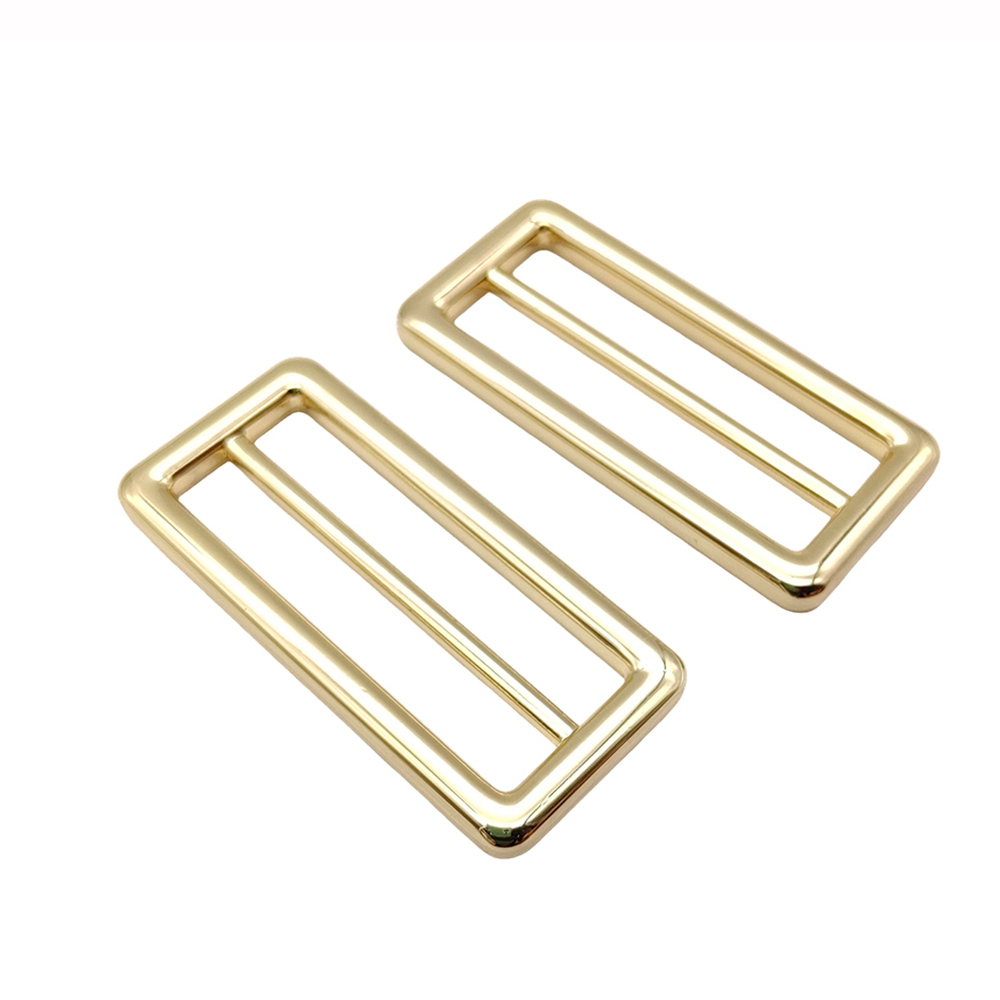
The standard MOQ for this individual hardware item is 1000 pcs, negotiable based on order details. The final quantity can depend on the selected finish, packaging plan, sampling status, and whether a Custom Mold or other OEM work is required. Buyers should provide the target quantity and finish assortment when requesting a quotation so the factory can review the complete sourcing requirement.
Sample Time is 5–7 Days for a custom or tooling-related sample. Stock samples are usually faster, subject to availability. Production Time is 10–15 Days, and Delivery Time is 10–15 Days under the fixed business information for this product program. Actual scheduling should be confirmed against the approved drawing, finish, order quantity, and shipping arrangement.
Free stock samples available; custom sample fees fully deductible from bulk orders. Courier charges are borne by the customer. A stock sample is useful for checking the visible shape, weight, and basic strap routing. A custom sample is recommended when the interior size, logo, plating, or packaging differs from the stock version.
Yes. Custom interior sizing is available to match proprietary webbing widths and thicknesses. The buyer should provide the actual strap specification, including woven or coated construction, finished width, thickness, and intended use. The factory can then evaluate whether a light dimensional adjustment is practical or whether a new mold is required.
Multiple plating finishes can be reviewed for brand matching. Depending on the geometry, logo options may include laser logo, embossing, debossing, or oil filling. Logo artwork should be checked for minimum line width and available application area before tooling approval. A physical sample remains the safest way to approve color and legibility.
We maintain quality certification documentation and are happy to provide the current valid certificates upon request during your sourcing evaluation. The appropriate documents depend on the project, destination, customer requirements, and applicable testing scope. Please identify the required compliance documentation during quotation review rather than assuming that every order needs the same file set.
Buyers should inspect the frame profile, center-bar alignment, wire diameter, interior clearance, corner smoothness, plating consistency, weight range, and strap movement. For a load-bearing Component, repeated adjustment and tension testing are more informative than a visual check alone. The approved golden sample should be used as the reference for color, feel, and appearance.
DG Buddy approaches this product as a manufacturing and development item rather than only a catalog image. The team combines nearly 20 years of manufacturing experience with OEM development, sampling coordination, engineering support, QC Inspection, and responsive communication. The practical advantage for a sourcing manager is a clearer path from webbing specification to drawing, sample approval, finish confirmation, production, and packing. Buyers can begin with stock evaluation and move to light customization when the product brief requires it.
If you already have technical drawings, webbing samples, or a target plating reference, send them to DG Buddy for review. If you are still comparing suppliers, start with the required strap width, finished thickness, target quantity, finish, packaging method, and delivery destination. We can confirm whether the stock DG-RS050 is suitable, identify the critical tolerance, and advise whether light customization or a Custom Mold is more efficient for your program.
Want to see how our hardware feels in your hand? Download our 2026 Premium Hardware Catalog today, or request a batch of free stock samples for your next quality test—we usually ship them out within 12 hours.