
Rack Plating vs Barrel Plating: Which Electroplating Method Delivers Better Hardware Quality?
Electroplating is one of the final manufacturing stages that determines whether handbag hardware looks premium after months of real-world use or begins showing scratches, color variation, and corrosion shortly after launch. When buyers compare suppliers, one question repeatedly appears during technical discussions: Rack Plating vs Barrel Plating. Although both processes apply a protective metal coating, they are designed for completely different production priorities. Understanding those differences helps buyers avoid costly quality problems while selecting a manufacturing process that matches both their product positioning and budget.
Quick Answer
Question: What is the difference between Rack Plating vs Barrel Plating?
Answer: Rack plating suspends each part individually during electroplating, producing more uniform coating thickness, better appearance, and fewer surface defects. Barrel plating tumbles many small parts together inside a rotating barrel, reducing production cost but increasing the chance of contact marks, uneven coverage, and minor scratches. Luxury handbag hardware almost always benefits from rack plating, while barrel plating is better suited to small functional components with limited cosmetic requirements.
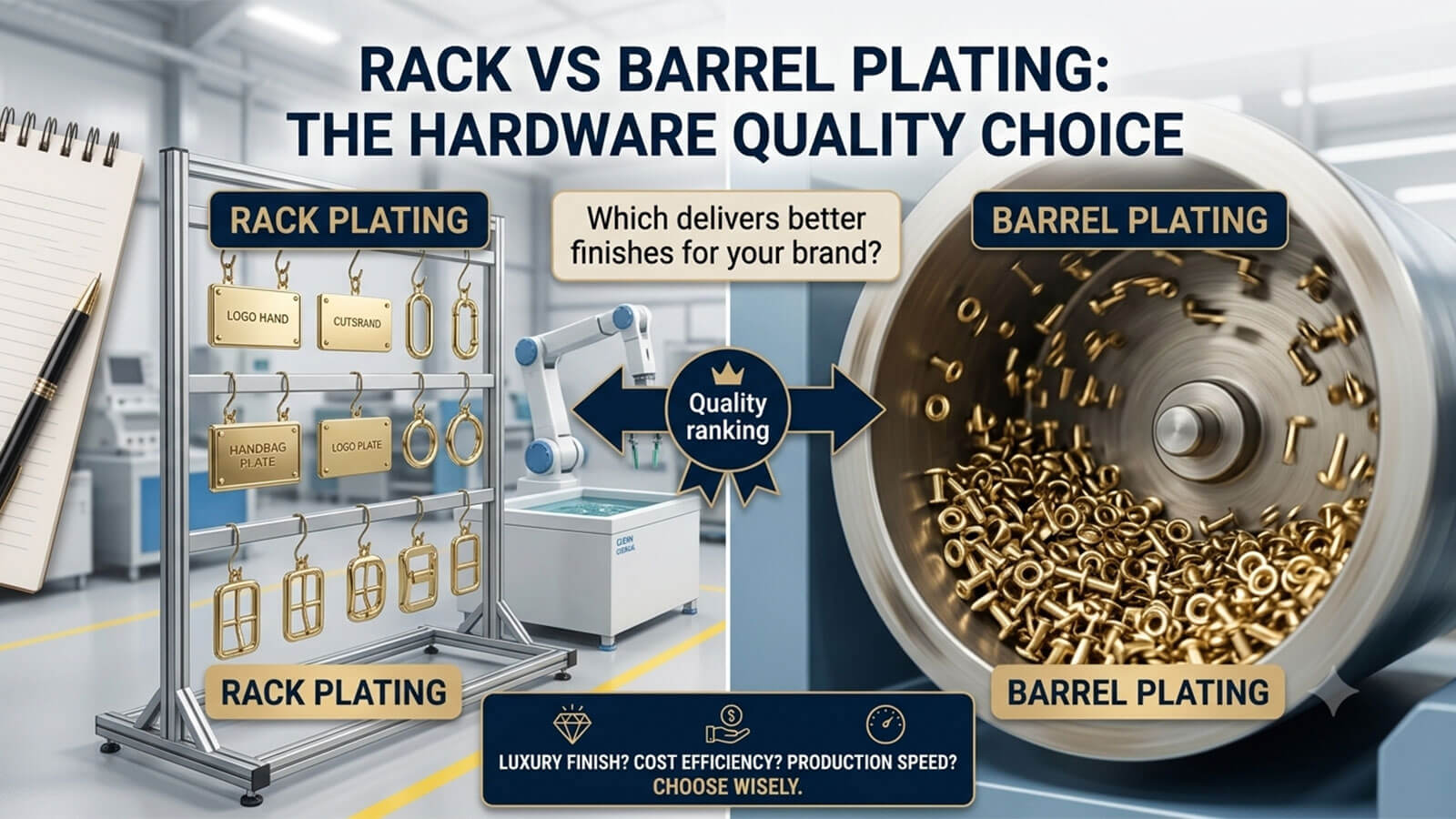
Table of Contents
- Why the Plating Method Matters
- How Rack Plating Works
- How Barrel Plating Works
- Rack Plating vs Barrel Plating Comparison
- Factory Production Experience
- Buyer Considerations
Why the Plating Method Matters
Many buyers focus first on material selection—zinc alloy, brass, or stainless steel. Material certainly affects strength and weight, but it is rarely the only reason hardware performs well. Surface finishing frequently determines whether a beautiful casting still looks attractive after months of handling.
One pattern we consistently see during production audits is that buyers often compare quotations without asking how the electroplating will actually be performed. Two suppliers may both describe their finish as “gold plating,” yet one intends to use rack plating while another plans to process thousands of components together using barrel plating. Those two approaches can produce noticeably different visual results even when the plating chemistry is identical. Similar observations are discussed in our guide to handbag hardware plating types.
For buyers evaluating complete manufacturing cost, plating should be considered alongside tooling, polishing, and inspection. Our article on manufacturing cost breakdown explains why finishing often becomes one of the largest cost variables after raw material selection.
Knowledge Box — Why does plating quality vary between suppliers?
Different plating equipment, polishing quality, current density, and inspection standards all influence the final finish. Even when suppliers use similar metals, inconsistent pretreatment or insufficient plating thickness may produce visible color differences or premature wear. The plating process itself is often a stronger predictor of appearance than the base alloy alone.
How Rack Plating Works
Rack plating holds every component individually on conductive fixtures before entering multiple electroplating baths. Each part remains separated throughout the entire process, allowing electrical current to distribute more evenly across visible surfaces.
Because components never collide with one another during plating, sharp edges remain crisp, polished surfaces stay smooth, and decorative finishes develop a more consistent appearance. This is one reason premium handbag locks, logo plates, buckles, decorative chains, and visible fittings are frequently produced using rack plating.
For brands developing premium collections, browsing our handbag lock hardware category demonstrates the types of visible components that typically require higher cosmetic standards.
Knowledge Box — What products benefit most from rack plating?
Rack plating is recommended whenever appearance directly influences customer perception. Logo hardware, twist locks, buckles, decorative chains, zipper pulls, and exposed metal trims usually justify the additional processing cost because cosmetic consistency becomes part of the product’s value.
International quality systems increasingly emphasize consistent finishing performance alongside corrosion resistance. Manufacturers commonly reference standards published by ISO when documenting production management systems, while environmental compliance frequently follows REACH requirements for restricted substances.
How Barrel Plating Works
Barrel plating takes a very different approach. Hundreds or even thousands of small components are placed inside a rotating barrel. During electroplating the entire barrel slowly turns, allowing electrical current to reach the moving parts collectively.
This method dramatically increases production efficiency because operators can process large quantities simultaneously. Labor requirements fall, equipment utilization improves, and unit cost decreases. For small functional hardware hidden inside finished products, these savings may outweigh minor cosmetic imperfections.
The compromise comes from constant part-to-part contact. While rotating, components touch each other repeatedly, making small scratches, polished edge rounding, and localized coating variation more likely. These effects become increasingly noticeable on mirror-polished decorative hardware.
Knowledge Box — Can barrel plating still produce good quality?
Yes. Barrel plating is not inherently poor quality. It performs very well for screws, rivets, washers, eyelets, and other compact components where tiny cosmetic marks have little influence on finished products. Problems arise when manufacturers apply barrel plating to highly visible luxury hardware where appearance expectations are much higher.
Rack Plating vs Barrel Plating Comparison
| Factor | Rack Plating | Barrel Plating |
| Appearance | Excellent consistency | Moderate consistency |
| Surface Contact | No part collision | Continuous part contact |
| Scratch Risk | Very low | Higher |
| Plating Thickness | More uniform | Can vary slightly |
| Production Speed | Lower | Higher |
| Labor Cost | Higher | Lower |
| Luxury Hardware | Highly recommended | Generally not preferred |
| Small Functional Parts | Possible | Ideal choice |
The comparison above explains why experienced OEM buyers rarely evaluate plating cost by itself. They instead consider the intended market, expected retail price, and long-term customer experience before selecting the process. Buyers who skip this step often find that small savings during manufacturing later become expensive warranty claims after products reach consumers.
View our product catalog
Download our complete handbag hardware catalog with full specs, finishes, and minimum order details.
⬇ Download catalogGet in touch with us
Have questions about pricing, MOQ, or lead time? Our team is ready to assist with your sourcing needs.
→ Contact usFactory Production Experience
In our production experience, the most successful projects begin with a discussion about product positioning rather than plating cost alone. A luxury handbag brand and a promotional accessories brand may use identical zinc alloy castings, yet their finishing requirements are completely different. The plating process should always match the product’s expected market rather than simply the lowest quotation.
A common misunderstanding is that thicker plating automatically solves cosmetic problems. In reality, plating thickness cannot compensate for poor polishing, surface porosity, or damage caused when parts collide during processing. The quality of die casting, grinding, polishing, cleaning, activation, electroplating, and final inspection all contribute to the finished appearance.
Visible hardware such as logo plates, turn locks, decorative buckles, and chain connectors generally benefit from rack plating because every surface remains exposed to a more consistent current density. This helps maintain smoother color transitions and reduces variation between production batches.
For concealed functional parts—including rivets, eyelets, washers, and certain internal fittings—barrel plating often delivers an excellent balance between manufacturing efficiency and acceptable cosmetic quality.
Knowledge Box — Why polishing matters before plating
Electroplating follows the existing surface rather than hiding imperfections. Fine scratches, casting marks, polishing waves, and pinholes remain visible after plating, especially with bright nickel, light gold, or mirror chrome finishes. Improving polishing quality before plating generally produces a greater visual improvement than simply increasing plating thickness.
Many premium brands also validate corrosion resistance using internationally recognized procedures such as ASTM B117 Salt Spray Testing. Passing a corrosion test depends on material selection, pretreatment, plating quality, and sealing—not on the plating method alone.
Buyer Considerations
Selecting between Rack Plating vs Barrel Plating should be based on the product’s intended use rather than habit. Buyers who evaluate only the unit price often overlook downstream costs such as product returns, inconsistent color between production lots, or customer complaints about premature finish wear.
When requesting quotations, it is helpful to specify the required appearance standard instead of simply asking for “gold plating.” Describing whether the hardware will be highly visible, mirror polished, brushed, or antique finished allows the manufacturer to recommend the most appropriate process.
Brands developing customized collections can also discuss plating options during the OEM stage through our custom handbag hardware manufacturing service. Early engineering reviews frequently prevent unnecessary tooling revisions after sampling.
If multiple decorative components are used within the same collection, maintaining process consistency becomes equally important. Selecting the same plating route for locks, buckles, rings, zipper pulls, and logo hardware helps reduce visible color variation across the finished handbag. Buyers can also review suitable categories within our handbag buckle hardware collection when planning coordinated hardware sets.
Knowledge Box — Should luxury brands always choose rack plating?
Not necessarily, but most visible luxury hardware benefits from rack plating because appearance consistency is a priority. Functional components hidden inside a product may still be produced using barrel plating if cosmetic standards are less demanding and cost efficiency is important.
Buyer Checklist Before Choosing a Plating Method
- Verify the base material (zinc alloy, brass, stainless steel, or iron).
- Confirm whether visible decorative parts require rack plating.
- Ask whether hidden functional components can use barrel plating.
- Request the target plating thickness and coating specification.
- Confirm polishing quality before electroplating begins.
- Request corrosion-resistance testing requirements, such as salt spray testing.
- Confirm color consistency requirements across multiple hardware components.
- Review OEM sampling procedures before mass production.
- Verify expected production lead time for both plating options.
- Document cosmetic acceptance standards before approving production.

Conclusion
Choosing between Rack Plating vs Barrel Plating is less about determining which process is universally better and more about selecting the right solution for the product’s quality expectations. Rack plating offers superior appearance, more consistent coating thickness, and lower risk of cosmetic damage, making it the preferred option for premium decorative handbag hardware. Barrel plating provides outstanding production efficiency and lower manufacturing costs, making it suitable for many small functional components where minor surface marks are acceptable.
From our manufacturing experience, successful OEM projects usually combine both methods strategically rather than relying on only one. Decorative exterior hardware often benefits from rack plating, while selected internal components can use barrel plating to improve production efficiency without affecting the customer’s perception of quality.
If you are evaluating finishing options for a new collection, understanding the relationship between material selection, polishing, electroplating, corrosion testing, and quality inspection will lead to more reliable production results. Additional product information is available through Belt Buckle Logo Plate, while material guidance can be found at Zinc Alloy materials, and manufacturing process information can be added through Handbag Hardware Quality Control Process.
Frequently Asked Questions
Which is better: Rack Plating vs Barrel Plating?
Rack plating generally delivers better cosmetic quality because each component is plated individually. Barrel plating is more economical and works well for many small functional parts that do not require a flawless decorative finish.
Does rack plating improve corrosion resistance?
Rack plating can improve coating uniformity, but corrosion resistance also depends on plating thickness, pretreatment, sealing, and quality control. The plating method alone does not determine durability.
Why is rack plating more expensive?
Rack plating requires operators to mount every component individually before processing. This increases labor time, reduces production throughput, and raises manufacturing cost compared with barrel plating.
Can zinc alloy hardware be barrel plated?
Yes. Zinc alloy hardware can be barrel plated when cosmetic requirements are moderate. Decorative luxury hardware usually benefits from rack plating to reduce surface contact marks.
How do buyers specify the correct plating process?
The best approach is to describe the hardware’s appearance requirements, application, expected durability, and testing standards instead of requesting only a color. This allows the manufacturer to recommend the most suitable electroplating process.
Is rack plating necessary for luxury handbag hardware?
In most cases, yes. Luxury products place much greater emphasis on appearance consistency, smooth surfaces, and premium visual quality. Rack plating helps achieve these requirements more reliably than barrel plating for exposed decorative hardware.
Ready to source your handbag hardware?
Explore our full product range, request a custom quote, or reach out directly — we respond fast.