
Types of Zippers for Bags: A Complete Guide to Nylon, Resin & Metal Zippers
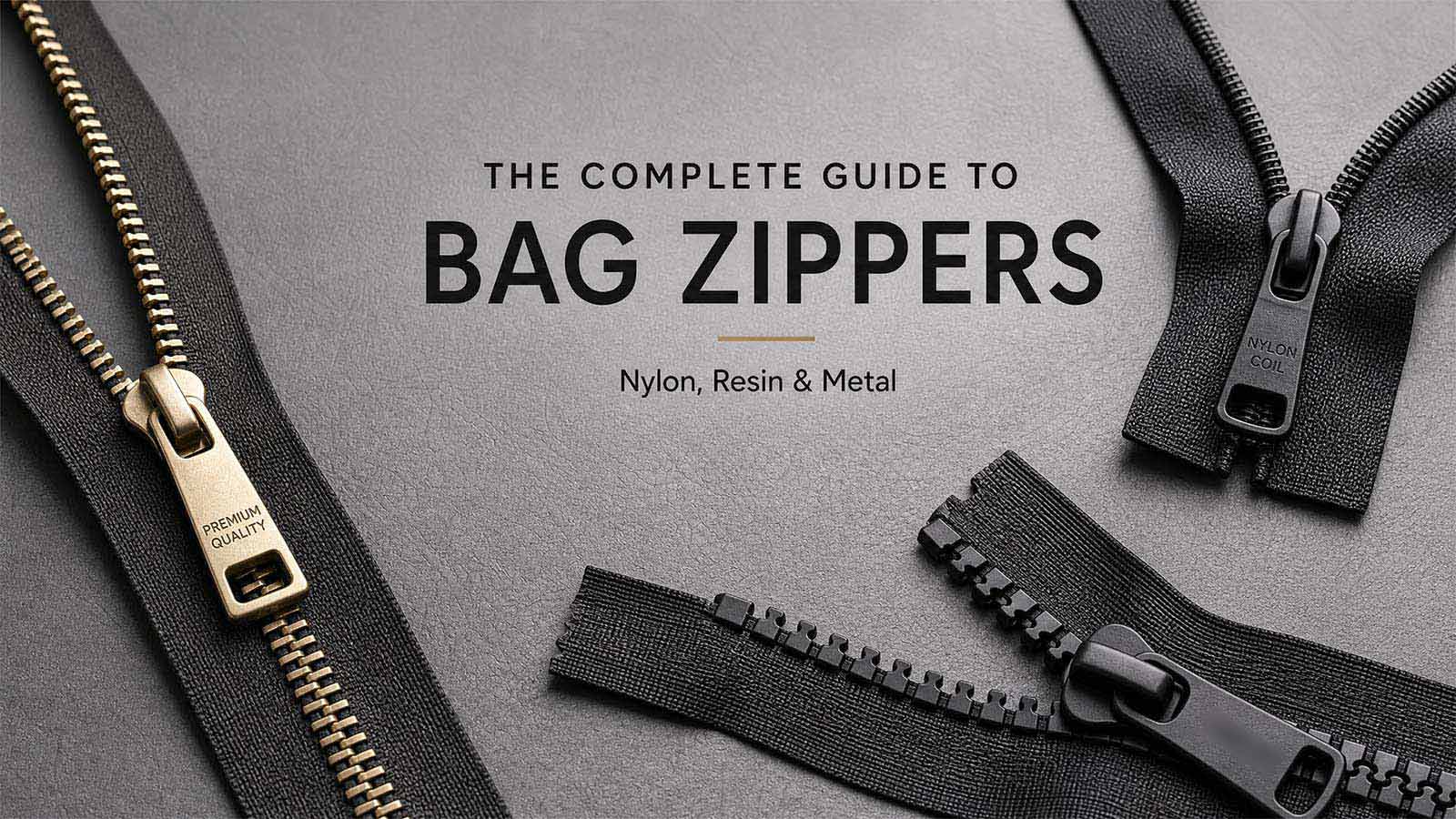
If you manufacture or source bags, the zipper you choose affects more than looks. It decides whether a customer’s backpack survives two years of daily commuting or fails at the worst possible moment. This guide breaks down every major type of zipper used in bag manufacturing, how the tail structure and size numbering work, and how experienced buyers select the right zipper for their product line — pairing well with our broader bag hardware selection guide for a full trims and hardware sourcing overview.
Quick Answer
What are the main types of zippers for bags? Bag zippers fall into three material categories: nylon coil zippers (soft, flexible, low cost), resin plastic zippers (molded plastic teeth, bold and durable), and metal zippers (brass, aluminum, or nickel teeth, premium look and high strength). Most fashion handbags use size 3 to 5 nylon or metal zippers, while backpacks and luggage typically use size 5 to 10 resin or metal zippers for heavier loads.
Key Takeaways
- ✔ Three base materials exist: nylon coil, resin (molded plastic), and metal — every other zipper variant is built from one of these.
- ✔ Zipper size numbers (3# to 10#) refer to the width of the closed teeth in millimeters, not the tape width.
- ✔ Closed-end, open-end, and double-slider structures determine whether a zipper can fully separate.
- ✔ Waterproof zippers use a PU or PVC film laminated onto nylon tape and typically test to a hydrostatic pressure rating rather than just “water-resistant” marketing claims.
- ✔ ASTM D2061 and D2059 remain the reference standards most Western buyers request during factory audits.
- ✔ Salt spray resistance of 48–96 hours is the realistic benchmark for metal zipper plating on export-grade bags.
Table of Contents
- 1. Zipper Anatomy: What Buyers Should Know Before Comparing Types
- 2. Zipper Types by Material
- 3. Zipper Types by Tail Structure
- 4. Specialty Zippers for Bag Applications
- 5. Zipper Size Guide: What #3 to #10 Actually Means
- 6. Comparison Table: Nylon vs Resin vs Metal
- 7. Pros and Cons of Each Zipper Type
- 8. Common Mistakes When Sourcing Bag Zippers
- 9. Factory Expert Tips From OEM Production
- 10. Quality Assurance and Compliance Standards
- 11. Expert Recommendation: Which Zipper Fits Your Bag?
- 12. Conclusion
- 13. FAQ
1. Zipper Anatomy: What Buyers Should Know Before Comparing Types
A zipper is not a single part — it is an assembly of five components that must be engineered together. Understanding this assembly explains why two zippers that look identical in a product photo can behave completely differently in the field.
What Makes Up a Bag Zipper?
What: A complete zipper consists of the tape (the fabric strip sewn into the seam), the elements or teeth (coil, molded, or metal), the slider (the moving part that locks or opens the teeth), the pull tab, and the top/bottom stops. Why: Each part is sourced, tested, and finished separately in most factories, so quality can vary part by part even within the same zipper. How: A responsible OEM factory audits tape tensile strength, element pull-off force, and slider lock strength individually before assembling finished zippers for a production run.
Why the Slider Matters More Than Buyers Expect
What: The slider is the single component most likely to fail first — through cracking, deformation, or the auto-lock mechanism wearing out. Why: A slider undergoes thousands of open-close cycles over a bag’s lifespan, far more mechanical stress than the tape or teeth. How: We test slider durability with repeated open-close cycling and torsion tests on the pull tab, following the methodology outlined in ASTM D2061, before approving a slider supplier for mass production.
Tape Quality: The Overlooked Failure Point
What: Zipper tape is woven or knitted polyester tape that anchors the teeth and gets sewn into the bag panel. Why: Cheap tape stretches under load, causing teeth to misalign and the zipper to gap open even when the slider itself is fine. How: Buyers should request tape tensile strength data, not just a sample zipper, since tape performance only becomes obvious after repeated stress in the finished product.
2. Zipper Types by Material
Every zipper used in bag manufacturing is built from one of three base materials. The material choice shapes weight, flexibility, cost, and how the finished bag reads to a retail customer.
Nylon Coil Zippers
Nylon coil zippers, also called spiral zippers, are made by winding a continuous nylon monofilament into a coil shape and stitching it onto the tape. This construction is what gives coil zippers their signature flexibility — the coil can curve around corners and pockets that molded teeth cannot follow. Coil zippers dominate handbag linings, laptop sleeves, and the interior pockets of backpacks because they are lightweight, quiet in operation, and available in almost unlimited tape colors to match a brand’s palette.
Within this category, factories further offer invisible zippers (teeth hidden behind the tape for dresses and clean-line handbag pockets), waterproof-laminated coil zippers, double-tape reinforced coil zippers for heavier straps, and reflective-tape coil zippers for outdoor and safety gear.
Resin (Molded Plastic) Zippers
Resin zippers use individually injection-molded POM (polyoxymethylene) plastic teeth fused onto the tape. Unlike coil zippers, each tooth is a separate, rigid unit, which gives resin zippers a bold visual profile and higher resistance to tooth separation under sideways pulling force.
This makes them a common choice for backpack main compartments, children’s bags, and outdoor gear where the zipper is a visible design element as much as a functional one. Resin teeth can be produced in transparent, semi-transparent, metallic-coated, glow-in-the-dark, or two-tone finishes, giving designers more creative range than either coil or metal options typically allow.
Metal Zippers
Metal zippers use stamped teeth in brass, aluminum, or nickel-plated alloys, crimped directly onto the tape. Brass remains the benchmark for premium handbags and leather goods because of its warm tone and resistance to deformation, while aluminum offers a lighter-weight alternative with a cooler silver finish. Within the metal category.
Buyers will also see antique brass, gunmetal, black nickel, and copper-tone finishes, each requiring a different plating process and carrying a different cost per meter — the same base-metal trade-offs covered in our zinc alloy types guide, since many “metal” zipper pulls and sliders are zinc alloy rather than solid brass. Denim jackets, leather handbags, and premium travel goods rely on metal zippers because the visible hardware communicates quality in a way that plastic teeth generally cannot replicate.
3. Zipper Types by Tail Structure
Beyond material, every zipper is also classified by how the bottom end is constructed, since this determines whether the two sides of the zipper can fully separate.
Closed-End Zippers
Closed-end zippers have a fixed bottom stop that permanently joins both sides of the tape, so the zipper cannot be pulled fully apart. This is the standard structure for pants, cosmetic bags, standard tote pockets, and most everyday handbags where full separation is never needed.
Open-End (Separating) Zippers
Open-end zippers use an insertion pin and box mechanism at the bottom, allowing the two sides to detach completely. This structure is essential for jackets, detachable bag panels, and expandable travel duffels where the two halves need to come fully apart for wear or storage.
Double-Slider (Two-Way) Zippers
Double-slider zippers place two sliders on the same chain, either facing each other (head-to-head, common on suitcases and duffel bags for opening from either end) or facing away from each other (back-to-back, used on some tent doors and structured totes). This structure adds cost and requires precision alignment during assembly, since both sliders must travel the full chain length without jamming.
Reversed Double-Closed (X/O) Zippers
This variant keeps both ends closed but places two sliders on the chain, letting users open a middle section only — useful on backpacks and duffel bags where partial access is more practical than opening the entire compartment.
4. Specialty Zippers for Bag Applications
Once the base material and tail structure are set, bag brands frequently add a functional treatment. These specialty finishes are where most product differentiation happens in the mid-to-premium bag market.
Waterproof Zippers
Waterproof zippers laminate a PU or PVC film over nylon tape and use a solid, unperforated slider to block water at the stitch line. They are standard on outdoor backpacks, camera bags, dry bags, and swim gear. Buyers should ask for a hydrostatic pressure rating rather than accepting a generic “waterproof” label, since performance can range from light splash resistance to genuine submersion protection depending on lamination thickness and slider design.
Reflective Zippers
Reflective zippers weave a reflective yarn or laminate a reflective strip directly onto the tape, improving visibility for cycling bags, safety vests, and night-use travel gear. This is a low-cost addition that meaningfully improves a product’s safety positioning for outdoor and commuter brands.
Heavy-Duty and Reinforced Zippers
Reinforced zippers use a thicker gauge coil or larger resin teeth (typically size 8 or size 10) paired with double-stitched tape, built for hard-shell luggage, tool bags, and military-spec equipment where the zipper carries structural load, not just a closure function.
Anti-Rust and Anti-Corrosion Zippers
For coastal markets or marine-use bags, metal zippers receive additional nickel or e-coating layers to extend salt spray resistance beyond the standard 48-hour benchmark. This matters most for luggage and bags shipped to humid or coastal climates, where standard plating can show surface oxidation within a single season — see our rack vs barrel plating guide for how plating method affects long-term coating durability.

🛠️ OEM/ODM Custom Hardware Solutions
Have a specific engineering drawing or custom design for luxury leather goods? Collaborate directly with our master engineers to transform your sketches into premium brass or zinc alloy components.
Start Your Custom Project →📂 Digital Product Catalog Access
Explore our comprehensive range of high-end handbag accessories, metal logo,turn locks, buckles, and chains. Download the full specifications and options catalog for your sourcing library.
Download Full Catalog ↓5. Zipper Size Guide: What #3 to #10 Actually Means
Zipper size numbers refer to the width, in millimeters, of the closed zipper teeth or coil measured across both sides — not the tape width or the slider size. Larger numbers mean wider, stronger teeth capable of carrying heavier structural loads.
- #3: Compact inner pockets, cosmetic bags, small leather goods
- #5: The default size for handbags, everyday backpacks, and jackets — roughly 70% of fashion bag zippers fall in this range
- #7 / #8: Backpack main compartments, travel bags, and mid-weight luggage
- #10: Hard-shell luggage, tool bags, and heavy-duty equipment cases
- #15 to #30: Industrial, marine, and tarpaulin applications, rarely used in consumer bags
A common sourcing mistake is specifying a size based on how a sample “feels” rather than the load the pocket will actually carry. A size 3 zipper on a laptop sleeve pocket that regularly holds a charger brick and cables will show premature wear far sooner than the same pocket built with a size 5 zipper.
6. Comparison Table: Nylon vs Resin vs Metal
| Property | Nylon Coil | Resin (Molded) | Metal |
| Flexibility | High | Medium | Low |
| Weight | Lightest | Medium | Heaviest |
| Cost per meter | Lowest | Medium | Highest |
| Color range | Widest (tape and coil dyeable) | Wide (molded color options) | Limited to plating finish |
| Typical bag use | Linings, pockets, fashion handbags | Backpacks, outdoor gear, kids’ bags | Premium handbags, denim, leather goods |
| Repair/replacement | Easiest to resew | Moderate | Hardest, often needs full replacement |
| Noise in use | Quiet | Slight click | Audible metallic sound |
7. Pros and Cons of Each Zipper Type
Nylon Coil — Pros: Lightweight, flexible around curved seams, wide color matching, lower cost for large production runs. Cons: Individual coil elements can be pried open under sideways stress, and long-term UV exposure can fade unprotected tape colors.
Resin (Molded Plastic) — Pros: Bold visual profile, strong resistance to tooth separation, good for children’s and outdoor products where visible chunky hardware is a design feature. Cons: Heavier than coil, and a single cracked tooth usually requires replacing the full zipper rather than a local repair.
Metal — Pros: Premium appearance, high tensile strength, long service life when plating is done correctly. Cons: Highest cost, heaviest weight, and plating can tarnish or corrode if the base alloy or nickel layer is under-specified for the shipping climate.
8. Common Mistakes When Sourcing Bag Zippers
- Choosing a zipper size based on appearance alone rather than the actual load and stress the pocket will see in daily use.
- Accepting a “waterproof” claim without requesting a hydrostatic pressure test result or lamination spec.
- Overlooking tape tensile strength while focusing only on the slider and teeth during sample approval.
- Mixing zipper suppliers mid-production, which can create subtle color or dimension mismatches between batches.
- Skipping salt spray testing for metal zippers destined for humid or coastal export markets.
- Assuming all “brass” zippers use solid brass teeth, when many use brass-plated zinc alloy at a lower cost and lower long-term durability.
9. Factory Expert Tips From OEM Production
From our OEM production experience manufacturing handbag hardware and zipper components for export brands, a few habits consistently separate durable bags from bags that generate return complaints. First, we always match the zipper’s rated pull strength to the pocket’s real-world load — a laptop compartment needs a different spec than a decorative front pocket, even on the same bag.
Second, we run every metal zipper batch through salt spray testing before shipment approval, targeting 48 to 96 hours of resistance depending on the destination market’s humidity profile. Third, we insist on dimensional consistency checks across dye lots, since a slider that fits loosely on one batch of tape but tightly on another is one of the most common causes of field complaints after a production run ships.
We also see buyers underestimate mold and tooling lead time when a custom zipper pull or logo-branded slider is required. A custom zinc alloy zipper pull typically needs a dedicated mold, similar to the process used for a custom metal logo tag, and that tooling timeline should be planned alongside fabric and trim sourcing, not after it.
Quality Assurance and Compliance Standards for Bag Zippers
Western retailers increasingly require documented compliance before accepting a container of finished bags, and zippers are one of the most frequently flagged components during a compliance audit because of plated metal parts and chemical treatments on tape.
Chemical Compliance: REACH, RoHS, and OEKO-TEX
What: REACH restricts substances such as nickel release and certain phthalates in items with prolonged skin contact, RoHS restricts heavy metals like lead and cadmium in plated finishes, and OEKO-TEX Standard 100 screens zipper tape for harmful substances relevant to skin-contact products.
Why: Buyers shipping into the EU or working with major US retailers are routinely asked to provide test reports for these three standards before a purchase order is finalized. How: A responsible factory sends metal zipper components and tape samples to a third-party lab such as SGS at the start of a new development, not after a shipment is already flagged at customs. For metal zipper pulls specifically, our nickel-free hardware compliance guide covers how nickel release limits apply to plated components that sit against skin.
Manufacturing Quality: ISO 9001 and Salt Spray Testing
What: ISO 9001 certification confirms a factory follows a documented quality management system across incoming materials, in-process checks, and final inspection. Salt spray (fog) testing, run to ASTM D2059 or an equivalent ISO method, exposes plated metal zippers to a saline mist chamber to simulate months of humidity or coastal exposure in a controlled test window.
Why: These two checks together tell a buyer whether a factory’s processes are consistent, and whether a specific plating recipe will actually hold up after shipping to a humid destination market. How: When evaluating a new zipper or hardware supplier, ask for the ISO 9001 certificate scope and a recent salt spray test report for the specific plating finish you plan to order, not a generic marketing claim of “high quality.”
11. Expert Recommendation: Which Zipper Fits Your Bag?
When should you choose nylon coil? Choose coil for fashion handbags, linings, and any pocket with curved seams where flexibility and color matching matter more than raw pull strength. When should you choose resin? Choose resin for backpacks, children’s products, and outdoor gear where a bold visible zipper and resistance to sideways prying are priorities.
When should you choose metal? Choose metal for premium leather goods, denim, and any product where the hardware itself is part of the brand’s visual identity — but only after confirming the plating specification matches your target market’s climate.
For brands unsure which option fits a new design, requesting physical samples in two or three zipper types on the same sample bag remains the most reliable way to compare weight, sound, and hand-feel before committing to a production order.

12. Conclusion
Choosing between nylon coil, resin, and metal zippers ultimately comes down to matching the zipper’s material, size, and tail structure to how the finished bag will actually be used — not just how the sample looks on a desk. Buyers who specify size, tape tensile strength, and plating requirements upfront consistently see fewer quality complaints after mass production than buyers who leave those details to the factory’s default settings.
If you are developing a new bag collection and want to compare nylon, resin, and metal zipper samples side by side, our team can prepare matched samples along with compatible zipper pull hardware and buckle hardware for your next collection. Reach out for a free sample kit and we’ll walk you through the right specification for your production volume.
FAQ
What is the difference between a nylon zipper and a metal zipper?
A nylon zipper uses a coiled monofilament for its teeth, making it lightweight and flexible, while a metal zipper uses stamped brass, aluminum, or nickel teeth crimped onto the tape, giving it a heavier feel, higher tensile strength, and a premium visual finish.
What size zipper is used for handbags?
Most handbags use a size 3 or size 5 zipper, with size 5 covering the majority of everyday totes, crossbody bags, and backpacks, while size 3 is typically reserved for smaller pockets and cosmetic bags.
Are resin zippers better than metal zippers?
Neither is universally better — resin zippers resist sideways tooth separation well and suit outdoor or children’s products, while metal zippers offer a premium appearance and higher tensile strength that suits leather goods and denim. The right choice depends on the bag’s use case and target price point.
How do I know if a zipper is genuinely waterproof?
Ask the supplier for a hydrostatic pressure test result rather than accepting a generic waterproof label. A true waterproof zipper uses a laminated PU or PVC film over the tape and a solid, unperforated slider designed to prevent water entry at the stitch line.
Can zipper color be custom matched to my bag fabric?
Yes, tape color, coil color, and slider plating can all typically be custom matched to a Pantone reference during the sampling stage, though tape dyeing usually requires a minimum order quantity per color.
How long should a bag zipper last before it fails?
A properly specified and tested zipper should withstand thousands of open-close cycles without slider failure. Factories following ASTM D2061 strength testing and D2059 salt spray testing can typically back this performance with test data rather than estimates.
Ready to source your handbag hardware?
Explore our full product range, request a custom quote, or reach out directly — we respond fast.