
PVD Coating for Bag Hardware vs Electroplating: Pros, Cons and When to Choose
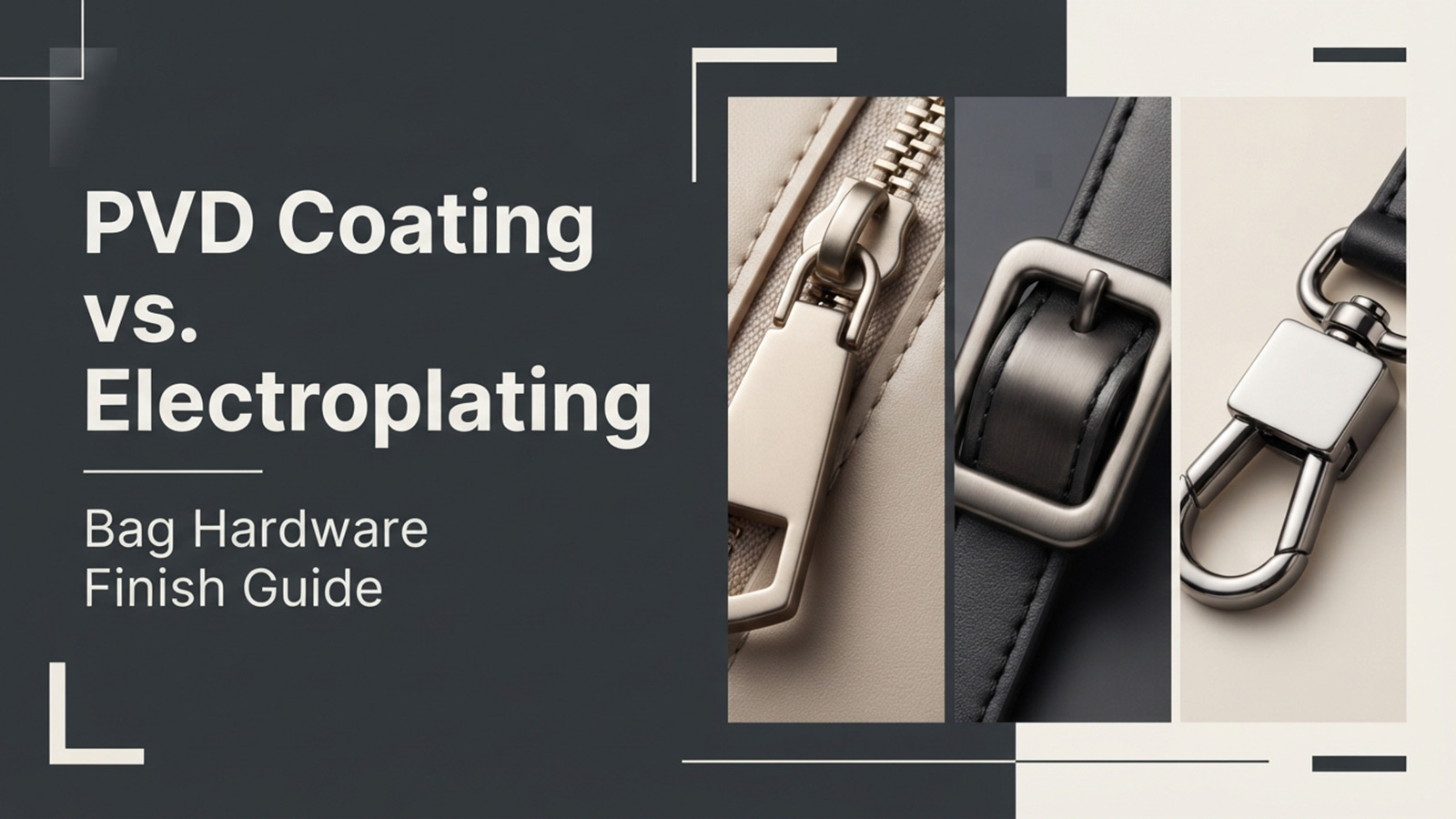
A scratched zipper pull or a peeling buckle can undo months of design work, and the finish you specify is usually the reason. For brands comparing PVD coating for bag hardware with traditional electroplating, the decision shapes durability, cost, compliance and customer reviews. This guide breaks down both processes with factory-level detail so you can specify the right finish the first time.
Quick Answer
PVD coating bonds a thin, ceramic-hard layer to metal inside a vacuum chamber, so it typically outperforms traditional electroplating on scratch resistance, tarnish resistance and salt spray hours. For high-touch parts such as zipper pulls, buckles and logo plates, PVD is usually the better long-term choice. Electroplating still fits decorative pieces, bright gold tones and tighter budgets.
Key Takeaways
- PVD (physical vapor deposition) creates a molecular-level bond in a vacuum; electroplating builds a metal layer in a chemical bath, so the two finishes age very differently.
- Typical PVD coatings reach about HV 1,500–3,000, several times harder than decorative electroplating (industry-estimated ranges, not lab guarantees).
- Well-built PVD stacks are commonly specified well beyond the 24–48 hour salt spray baseline of basic decorative plating.
- PVD costs more per piece but often lowers lifecycle cost on high-touch parts; electroplating remains practical for decorative or short-life designs.
- Write base metal, coating stack, salt spray hours and adhesion criteria into the purchase order, not just a color name.
Table of Contents
- How PVD Coating and Electroplating Actually Work
- PVD vs Electroplating: Performance on Real Hardware
- PVD vs Electroplating Cost, MOQ and Lead Time
- Environmental and Compliance Differences
- Where PVD Coating for Bag Hardware Wins: 5 Parts
- Pros and Cons at a Glance
- Common Mistakes When Specifying Finishes
- Factory Expert Tips from the Production Floor
- Expert Recommendation: When to Choose Which
- Conclusion
- FAQ
How PVD Coating and Electroplating Actually Work
The two finishes differ at the atomic level, which is why they age so differently in daily use. Electroplating uses electric current to deposit metal ions from a liquid bath onto the part. PVD, short for physical vapor deposition, vaporizes metal in a vacuum chamber and reacts it into a hard, thin ceramic layer bonded to the surface.
In traditional electroplating, cleaned parts are mounted on racks and moved through a series of baths, typically copper, nickel and a final decorative metal such as gold-tone. Quality depends on bath chemistry, current density and plating time, which is why plating thickness in microns matters so much in a specification. Most common bag hardware plating types, from nickel to antique brass, still use this route.
PVD works differently. Inside a sealed chamber, a solid metal target such as titanium is vaporized and reacted with nitrogen or argon, forming a titanium nitride based layer roughly 0.2–5 microns thick on the part (typical industry range, estimate). Because the coating grows atom by atom, it bonds far more tightly than a plated layer. Suppliers often market this process as vacuum coating.
Knowledge Box: What Is PVD Coating?
What: PVD is a vacuum coating process that deposits a thin, hard film, often titanium nitride, onto metal hardware. Why: the film bonds at a molecular level instead of sitting on top like paint or a plated layer, so it resists scratching, sweat and humidity far better. How: parts are polished, cleaned, fixtured in a chamber, then coated as the vaporized metal reacts with process gas. Surface preparation decides the final look, because PVD is too thin to hide polishing defects.
PVD vs Electroplating: Performance on Real Hardware
On the metrics buyers feel in hand — scratching, tarnish and corrosion — PVD coating durability is consistently ahead, while electroplating keeps an edge in bright color range and upfront cost. The table below summarizes typical orientation values for decorative handbag hardware finishes.
Table scope: values are typical industry-specified ranges for decorative handbag hardware, compiled from public supplier and technical sources (accessed 2025–2026). Treat them as orientation estimates and confirm with project-specific test reports.
| Criterion | PVD Coating | Traditional Electroplating |
|---|---|---|
| Bond mechanism | Molecular-level bond | Surface metal adhesion |
| Typical thickness | ~0.2–5 μm (estimate) | ~0.1–3 μm decorative (estimate) |
| Hardness | ~HV 1,500–3,000 (estimate) | ~HV 200–800 by metal (estimate) |
| Salt spray orientation | Often specified 96 h+ for premium stacks | Basic decorative 24–48 h; more with sealing |
| Wear pattern | Gradual, even wear | Can chip or peel when thin |
| Color range | Gold, rose gold, black, gunmetal, rainbow | Widest range, incl. bright gold |
| Process waste | No wet plating wastewater | Metal-bearing baths need treatment |

🛠️ OEM/ODM Custom Hardware Solutions
Have a specific engineering drawing or custom design for luxury leather goods? Collaborate directly with our master engineers to transform your sketches into premium brass or zinc alloy components.
Start Your Custom Project →📂 Digital Product Catalog Access
Explore our comprehensive range of high-end handbag accessories, metal logo,turn locks, buckles, and chains. Download the full specifications and options catalog for your sourcing library.
Download Full Catalog ↓Numbers only tell the story with context. A basic flash-plated zipper pull may fail within a season of daily use, while a PVD-coated pull on the same bag usually shows slow, even wear over years (common manufacturing scenario, not a guaranteed lifespan). Conversely, a thick, well-sealed electroplated finish can still perform respectably on low-contact decorative parts.
Knowledge Box: Why the Base Metal Decides the Result
PVD is not a magic layer that fixes weak substrates. On zinc alloy (Zamak) die-cast parts — the workhorse of bag hardware — a copper-nickel undercoat is normally applied before PVD to seal porosity and improve corrosion resistance. Stainless steel can take PVD directly and gives the strongest stack; brass sits in between. When two suppliers quote very different PVD prices, the difference is often the undercoat, not the color.
Knowledge Box: How Salt Spray Hours Predict Field Life
A salt spray test exposes hardware to a salt fog under standardized conditions such as ASTM B117, then records when corrosion appears. Lab hours do not convert directly into months of use, but they rank finishes reliably: a 48-hour neutral salt spray baseline is common for zinc alloy hardware, while premium PVD stacks are often specified higher. Our guide to salt spray test methods for fashion hardware explains how to read a report.
PVD vs Electroplating Cost, MOQ and Lead Time
PVD costs more per piece; whether it costs more per bag sold depends on returns and brand positioning. The PVD vs electroplating cost gap comes from chamber time, fixturing and polishing labor, and it narrows as batch volume grows. Exact premiums vary by part size and color, so treat any quote comparison as project-specific (estimate).
- Part size and geometry: large or deeply recessed parts load chambers inefficiently and cost more to coat evenly.
- Polishing quality: PVD shows every surface defect, so better pre-polishing adds labor before coating starts.
- Color and stack: standard gold tones are simplest; special colors or extra protective top layers add process steps.
- Batch volume: chamber loads carry fixed costs, so very small runs bear the highest per-piece premium.
Lead time also differs. Many hardware factories run in-house rack plating lines but send PVD work to specialized vacuum coaters, adding transport and queue days (common manufacturing scenario). At DG Buddy, standard OEM orders are quoted at roughly 10–15 days for delivery, and finishes requiring outside PVD processing are scheduled accordingly during sampling and production planning.
Environmental and Compliance Differences
PVD is the cleaner coating step: it happens in a vacuum chamber with no chemical baths and no metal-bearing wastewater from the coating itself. Traditional electroplating relies on liquid chemistry, so responsible plants need licensed wastewater treatment and controlled chemical sourcing. For brands building REACH compliance programs, process chemistry is now part of supplier audits, not just the finished material.
Practical steps for buyers: ask which plant performs the plating, request wastewater treatment evidence, and align on restricted-substance requirements early. The EU REACH regulation frames many of the chemical obligations brands cascade to hardware suppliers, and nickel release remains a common checkpoint for metal parts that touch skin.
Where PVD Coating for Bag Hardware Wins: 5 Parts
PVD earns its premium on parts that suffer constant friction, sweat or handling. For decorative pieces that sit untouched, traditional electroplating usually delivers the same visual result for less money. These five applications see the clearest PVD advantage in OEM production.
- Zipper pulls: rubbed by fingers and fabric on every use; PVD keeps custom zipper pulls looking new far longer.
- Buckles and strap adjusters: webbing friction strips thin plating quickly; PVD resists this abrasion.
- Logo plates: the brand’s signature piece; fading here is the most visible quality failure.
- Chain strap connectors and snap hooks: metal-on-metal contact points wear fast under load.
- Turn locks and clasps: high-touch closures that also face sweat and cosmetic contact.
Electroplating still wins for bright yellow-gold tones, deep recesses that chamber line-of-sight cannot reach evenly, tiny decorative studs, and early prototypes where tooling and color iteration speed matter more than wear life.
Pros and Cons at a Glance
PVD coating
- Pros: much higher hardness and scratch resistance; strong tarnish and corrosion resistance; gradual, even wear pattern; no wet plating wastewater.
- Cons: higher per-piece cost; limited bright-gold range; batch-to-batch color matching needs control; rework requires stripping and recoating.
Traditional electroplating
- Pros: lowest upfront cost; widest color selection including bright gold; fast turnaround on in-house lines; easy to repair or re-plate.
- Cons: thinner, softer layer that can fade or peel; lower salt spray performance without sealing; generates wastewater requiring licensed treatment.
Common Mistakes When Specifying Finishes
- Writing only “PVD” on the tech pack. Without base metal, undercoat and color standard, two factories will quote different stacks and deliver different results.
- Comparing unit price only. A cheaper plated pull that fades in a season costs more in returns and reviews than the PVD upgrade.
- Approving color from photos. Screen color lies; approve physical metal swatches under agreed lighting and keep a signed master sample.
- Skipping test criteria in the PO. Salt spray hours, adhesion checks and abrasion expectations belong in writing before production, not after complaints.
- Assuming PVD hides poor polishing. The layer is microns thin, so every casting or polishing defect shows through; fix the surface first.
Factory Expert Tips from the Production Floor
From OEM production experience at DG Buddy’s Dongguan facility, finish failures are usually process failures, not material surprises. These checkpoints prevent most disputes (general manufacturing guidance; no client data disclosed).
- Polish before you coat. On our rack plating and PVD-prep lines, parts are polished and inspected under light before any coating; a dull base makes a dull PVD finish.
- Approve a finish swatch set. Sign off gold-tone, gunmetal or black swatches and keep sealed masters for batch comparison at mass production.
- Control color by batch. Run zipper pulls, buckles and logo plates in the same chamber load or plating lot when they sit side by side on one bag.
- Test before you ship. Third-party labs such as SGS testing services can verify salt spray and adhesion results when a project needs documented evidence.
- Protect after coating. Individual poly bags or tissue between finished parts prevent transit scratches that buyers mistake for coating failure.
Expert Recommendation: When to Choose Which
Choose PVD when the part is high-touch, the brand promises longevity, or the design uses dark tones like black and gunmetal that show scratches easily on plated zinc alloy. The upgrade pays for itself on zipper pulls, buckles, logo plates and closures carried daily.
Choose traditional electroplating when the part is decorative, the target is a bright yellow gold, the budget is firm, or the style is seasonal with a short retail life. For many mid-range bags, a hybrid bill of materials works best: PVD on the five high-touch parts above, quality rack plating on the rest. Whatever you choose, lock the base metal, stack, thickness and salt spray hours into the specification sheet.

Conclusion
The PVD versus electroplating decision is not about which finish is “best” but which one matches each part’s wear, budget and brand promise. Specify PVD where hands and hardware meet every day, use well-controlled electroplating where looks matter more than longevity, and put measurable test criteria in every purchase order. Ready to compare finishes on real samples? Request free hardware samples from DG Buddy, or review our OEM development process to plan your next custom project.
FAQ
Does PVD coating fade or wear off?
PVD coatings do not peel or flake like thin plating, because the film bonds at a molecular level. Under heavy abrasion they wear gradually and evenly, usually at edges and high-contact points first. On high-touch bag hardware, this slow wear pattern is exactly why brands choose PVD.
How much more does PVD cost than electroplating?
PVD carries a visible per-piece premium driven by chamber time, fixturing and polishing labor, with the exact gap depending on part size, color and volume (estimate; confirm by RFQ). On high-touch parts, brands usually recover the difference through fewer returns and longer-looking product life.
Can zinc alloy hardware be PVD coated?
Yes, and most PVD bag hardware is zinc alloy die-castings. Because Zamak is porous and softer than steel, a copper-nickel undercoat is applied first to seal the surface and boost corrosion resistance. When comparing quotes, always ask whether the undercoat is included.
What salt spray hours should I specify for handbag hardware?
A 24–48 hour neutral salt spray baseline is common for basic decorative plating on zinc alloy, while premium programs specify 72–96 hours or more for PVD stacks (orientation values, estimate). Match the requirement to your market’s humidity, price point and warranty promise, and record it in the PO.
Is PVD coating more environmentally friendly?
The PVD coating step itself uses no chemical baths and produces no plating wastewater, which simplifies compliance compared with wet processes. Electroplating can still be responsible when the plant runs licensed wastewater treatment. Ask any supplier which facility performs the finish and request treatment evidence.
Ready to source your handbag hardware?
Explore our full product range, request a custom quote, or reach out directly — we respond fast.